Ukraine’s premier law enforcement and counterintelligence agency
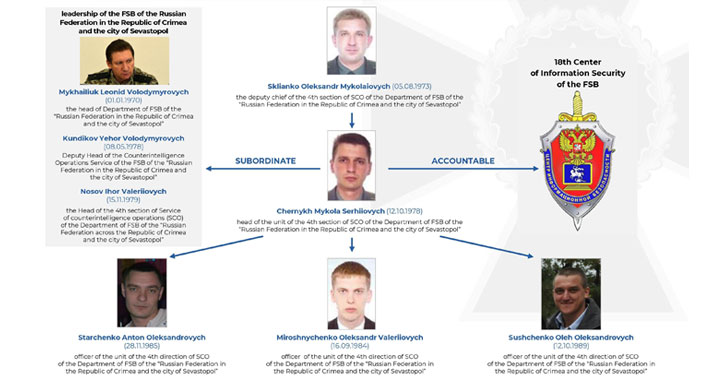
on Thursday disclosed the real identities of five individuals
allegedly involved in cyberattacks attributed to a cyber-espionage
group named Gamaredon, linking the members to Russia’s
Federal Security Service (FSB).
Calling the hacker group “an FSB special project, which
specifically targeted Ukraine,” the Security Service of Ukraine
(SSU) said[1]
the perpetrators “are officers of the ‘Crimean’ FSB and traitors
who defected to the enemy during the occupation of the peninsula in
2014.”
The names of the five individuals the SSU alleges are part of
the covert operation are Sklianko Oleksandr Mykolaiovych, Chernykh
Mykola Serhiiovych, Starchenko Anton Oleksandrovych, Miroshnychenko
Oleksandr Valeriiovych, and Sushchenko Oleh Oleksandrovych.
Since its inception in 2013, the Russia-linked Gamaredon[2]
group (aka Primitive Bear, Armageddon, Winterflounder, or Iron
Tilden) has been responsible for a number of malicious phishing
campaigns, primarily aimed at Ukrainian institutions, with the goal
of harvesting classified information from compromised Windows
systems for geopolitical gains.
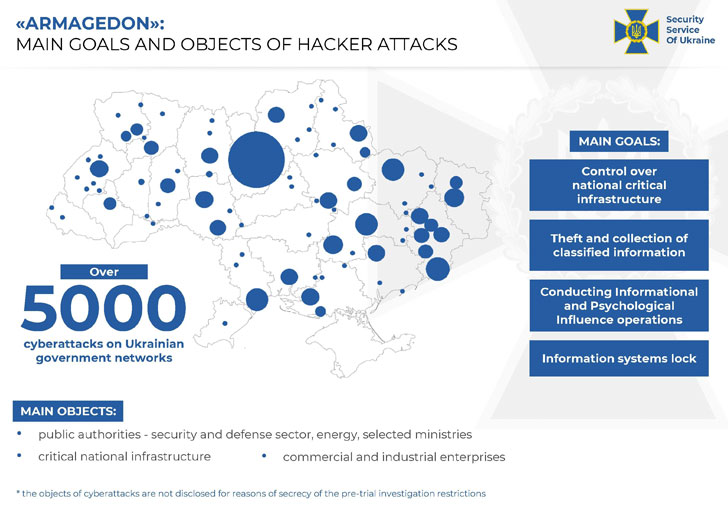
The threat actor is believed to have carried out no fewer than
5,000 cyberattacks against public authorities and critical
infrastructure located in the country, and attempted to infect over
1,500 government computer systems, with most attacks directed at
security, defense, and law enforcement agencies to obtain
intelligence information.
“Contrary to other APT groups, the Gamaredon group seems to make
no effort in trying to stay under the radar,” Slovak cybersecurity
firm ESET noted[3]
in an analysis published in June 2020. “Even though their tools
have the capacity to download and execute arbitrary binaries that
could be far stealthier, it seems that this group’s main focus is
to spread as far and fast as possible in their target’s network
while trying to exfiltrate data.”
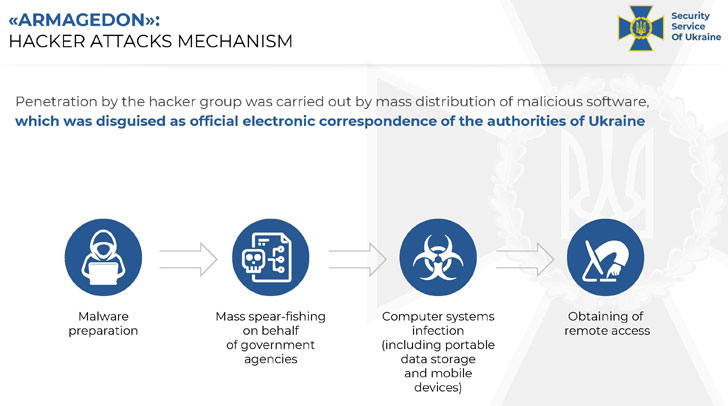
Besides its heavy reliance on social engineering tactics as an
intrusion vector, Gamaredon is known to have invested in a range of
tools for scything through organizations’ defenses that are coded
in a variety of programming languages such as VBScript, VBA Script,
C#, C++, as well as using CMD, PowerShell, and .NET command
shells.
“The group’s activities are characterized by intrusiveness and
audacity,” the agency pointed out in a technical report[4].
Chief among its malware arsenal is a modular remote
administration tool named Pterodo (aka Pteranodon[5]) that comes with remote
access capabilities, keystroke logging, the ability to take
screenshots, access microphone, and also download additional
modules from a remote server. Also put to use is a .NET-based file
stealer that’s designed to collect files with the following
extensions: *.doc, *.docx, *.xls, *.rtf, *.odt, *.txt, *.jpg, and
*.pdf.
A third tool concerns a malicious payload that’s engineered to
distribute the malware through connected removable media, in
addition to collecting and siphoning data stored in those
devices.
“The SSU is continuously taking steps to contain and neutralize
Russia’s cyber aggression against Ukraine,” the agency said.
“Established as a unit of the so-called ‘FSB Office of Russia in
the Republic of Crimea and the city of Sevastopol,’ this group of
individuals acted as an outpost […] from 2014 purposefully
threatening the proper functioning of state bodies and critical
infrastructure of Ukraine.”
References
- ^
said
(ssu.gov.ua) - ^
Gamaredon
(malpedia.caad.fkie.fraunhofer.de) - ^
noted
(thehackernews.com) - ^
technical report
(ssu.gov.ua) - ^
Pteranodon
(malpedia.caad.fkie.fraunhofer.de)