Microsoft on Thursday disclosed details of a new vulnerability
that could allow an attacker to bypass security restrictions in
macOS and take complete control of the device to perform arbitrary
operations on the device without getting flagged by traditional
security solutions.
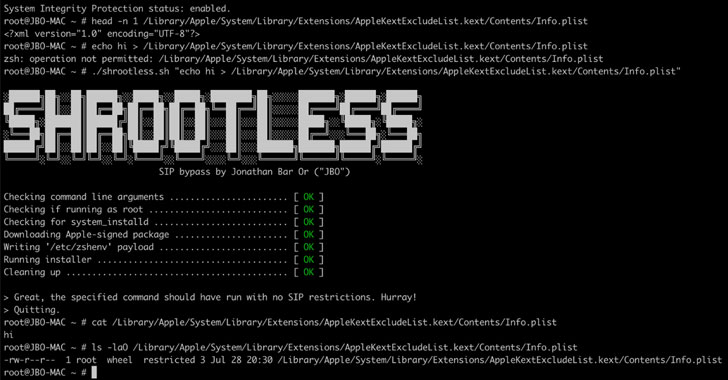
Dubbed “Shrootless” and tracked as CVE-2021-30892[1], the “vulnerability lies
in how Apple-signed packages with post-install scripts are
installed,” Microsoft 365 Defender Research Team’s Jonathan Bar Or
said[2]
in a technical write-up. “A malicious actor could create a
specially crafted file that would hijack the installation
process.”
System Integrity Protection (SIP[3]) aka “rootless” is a
security feature[4]
introduced in OS X El Capitan that’s designed to protect the macOS
operating system by restricting a root
user[5] from executing
unauthorized code or performing operations that may compromise
system integrity.
Specifically, SIP allows modification of protected parts of the
system — such as /System, /usr, /bin, /sbin, and /var — only by
processes that are signed by Apple or those that have special
entitlements to write to system files, like Apple software updates
and Apple installers, while also automatically authorizing apps
that are downloaded from the Mac App Store.
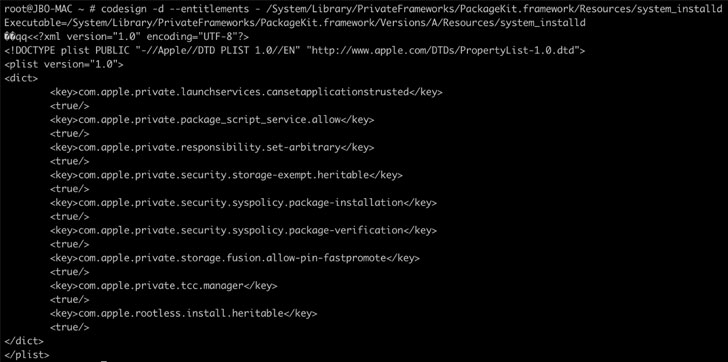
Microsoft’s investigation into the security technology looked at
macOS processes entitled to bypass SIP protections, leading to the
discovery of a software installation daemon called
“system_installd” that enables any of its child processes to
completely circumvent SIP filesystem restrictions.
Thus when an Apple-signed package is being installed, it invokes
the system_installd daemon, and any post-install scripts contained
in the package is executed by invoking a default shell, which is Z
shell (zsh[6]) on macOS.
“Interestingly, when zsh starts, it looks for the file
/etc/zshenv, and — if found — runs commands from that file
automatically, even in non-interactive mode,” Bar Or said.
“Therefore, for attackers to perform arbitrary operations on the
device, a fully reliable path they could take would be to create a
malicious /etc/zshenv file and then wait for system_installd to
invoke zsh.”
Successful exploitation of CVE-2021-30892 could enable a
malicious application to modify protected parts of the file system,
including the capability to install malicious kernel drivers (aka
rootkits), overwrite system files, or install persistent,
undetectable malware. Apple said it remediated[7]
the problem[8]
with additional restrictions as part of security updates pushed on
October 26, 2021.
“Security technology like SIP in macOS devices serves both as
the device’s built-in baseline protection and the last line of
defense against malware and other cybersecurity threats,” Bar Or
said. “Unfortunately, malicious actors continue to find innovative
ways of breaching these barriers for these very same reasons.”