An “aggressive” financially motivated threat actor has been
identified as linked to a string of RYUK ransomware attacks since
October 2018, while maintaining close partnerships with
TrickBot-affiliated threat actors and using a publicly available
arsenal of tools such as Cobalt Strike Beacon payloads to interact
with victim networks.
Cybersecurity firm Mandiant attributed the intrusions to a
Russian-speaking hacker group codenamed FIN12, and previously
tracked as UNC1878[1], with a disproportionate
focus on healthcare organizations with more than $300 million in
revenue, among others, including education, financial,
manufacturing, and technology sectors, located in North America,
Europe, and the Asia Pacific.
“FIN12 relies on partners to obtain initial access to victim
environments,” Mandiant researchers said[2]. “Notably, instead of
conducting multifaceted extortion, a tactic widely adopted by other
ransomware threat actors, FIN12 appears to prioritize speed and
higher revenue victims.”
The use of initial access brokers to facilitate ransomware
deployments isn’t new. In June 2021, findings from enterprise
security company Proofpoint revealed[3]
that ransomware actors are increasingly shifting from using email
messages as an intrusion route to purchasing access from
cybercriminal enterprises that have already infiltrated major
entities, with Ryuk infections mainly leveraging accesses obtained
via malware families like TrickBot and BazaLoader.
FIN12’s targeting of the healthcare sector suggests that its
initial access brokers “cast a wider net and allow FIN12 actors to
choose from a list of victims after accesses are already
obtained.”
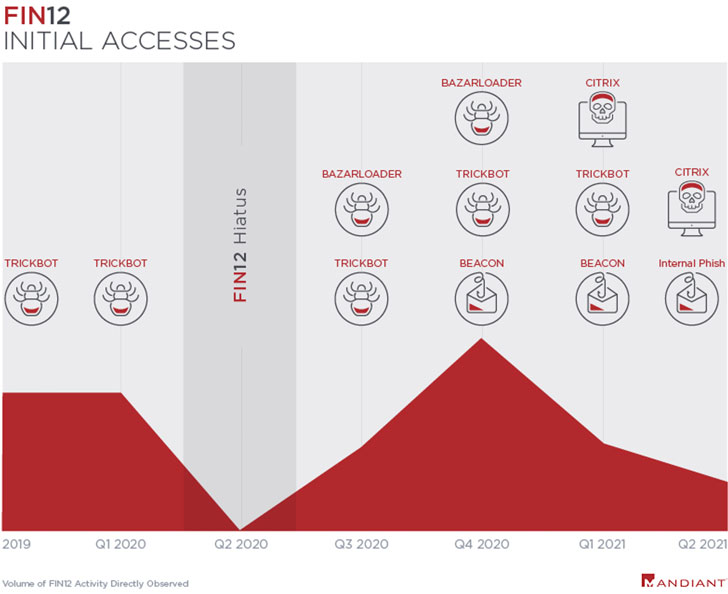
Mandiant also noted that it observed, in May 2021, threat actors
obtaining a foothold in the network through phishing email
campaigns distributed internally from compromised user accounts,
before leading to the deployment of Cobalt Strike Beacon and
WEIRDLOOP payloads. Attacks mounted between mid-February and
mid-April of 2021 are said to also have taken advantage of remote
logins by getting hold of credentials to victims’ Citrix
environments.
Although FIN12’s tactics in late 2019 involved using TrickBot as
a means to maintain a foothold in the network and carry out
latter-stage tasks, including reconnaissance, delivering malware
droppers, and deploying the ransomware, the group has since
consistently banked on Cobalt Strike Beacon payloads for performing
post-exploitation activities.
FIN12 also distinguishes itself from other intrusion threat
actors in that it doesn’t engage in data theft extortion — a tactic
that’s used to leak exfiltrated data when victims refuse to pay up
— which Mandiant says stems from the threat actor’s desire to move
quickly and strike targets that are willing to settle with minimal
negotiation.
“The average time to ransom (TTR) across our FIN12 engagements
involving data theft was 12.4 days (12 days, 9 hours, 44 minutes)
compared to 2.48 days (2 days, 11 hours, 37 minutes) where data
theft was not observed,” the researchers said. “FIN12’s apparent
success without the need to incorporate additional extortion
methods likely reinforces this notion.”
“[FIN12 is the] first FIN actor that we are promoting who
specializes in a specific phase of the attack lifecycle —
ransomware deployment — while relying on other threat actors for
gaining initial access to victims,” Mandiant noted. “This
specialization reflects the current ransomware ecosystem, which is
comprised of various loosely affiliated actors partnering together,
but not exclusively with one another.”