Cybersecurity researchers have disclosed an unpatched flaw in
Apple Pay that attackers could abuse to make an unauthorized Visa
payment with a locked iPhone by taking advantage of the Express
Travel mode set up in the device’s wallet.
“An attacker only needs a stolen, powered on iPhone. The
transactions could also be relayed from an iPhone inside someone’s
bag, without their knowledge,” a group of academics from the
University of Birmingham and University of Surrey said[1]. “The attacker needs no
assistance from the merchant and backend fraud detection checks
have not stopped any of our test payments.”
Express Travel[2]
is a feature that allows users of iPhone and Apple Watch to make
quick contactless payments for public transit without having to
wake or unlock the device, open an app, or even validate with Face
ID, Touch ID or a passcode.
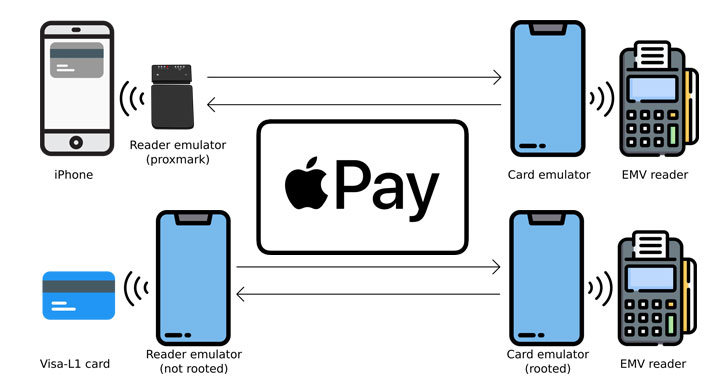
The man-in-the-middle (MitM[3]) replay and relay attack[4], which involves
bypassing the lock screen to make a payment to any EMV reader
illicitly, is made possible due to a combination of flaws in both
Apple Pay and Visa’s system, and doesn’t impact, say, Mastercard on
Apple Pay or Visa cards on Samsung Pay.
The modus operandi hinges on mimicking a transit gate
transaction by using a Proxmark device that acts as an EMV card
reader communicating with a victim’s iPhone and an NFC-enabled
Android app that functions as a card emulator to relay signals to a
payment terminal.
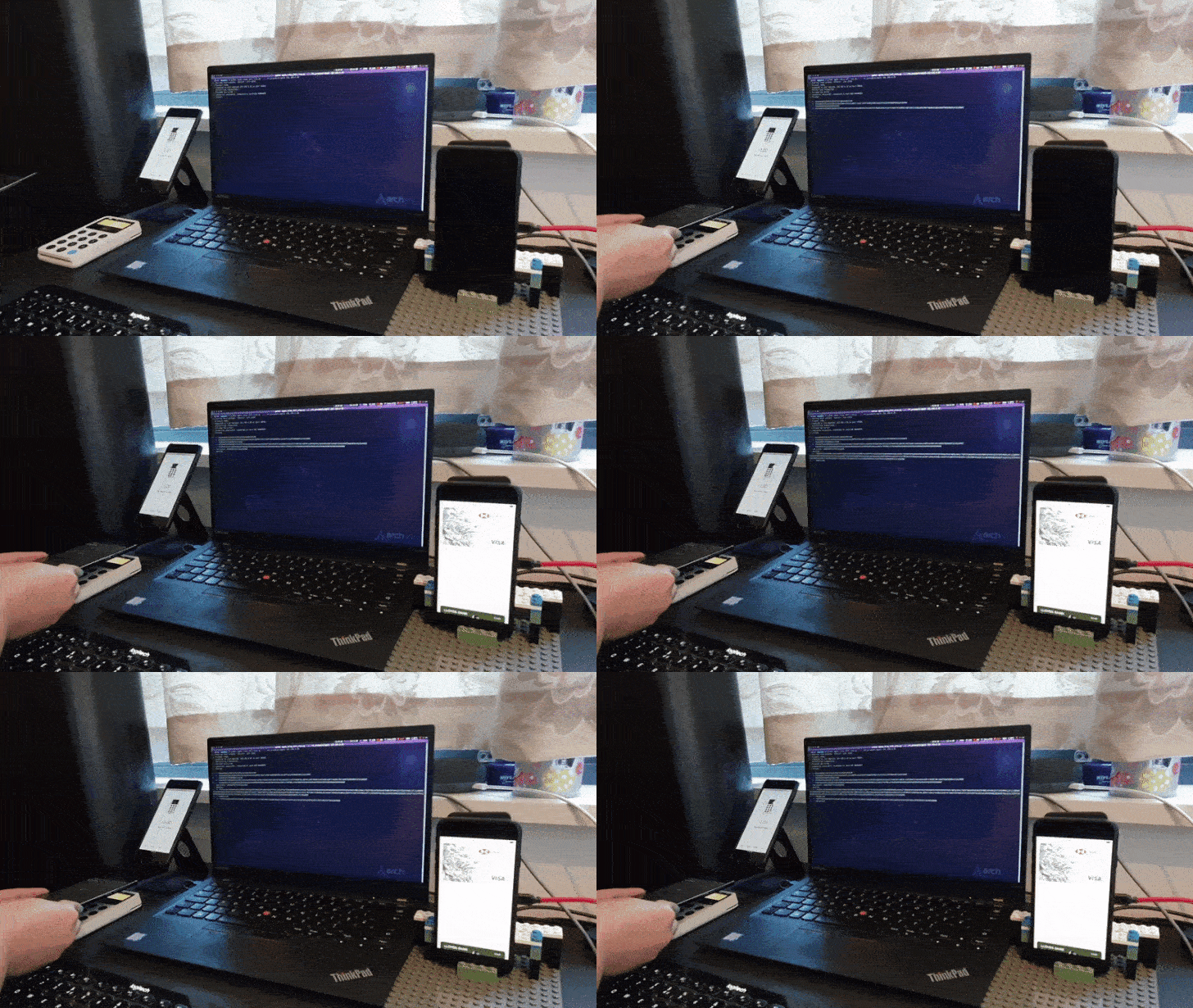
Specifically, it takes advantage of a unique code — aka Magic
Bytes — broadcast by the transit gates to unlock Apple Pay,
resulting in a scenario whereby replaying the sequence of bytes,
the Apple device is deceived into authorizing a rogue transaction
as if it’s originated from the ticket barrier, when, in reality,
it’s been triggered via a contactless payment terminal under the
attacker’s control.
At the same time, the EMV reader is also tricked into believing
that on-device user authentication has been performed, thus
enabling payments of any amount to be made without the iPhone
user’s knowledge.
Apple and Visa were alerted to the vulnerability in October 2020
and May 2021, respectively, the researchers said, adding, “both
parties acknowledge the seriousness of the vulnerability, but have
not come to an agreement on which party should implement a
fix.”
In a statement[5]
shared with the BBC, Visa said this type of attack was
“impractical,” adding, “Variations of contactless fraud schemes
have been studied in laboratory settings for more than a decade and
have proven to be impractical to execute at scale in the real
world.”
“This is a concern with a Visa system but Visa does not believe
this kind of fraud is likely to take place in the real world given
the multiple layers of security in place,” an Apple spokesperson
was quoted as saying to the U.K. national broadcaster.
References
- ^
said
(practical_emv.gitlab.io) - ^
Express
Travel (support.apple.com) - ^
MitM
(en.wikipedia.org) - ^
relay
attack (en.wikipedia.org) - ^
statement
(www.bbc.com)
Read more http://feedproxy.google.com/~r/TheHackersNews/~3/Nk8KgeyQBv0/apple-pay-can-be-abused-to-make.html