A formerly unknown Chinese-speaking threat actor has been linked
to a long-standing evasive operation aimed at South East Asian
targets as far back as July 2020 to deploy a kernel-mode rootkit on
compromised Windows systems.
Attacks mounted by the hacking group, dubbed
GhostEmperor by Kaspersky, are also said to have
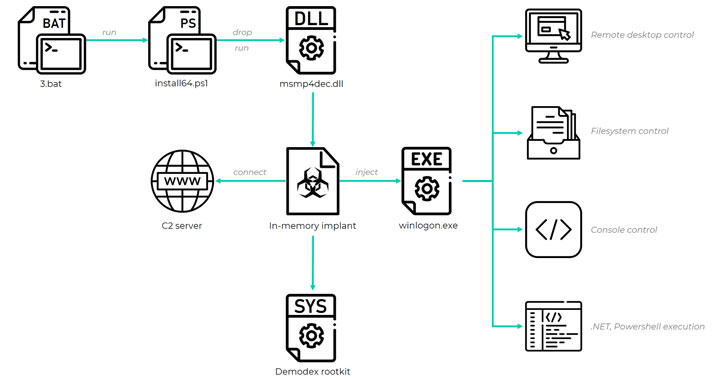
used a “sophisticated multi-stage malware framework” that allows
for providing persistence and remote control over the targeted
hosts.
The Russian cybersecurity firm called the rootkit
Demodex, with infections reported across several
high-profile entities in Malaysia, Thailand, Vietnam, and
Indonesia, in addition to outliers located in Egypt, Ethiopia, and
Afghanistan.
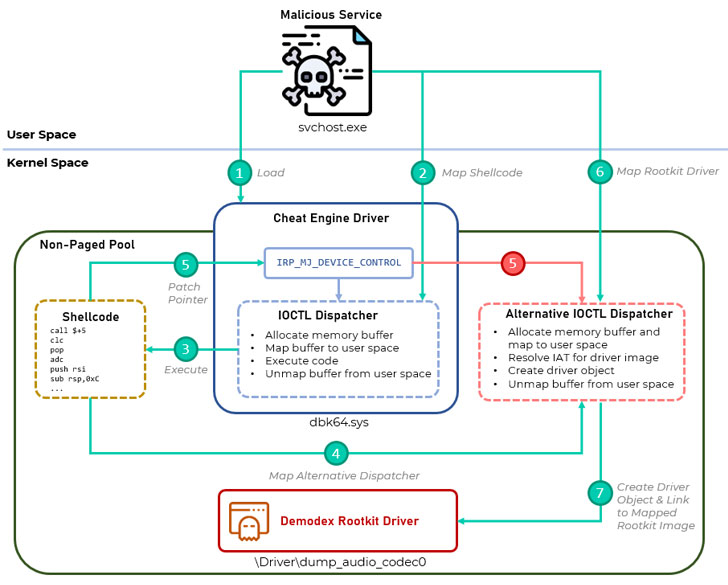
“[Demodex] is used to hide the user mode malware’s artefacts
from investigators and security solutions, while demonstrating an
interesting undocumented loading scheme involving the kernel mode
component of an open-source project named Cheat Engine[1] to bypass the Windows
Driver Signature Enforcement mechanism,” Kaspersky researchers
said[2].
GhostEmperor infections have been found to leverage multiple
intrusion routes that culminate in the execution of malware in
memory, chief among them being exploiting known vulnerabilities in
public-facing servers such as Apache, Window IIS, Oracle, and
Microsoft Exchange — including the ProxyLogon[3]
exploits that came to light in March 2021 — to gain an initial
foothold and laterally pivot to other parts of the victim’s
network, even on machines running recent versions of the Windows 10
operating system.
Following a successful breach, select infection chains that
resulted in the deployment of the rootkit were carried out remotely
via another system in the same network using legitimate software
such as WMI[4]
or PsExec[5], leading to the
execution of an in-memory implant capable of installing additional
payloads during run time.
Notwithstanding its reliance on obfuscation and other
detection-evasion methods to elude discovery and analysis, Demodex
gets around Microsoft’s Driver Signature Enforcement mechanism to
permit the execution of unsigned, arbitrary code in kernel space by
leveraging a legitimate and open-source signed driver named
(“dbk64.sys”) that’s shipped alongside Cheat Engine, an application
used to introduce cheats into video games.
“With a long-standing operation, high profile victims, [and]
advanced toolset […] the underlying actor is highly skilled and
accomplished in their craft, both of which are evident through the
use of a broad set of unusual and sophisticated anti-forensic and
anti-analysis techniques,” the researchers said.
The disclosure comes as a China-linked threat actor codenamed
TAG-28 has been discovered[6]
as being behind intrusions against Indian media and government
agencies such as The Times Group, the Unique Identification
Authority of India (UIDAI), and the police department of the state
of Madhya Pradesh.
Recorded Future, earlier this week, also unearthed[7]
malicious activity targeting a mail server of Roshan, one of
Afghanistan’s largest telecommunications providers, that it
attributed to four distinct Chinese state-sponsored actors —
RedFoxtrot[8], Calypso APT, as well as
two separate clusters using backdoors associated with the Winnti
and PlugX groups.
References
- ^
Cheat Engine
(www.cheatengine.org) - ^
said
(securelist.com) - ^
ProxyLogon
(thehackernews.com) - ^
WMI
(docs.microsoft.com) - ^
PsExec
(docs.microsoft.com) - ^
discovered
(www.recordedfuture.com) - ^
unearthed
(therecord.media) - ^
RedFoxtrot
(thehackernews.com)