Microsoft on Monday revealed new malware deployed by the hacking
group behind the SolarWinds supply chain attack last December to
deliver additional payloads and steal sensitive information from
Active Directory Federation Services (AD FS[1]) servers.
The tech giant’s Threat Intelligence Center (MSTIC) codenamed
the “passive and highly targeted backdoor” FoggyWeb, making it the
threat actor tracked as Nobelium’s latest tool in a long list of
cyber weaponry such as Sunburst[2], Sunspot[3], Raindrop[4], Teardrop[5], GoldMax, GoldFinder, Sibot[6], Flipflop[7], NativeZone[8], EnvyScout, BoomBox, and VaporRage[9].
“Once Nobelium obtains credentials and successfully compromises
a server, the actor relies on that access to maintain persistence
and deepen its infiltration using sophisticated malware and tools,”
MSTIC researchers said[10]. “Nobelium uses
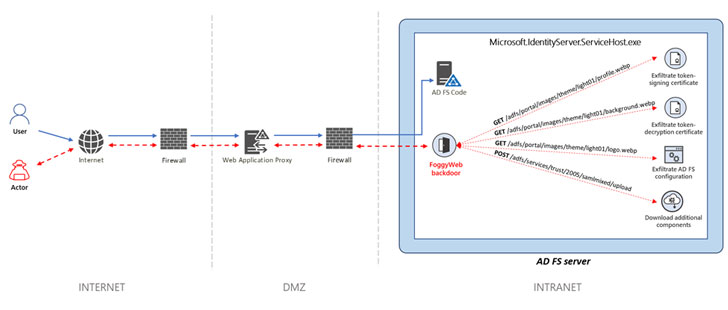
FoggyWeb to remotely exfiltrate the configuration database of
compromised AD FS servers, decrypted token-signing certificate, and
token-decryption certificate, as well as to download and execute
additional components.”
Microsoft said it observed FoggyWeb in the wild as early as
April 2021, describing the implant as a “malicious memory-resident
DLL.”
Nobelium is the moniker assigned by the company to the
nation-state hacking group widely known as APT29[11], The Dukes, or Cozy
Bear — an advanced persistent threat that has been attributed to
Russia’s Foreign Intelligence Service (SVR) — and believed to have
been behind the wide-ranging attack targeting
SolarWinds[12] that came to light in
December 2020. The adversary behind this campaign is also being
monitored under a variety of codenames like UNC2452 (FireEye),
SolarStorm (Unit 42), StellarParticle (CrowdStrike), Dark Halo
(Volexity), and Iron Ritual (Secureworks).
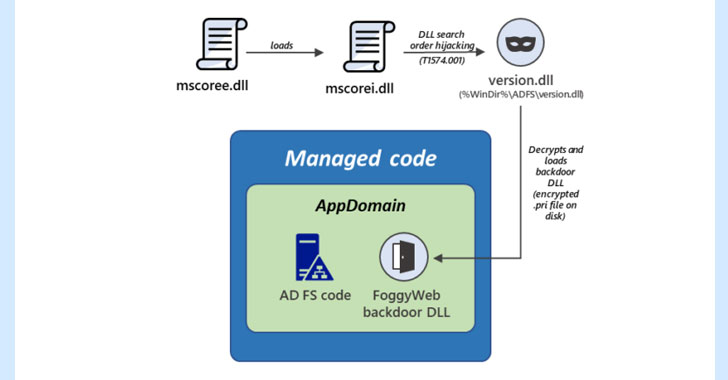
FoggyWeb, installed using a loader by exploiting a technique
called DLL search order hijacking[13], is capable of
transmitting sensitive information from a compromised AD FS server
as well as receive and execute additional malicious payloads
retrieved from a remote attacker-controlled server. It’s also
engineered to monitor all incoming HTTP GET and POST requests sent
to the server from the intranet (or internet) and intercept HTTP
requests that are of interest to the actor.
“Protecting AD FS servers is key to mitigating Nobelium
attacks,” the researchers said. “Detecting and blocking malware,
attacker activity, and other malicious artifacts on AD FS servers
can break critical steps in known Nobelium attack chains. Customers
should review their AD FS Server
configuration[14] and implement changes
to secure these systems from attacks.”
References
- ^
AD
FS (docs.microsoft.com) - ^
Sunburst
(thehackernews.com) - ^
Sunspot
(thehackernews.com) - ^
Raindrop
(thehackernews.com) - ^
Teardrop
(thehackernews.com) - ^
GoldMax,
GoldFinder, Sibot (thehackernews.com) - ^
Flipflop
(www.volexity.com) - ^
NativeZone
(thehackernews.com) - ^
EnvyScout, BoomBox, and VaporRage
(thehackernews.com) - ^
said
(www.microsoft.com) - ^
APT29
(attack.mitre.org) - ^
wide-ranging attack targeting
SolarWinds (thehackernews.com) - ^
DLL
search order hijacking (attack.mitre.org) - ^
review
their AD FS Server configuration
(docs.microsoft.com)