Users searching for TeamViewer remote desktop software on search
engines like Google are being redirected to malicious links that
drop ZLoader[1]
malware onto their systems while simultaneously embracing a
stealthier infection chain that allows it to linger on infected
devices and evade detection by security solutions.
“The malware is downloaded from a Google advertisement published
through Google Adwords,” researchers from SentinelOne said[2]
in a report published on Monday. “In this campaign, the attackers
use an indirect way to compromise victims instead of using the
classic approach of compromising the victims directly, such as by
phishing.”
First discovered in 2016, ZLoader (aka Silent Night and ZBot) is
a fully-featured banking trojan[3] and a fork of another
banking malware called ZeuS, with newer versions implementing a VNC
module that grants adversaries remote access to victim systems. The
malware is in active development, with criminal actors spawning an
array of variants in recent years, no less fuelled by the leak of
ZeuS source code in 2011.
The latest wave of attacks is believed to target users of
Australian and German financial institutions with the primary goal
of intercepting users’ web requests to the banking portals and
stealing bank credentials. But the campaign is also noteworthy
because of the steps it takes to stay under the radar, including
running a series of commands to hide the malicious activity by
disabling Windows Defender.
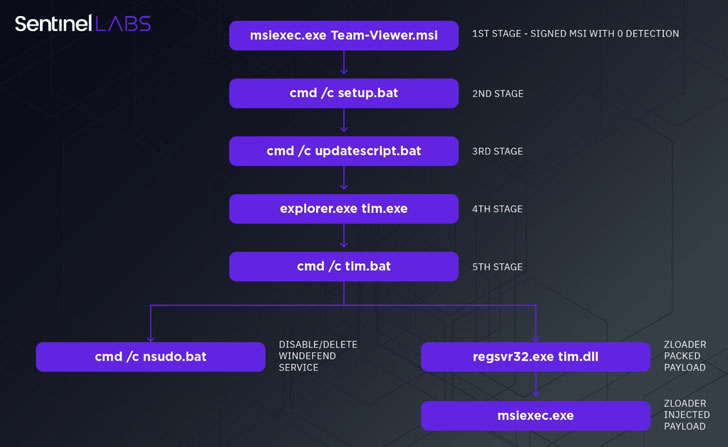
The infection chain commences when a user clicks on an
advertisement shown by Google on the search results page and is
redirected to the fake TeamViewer site under the attacker’s
control, thus tricking the victim into downloading a rogue but
signed variant of the software (“Team-Viewer.msi”). The fake
installer acts as the first stage dropper to trigger a series of
actions that involve downloading next-stage droppers aimed at
impairing the defenses of the machine and finally downloading the
ZLoader DLL payload (“tim.dll”).
“At first, it disables all the Windows Defender modules through
the PowerShell cmdlet Set-MpPreference,” SentinelOne Senior Threat
Intelligence Researcher Antonio Pirozzi said. “It then adds
exclusions, such as regsvr32, *.exe, *.dll, with the cmdlet
Add-MpPreference to hide all the components of the malware from
Windows Defender.”
The cybersecurity firm said it found additional artifacts that
mimic popular apps like Discord and Zoom, suggesting that the
attackers had multiple campaigns ongoing beyond leveraging
TeamViewer.
“The attack chain analyzed in this research shows how the
complexity of the attack has grown in order to reach a higher level
of stealthiness, using an alternative to the classic approach of
compromising victims through phishing emails,” Pirozzi explained.
“The technique used to install the first stage dropper has been
changed from socially engineering the victim into opening a
malicious document to poisoning the user’s web searches with links
that deliver a stealthy, signed MSI payload.”
References
Read more http://feedproxy.google.com/~r/TheHackersNews/~3/8ae2cGOR5tA/new-stealthier-zloader-variant.html