
A set of new security vulnerabilities has been disclosed in
commercial Bluetooth stacks that could enable an adversary to
execute arbitrary code and, worse, crash the devices via
denial-of-service (DoS) attacks.
Collectively dubbed “BrakTooth[1]” (referring to the
Norwegian word “Brak” which translates to “crash”), the 16 security
weaknesses span across 13 Bluetooth chipsets from 11 vendors such
as Intel, Qualcomm, Zhuhai Jieli Technology, and Texas Instruments,
covering an estimated 1,400 or more commercial products, including
laptops, smartphones, programmable logic controllers, and IoT
devices.
The flaws were disclosed by researchers from the ASSET
(Automated Systems SEcuriTy) Research Group at the Singapore
University of Technology and Design (SUTD).
“All the vulnerabilities […] can be triggered without any
previous pairing or authentication,” the researchers noted. “The
impact of our discovered vulnerabilities is categorized into (I)
crashes and (II) deadlocks. Crashes generally trigger a fatal
assertion, segmentation faults due to a buffer or heap overflow
within the SoC firmware. Deadlocks, in contrast, lead the target
device to a condition in which no further BT communication is
possible.”
The most severe of the 16 bugs is CVE-2021-28139, which affects
the ESP32 SoC used in many Bluetooth-based appliances ranging from
consumer electronics to industrial equipment. Arising due to a lack
of an out-of-bounds check in the library, the flaw enables an
attacker to inject arbitrary code on vulnerable devices, including
erasing its NVRAM[2]
data.
Other vulnerabilities could result in the Bluetooth
functionality getting entirely disabled via arbitrary code
execution, or cause a denial-of-service condition in laptops and
smartphones employing Intel AX200 SoCs. “This vulnerability allows
an attacker to forcibly disconnect slave BT devices currently
connected to AX200 under Windows or Linux Laptops,” the researchers
said. “Similarly, Android phones such as Pocophone F1 and Oppo Reno
5G experience BT disruptions.”
A last collection of flaws discovered in Bluetooth speakers,
headphones, and audio modules could be abused to freeze and even
completely shut down the devices, requiring the users to manually
turn them back on. Troublingly, all the aforementioned BrakTooth
attacks could be carried out with a readily available Bluetooth
packet sniffer that costs less than $15.
While Espressif, Infineon (Cypress), and Bluetrum Technology
have released firmware patches to rectify the identified
vulnerabilities, Intel, Qualcomm, and Zhuhai Jieli Technology are
said to be investigating the flaws or in the process of readying
security updates. Texas Instruments, however, doesn’t intend to
release a fix unless “demanded by customers.”
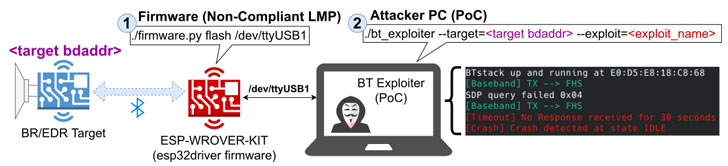
The ASSET group has also made available a proof-of-concept (PoC)
tool[3] that can be used by
vendors producing Bluetooth SoCs, modules, and products to
replicate the vulnerabilities and validate against BrakTooth
attacks.