
A now-patched high-severity security vulnerability in WhatApp’s
image filter feature could have been abused to send a malicious
image over the messaging app to read sensitive information from the
app’s memory.
Tracked as CVE-2020-1910[1]
(CVSS score: 7.8), the flaw concerns an out-of-bounds read/write
and stems from applying specific image filters to a rogue image and
sending the altered image to an unwitting recipient, thereby
enabling an attacker to access valuable data stored the app’s
memory.
“A missing bounds check in WhatsApp for Android prior to
v2.21.1.13 and WhatsApp Business for Android prior to v2.21.1.13
could have allowed out-of-bounds read and write if a user applied
specific image filters to a specially-crafted image and sent the
resulting image,” WhatsApp noted[2]
in its advisory published in February 2021.
Cybersecurity firm Check Point[3]
Research, which disclosed the issue to the Facebook-owned platform
on November 10, 2020, said it was able to crash WhatsApp by
switching between various filters on the malicious GIF files.
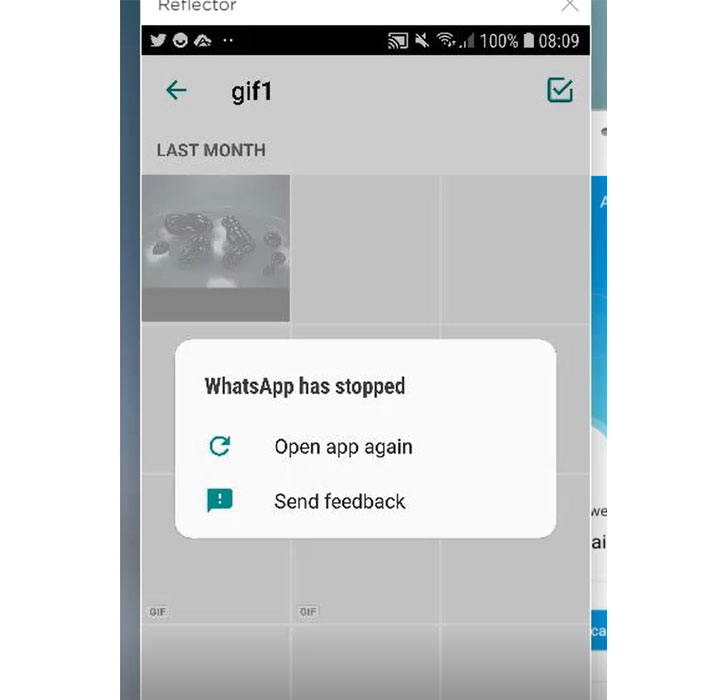
Specifically, the issue was rooted in an
“applyFilterIntoBuffer()” function that handles image filters,
which takes the source image, applies the filter selected by the
user, and copies the result into the destination buffer. By
reverse-engineering the “libwhatsapp.so” library, the researchers
found that the vulnerable function relied on the assumption that
both the source and filtered images have the same dimensions and
also the same RGBA[4]
color format.
Given that each RGBA pixel is stored as 4 bytes, a malicious
image having only 1 byte per pixel can be exploited to achieve an
out-of-bounds memory access since the “function tries to read and
copy 4 times the amount of the allocated source image buffer.”
WhatsApp said it has “no reason to believe users would have been
impacted by this bug.” Since WhatsApp version 2.21.1.13, the
company has added two new checks on the source image and filter
image that ensure that both source and filter images are in RGBA
format and that the image has 4 bytes per pixel to prevent
unauthorized reads.
References
- ^
CVE-2020-1910
(nvd.nist.gov) - ^
noted
(www.whatsapp.com) - ^
Check
Point (research.checkpoint.com) - ^
RGBA
(en.wikipedia.org)