Details have emerged about a now-patched security vulnerability
impacting Microsoft Exchange Server that could be weaponized by an
unauthenticated attacker to modify server configurations, thus
leading to the disclosure of Personally Identifiable Information
(PII).
The issue, tracked as CVE-2021-33766[1]
(CVSS score: 7.3) and coined “ProxyToken,” was
discovered by Le Xuan Tuyen, a researcher at the Information
Security Center of Vietnam Posts and Telecommunications Group
(VNPT-ISC), and reported through the Zero-Day Initiative (ZDI)
program in March 2021.
“With this vulnerability, an unauthenticated attacker can
perform configuration actions on mailboxes belonging to arbitrary
users,” the ZDI said[2]
Monday. “As an illustration of the impact, this can be used to copy
all emails addressed to a target and account and forward them to an
account controlled by the attacker.”
Microsoft addressed the issue as part of its Patch Tuesday updates[3]
for July 2021.
The security issue resides in a feature called Delegated
Authentication, which refers to a mechanism whereby the front-end
website — the Outlook web access (OWA) client — passes
authentication requests directly to the back-end when it detects
the presence of a SecurityToken cookie.
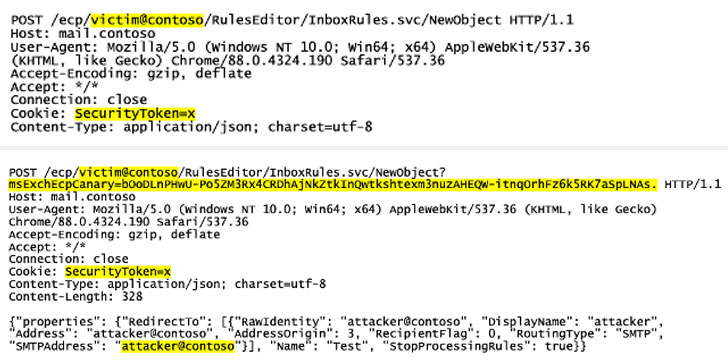
However, since Exchange has to be specifically configured to use
the feature and have the back-end carry out the checks, it leads to
a scenario in which the module handling this delegation
(“DelegatedAuthModule”) isn’t loaded under default configuration,
culminating in a bypass as the back-end fails to authenticate
incoming requests based on the SecurityToken cookie.
“The net result is that requests can sail through, without being
subjected to authentication on either the front or back end,” ZDI’s
Simon Zuckerbraun explained.
The disclosure adds to a growing list of Exchange Server
vulnerabilities that have come to light this year, including
ProxyLogon[4], ProxyOracle[5], and ProxyShell[6], which have actively
exploited by threat actors to take over unpatched servers, deploy
malicious web shells and file-encrypting ransomware such as
LockFile[7].
Troublingly, in-the-wild exploit attempts abusing ProxyToken
have already been recorded as early as August 10, according[8]
to NCC Group security researcher Rich Warren, making it imperative
that customers move quickly to apply the security updates from
Microsoft.
References
- ^
CVE-2021-33766
(msrc.microsoft.com) - ^
said
(www.zerodayinitiative.com) - ^
Patch
Tuesday updates (thehackernews.com) - ^
ProxyLogon
(thehackernews.com) - ^
ProxyOracle
(thehackernews.com) - ^
ProxyShell
(thehackernews.com) - ^
LockFile
(thehackernews.com) - ^
according
(twitter.com)