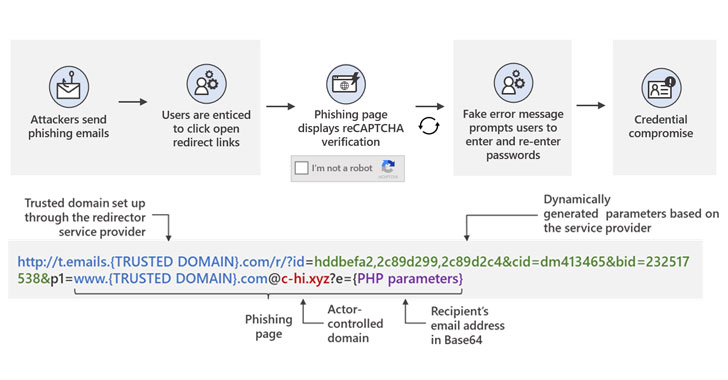
Microsoft is warning of a widespread credential phishing
campaign that leverages open redirector links[1]
in email communications as a vector to trick users into visiting
malicious websites while effectively bypassing security
software.
“Attackers combine these links with social engineering baits
that impersonate well-known productivity tools and services to lure
users into clicking,” Microsoft 365 Defender Threat Intelligence
Team said[2]
in a report published this week.
“Doing so leads to a series of redirections — including a
CAPTCHA verification page that adds a sense of legitimacy and
attempts to evade some automated analysis systems — before taking
the user to a fake sign-in page. This ultimately leads to
credential compromise, which opens the user and their organization
to other attacks.”
Although redirect links in email messages serve a vital tool to
take recipients to third-party websites or track click rates and
measure the success of sales and marketing campaigns, the same
technique can be abused by adversaries to redirect such links to
their own infrastructure, at the same time keeping the trusted
domain in the full URL intact to evade analysis by anti-malware
engines, even when users attempt to hover on links to check for any
signs of suspicious content.
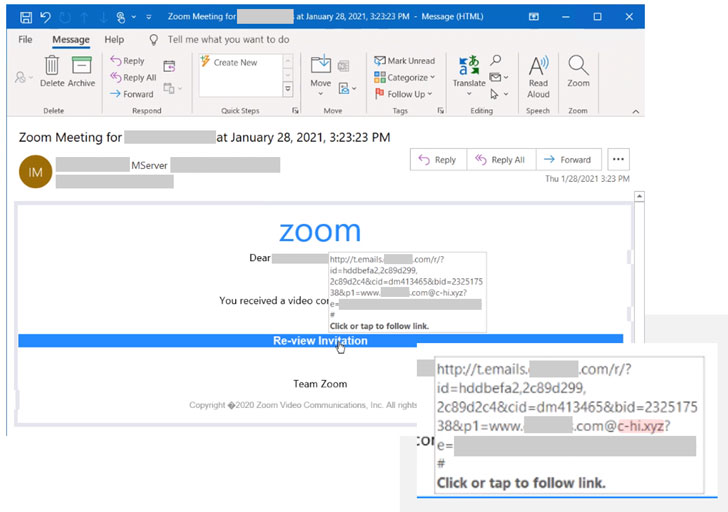
The redirect URLs embedded in the message are set up using a
legitimate service in an attempt to lead potential victims to
phishing sites, while the final actor-controlled domains contained
in the link leverage the top-level domains .xyz, .club, .shop, and
.online (e.g. “c-tl[.]xyz”), which are passed as parameters and
thus sneaking past email gateway solutions.
Microsoft said it observed at least 350 unique phishing domains
as part of the campaign — an attempt to obscure detection —
underscoring the campaign’s effective use of convincing social
engineering lures that purport to be notification messages from
apps like Office 365 and Zoom, well-crafted detection evasion
technique, and a durable infrastructure to carry out the
attacks.
“This not only shows the scale with which this attack is being
conducted, but it also demonstrates how much the attackers are
investing in it, indicating potentially significant payoffs,” the
researcher said.
To give the attack a veneer of authenticity, clicking the
specially-crafted links redirects the users to a malicious landing
page that employs Google reCAPTCHA to block any dynamic scanning
attempts. Upon completion of the CAPTCHA verification, the victims
are displayed a fraudulent login page mimicking a known service
like Microsoft Office 365, only to swipe their passwords upon
submitting the information.
“This phishing campaign exemplifies the perfect storm of [social
engineering, detection evasion, and a large attack infrastructure]
in its attempt to steal credentials and ultimately infiltrate a
network,” the researchers noted. “And given that 91% of all cyberattacks originate with
email[3], organizations must
therefore have a security solution that will provide them
multi-layered defense against these types of attacks.”
References
- ^
open
redirector links (cwe.mitre.org) - ^
said
(www.microsoft.com) - ^
91% of
all cyberattacks originate with email
(www.microsoft.com)