Cisco Systems on Wednesday issued patches to address a critical
security vulnerability affecting the Application Policy
Infrastructure Controller (APIC) interface used in its Nexus 9000
Series Switches that could be potentially abused to read or write
arbitrary files on a vulnerable system.
Tracked as CVE-2021-1577 (CVSS score: 9.1), the
issue — which is due to improper access control — could enable an
unauthenticated, remote attacker to upload a file to the
appliances. ” A successful exploit could allow the attacker to read
or write arbitrary files on an affected device,” the company
said[1]
in an advisory.
The APIC appliance is a centralized, clustered controller that
programmatically automates network provisioning and control based
on the application requirements and policies across physical and
virtual environments.
Cisco said it discovered the vulnerability during internal
security testing by the Cisco Advanced Security Initiatives Group
(ASIG).
Additionally, the network equipment major said[2]
it concluded its investigation[3]
into a new BadAlloc flaw[4]
in BlackBerry’s QNX real-time operating system, reported on August
17 by the Canadian company. “Cisco has completed its investigation
into its product line to determine which products may be affected
by this vulnerability. No products are known to be affected,” it
noted.
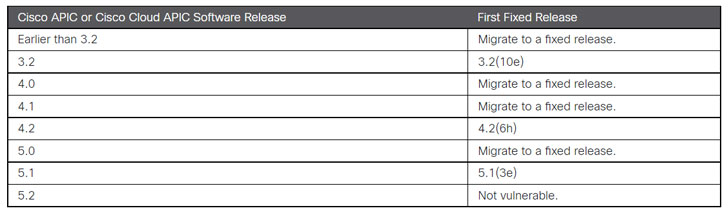
Cisco products that run QNX are listed below –
References
- ^
said
(tools.cisco.com) - ^
said
(tools.cisco.com) - ^
investigation
(thehackernews.com) - ^
BadAlloc
flaw (thehackernews.com)