
ShadowPad, an infamous Windows backdoor that allows attackers to
download further malicious modules or steal data, has been put to
use by five different Chinese threat clusters since 2017.
“The adoption of ShadowPad significantly reduces the costs of
development and maintenance for threat actors,” SentinelOne
researchers Yi-Jhen Hsieh and Joey Chen said[1]
in a detailed overview of the malware, adding “some threat groups
stopped developing their own backdoors after they gained access to
ShadowPad.”
The American cybersecurity firm dubbed ShadowPad a “masterpiece
of privately sold malware in Chinese espionage.”
A successor to PlugX and a modular malware platform since 2015,
ShadowPad[2]
catapulted to widespread attention in the wake of supply chain
incidents targeting NetSarang[3], CCleaner[4], and ASUS[5], leading the operators
to shift tactics and update their defensive measures with advanced
anti-detection and persistence techniques.
More recently, attacks involving ShadowPad have singled out
organizations in Hong Kong[6]
as well as critical infrastructure in India, Pakistan, and other
Central Asian countries. Although primarily attributed to APT41,
the implant is known to be shared among several Chinese espionage
actors such as Tick, RedEcho[7], RedFoxtrot[8], and clusters dubbed
Operation Redbonus, Redkanku, and Fishmonger.
“[The threat actor behind Fishmonger is] now using it and
another backdoor called Spyder as their primary backdoors for
long-term monitoring, while they distribute other first-stage
backdoors for initial infections including FunnySwitch, BIOPASS RAT[9], and Cobalt Strike,” the
researchers said. “The victims include universities, governments,
media sector companies, technology companies and health
organizations conducting COVID-19 research in Hong Kong, Taiwan,
India and the U.S.”
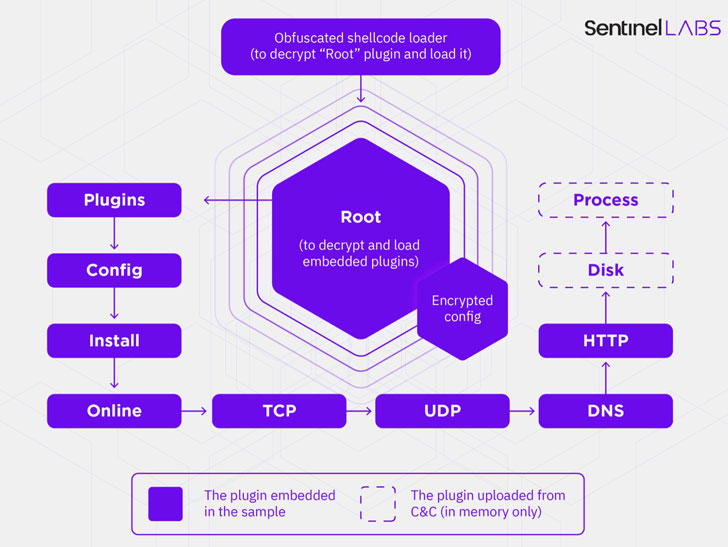
The malware functions by decrypting and loading a Root plugin in
memory, which takes care of loading other embedded modules during
runtime, in addition to dynamically deploying additional plugins
from a remote command-and-control (C2) server, enabling adversaries
to incorporate extra functionality not built into the malware by
default. At least 22 unique plugins have been identified to
date.
The infected machines, for their part, are commandeered by a
Delphi-based controller that’s used for backdoor communications,
updating the C2 infrastructure, and managing the plugins.
Interestingly, the feature set made available to ShadowPad users
is not only tightly controlled by its seller, each plugin is sold
separately instead of offering a full bundle containing all of the
modules, with most samples — out of about 100 — embedded with less
than nine plugins.
“The emergence of ShadowPad, a privately sold, well-developed
and functional backdoor, offers threat actors a good opportunity to
move away from self-developed backdoors,” the researchers said.
“While it is well-designed and highly likely to be produced by an
experienced malware developer, both its functionalities and its
anti-forensics capabilities are under active development.”