Multiple cybercriminal groups are leveraging a
malware-as-a-service (MaaS) solution to distribute a wide range of
malicious software distribution campaigns that result in the
deployment of payloads such as Campo Loader, Hancitor, IcedID[1], QBot[2], Buer Loader[3], and SocGholish against
individuals in Belgium as well as government agencies, companies,
and corporations in the U.S.
Dubbed “Prometheus TDS” (short for Traffic Direction
System) and available for sale on underground platforms for $250 a
month since August 2020, the service is designed to distribute
malware-laced Word and Excel documents and divert users to phishing
and malicious sites, according to a Group-IB report[4] shared with The Hacker
News.
More than 3,000 email addresses are said to have been singled
out via malicious campaigns in which Prometheus TDS was used to
send malicious emails, with banking and finance, retail, energy and
mining, cybersecurity, healthcare, IT, and insurance emerging the
prominent verticals targeted by the attacks.
“Prometheus TDS is an underground service that distributes
malicious files and redirects visitors to phishing and malicious
sites,” Group-IB researchers said. “This service is made up of the
Prometheus TDS administrative panel, in which an attacker
configures the necessary parameters for a malicious campaign:
downloading malicious files, and configuring restrictions on users’
geolocation, browser version, and operating system.”
The service is also known to employ third-party infected
websites that are manually added by the campaign’s operators and
act as a middleman between the attacker’s administrative panel and
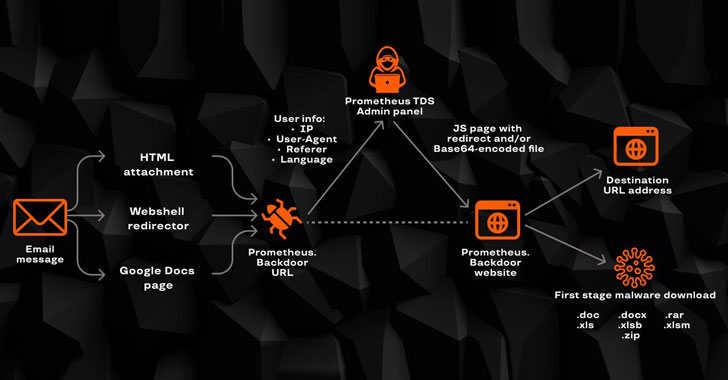
the user. To achieve this, a PHP file named
“Prometheus.Backdoor” is uploaded to the compromised website
to collect and send back data about the victim, based on which a
decision is taken as to whether to send the payload to the user
and/or to redirect them to the specified URL.
The attack scheme commences with an email containing a HTML
file, a link to a web shell that redirects users to a specified
URL, or a link to a Google Doc that’s embedded with an URL that
redirects users to the malicious link that when either opened or
clicked leads the recipient to the infected website, which
stealthily collects basic information (IP address, User-Agent,
Referrer header, time zone, and language data) and then forwards
this data to the Prometheus admin panel.
In the final phase, the administrative panel takes
responsibility for sending a command to redirect the user to a
particular URL, or to send a malware-ridden Microsoft Word or Excel
document, with the user redirected to a legitimate site like
DocuSign or USPS immediately after downloading the file to mask the
malicious activity. Besides distributing malicious files,
researchers found that Prometheus TDS is also used as a classic TDS
to redirect users to specific sites, such as fake VPN websites,
dubious portals selling Viagra and Cialis, and banking phishing
sites.
“Prometheus TDS also redirected users to sites selling
pharmaceutical products,” the researchers noted. “Operators of such
sites often have affiliate and partnership programs. Partners, in
turn, often resort to aggressive SPAM campaigns in order to
increase the earnings within the affiliate program. Analysis of the
Prometheus infrastructure by Group-IB specialists revealed links
that redirect users to sites relating to a Canadian pharmaceutical
company.”
References
Read more http://feedproxy.google.com/~r/TheHackersNews/~3/mi7rIHIlOWw/a-wide-range-of-cyber-attacks.html