
Three distinct clusters of malicious activities operating on
behalf of Chinese state interests have staged a series of attacks
to target networks belonging to at least five major
telecommunications companies located in Southeast Asian countries
since 2017.
“The goal of the attackers behind these intrusions was to gain
and maintain continuous access to telecommunication providers and
to facilitate cyber espionage by collecting sensitive information,
compromising high-profile business assets such as the billing
servers that contain Call Detail Record (CDR) data, as well as key
network components such as the Domain Controllers, Web Servers and
Microsoft Exchange servers,” Cybereason’s Lior Rochberger, Tom
Fakterman, Daniel Frank, and Assaf Dahan revealed[1]
in a technical analysis published Tuesday.
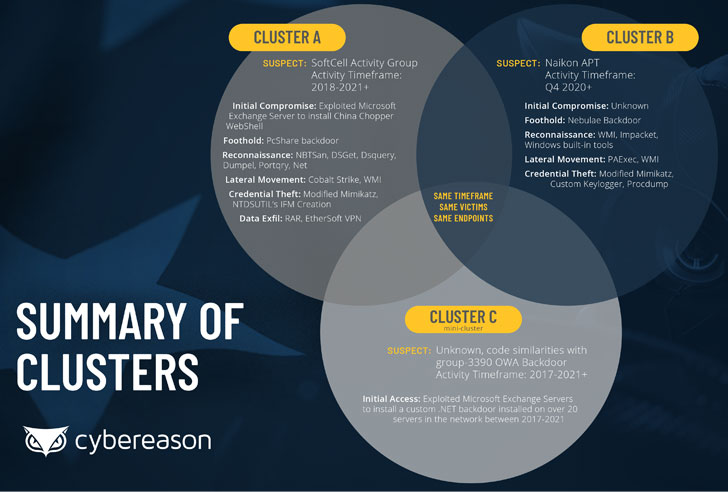
The Boston-based cybersecurity firm linked the campaigns to
three different Chinese threat actors, namely Gallium[2]
(aka Soft Cell), Naikon[3]
APT (aka APT30 or Lotus Panda), and TG-3390[4]
(aka APT27 or Emissary Panda).
The activity surrounding the latter of the three clusters
started in 2017, while Gallium-related attacks were first observed
in Q4 2020, with the Naikon group jumping on the exploitation
bandwagon last in Q4 2020. All three espionage operations are
believed to have continued all the way to mid-2021.
Calling the attackers “highly adaptive,” the researchers called
out their diligent efforts to stay under the radar and maintain
persistence on the infected endpoints, while simultaneously
shifting tactics and updating their defensive measures to
compromise and backdoor unpatched Microsoft Exchange email servers
using the ProxyLogon exploits that came to light earlier this
March.
“Each phase of the operation demonstrates the attackers’
adaptiveness in how they responded to various mitigation efforts,
changing infrastructure, toolsets, and techniques while attempting
to become more stealthy,” the researchers noted.
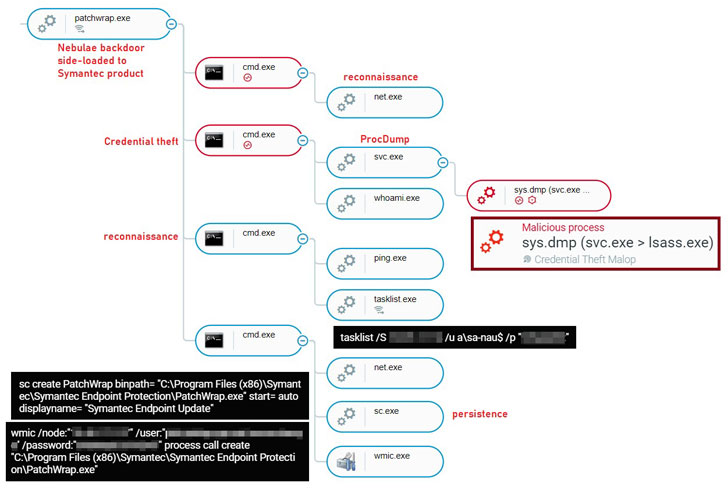
Naikon, on the other hand, was found to leverage a backdoor
named “Nebulae” as well as a previously undocumented keylogger
dubbed “EnrollLoger” on selected high-profile assets. It’s worth
pointing out that Naikon’s use of Nebulae[5]
first emerged in April 2021 when the adversary was attributed as
behind a wide-ranging cyber-espionage campaign targeting military
organizations in Southeast Asia.
Regardless of the attack chain, a successful compromise
triggered a sequence of steps, enabling the threat actors to
perform network reconnaissance, credential theft, lateral movement,
and data exfiltration.
The Emissary Panda cluster is the oldest of the three, primarily
involving the deployment of a custom .NET-based OWA (Outlook Web
Access) backdoor, which is used to pilfer credentials of users
logging into Microsoft OWA services, granting the attackers the
ability to access the environment stealthily.
Also of note is the overlap among the clusters in terms of the
victimology and the use of generic tools like Mimikatz, with the
three groups detected in the same target environment, around the
same timeframe, and even on the same systems.
“At this point, there is not enough information to determine
with certainty the nature of this overlap — namely, whether these
clusters represent the work of three different threat actors
working independently, or whether these clusters represent the work
of three different teams operating on behalf of a single threat
actor,” the researchers said.
“A second hypothesis is that there are two or more Chinese
threat actors with different agendas / tasks that are aware of each
other’s work and potentially even working in tandem.”