
An Android malware that was observed abusing accessibility
services in the device to hijack user credentials from European
banking applications has morphed into an entirely new botnet as
part of a renewed campaign that began in May 2021.
Italy’s CERT-AGID, in late January, disclosed details about
Oscorp[1], a mobile malware
developed to attack multiple financial targets with the goal of
stealing funds from unsuspecting victims. Its features include the
ability to intercept SMS messages and make phone calls and perform
Overlay Attacks for more than 150 mobile applications by making use
of lookalike login screens to siphon valuable data.
The malware was distributed through malicious SMS messages, with
the attacks often conducted in real-time by posing as bank
operators to dupe targets over the phone and surreptitiously gain
access to the infected device via WebRTC protocol and ultimately
conduct unauthorized bank transfers. While no new activities were
reported since then, it appears that Oscorp may have staged a
return after a temporary hiatus in the form of an Android botnet
known as UBEL.

“By analyzing some related samples, we found multiple indicators
linking Oscorp and UBEL to the same malicious codebase, suggesting
a fork of the same original project or just a rebrand by other
affiliates, as its source-code appears to be shared between
multiple [threat actors],” Italian cybersecurity company Cliffy
said[2]
Tuesday, charting the malware’s evolution.
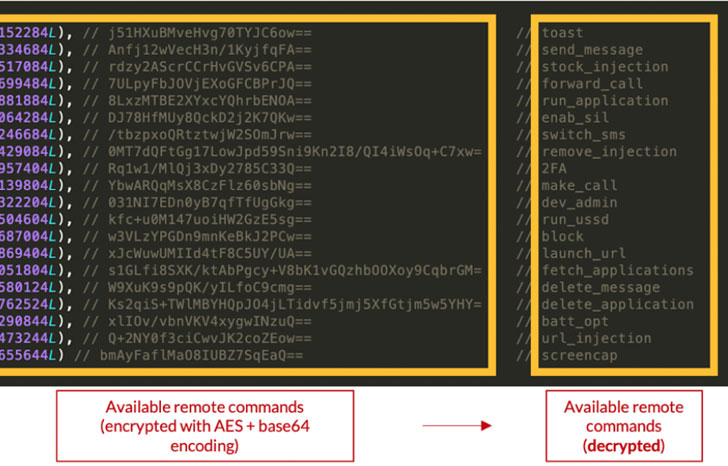
Advertised on underground forums for $980, UBEL, like its
predecessor, requests for intrusive permissions that allows it to
read and send SMS messages, record audio, install and delete
applications, launch itself automatically after system boot, and
abuse accessibility services on Android to amass sensitive
information from the device such as login credentials and
two-factor authentication codes, the results of which are
exfiltrated back to a remote server.
Once downloaded on the device, the malware attempts to install
itself as a service and hide its presence from the target, thereby
achieving persistence for extended periods of time.
Interestingly, the use of WebRTC to interact with the
compromised Android phone in real-time circumvents the need to
enroll a new device and take over an account to perform fraudulent
activities.
“The main goal for this [threat actor] by using this feature, is
to avoid a ‘new device enrollment’, thus drastically reducing the
possibility of being flagged ‘as suspicious’ since device’s
fingerprinting indicators are well-known from the bank’s
perspective,” the researchers said.
The geographical distribution of banks and other apps targeted
by Oscorp consists of Spain, Poland, Germany, Turkey, the U.S.,
Italy, Japan, Australia, France, and India, among others.