
Microsoft’s Windows 10 and the upcoming Windows 11 versions have
been found vulnerable to a new local privilege escalation
vulnerability that permits users with low-level permissions access
Windows system files, in turn, enabling them to unmask the
operating system installation password and even decrypt private
keys.
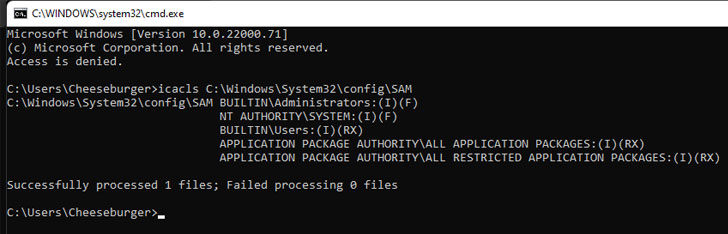
“Starting with Windows 10 build 1809, non-administrative users
are granted access to SAM, SYSTEM, and SECURITY registry hive
files,” CERT Coordination Center (CERT/CC) said in a vulnerability
note[1] published Monday. “This
can allow for local privilege escalation (LPE).”
The files in question are as follows –
- c:\Windows\System32\config\sam
- c:\Windows\System32\config\system
- c:\Windows\System32\config\security
Microsoft, which is tracking the vulnerability under the
identifier CVE-2021-36934[2], acknowledged the issue,
but has yet to roll out a patch, or provide a timeline for when the
fix will be made available.
“An elevation of privilege vulnerability exists because of
overly permissive Access Control Lists (ACLs) on multiple system
files, including the Security Accounts Manager (SAM[3]) database,” the Windows
makers noted. “An attacker who successfully exploited this
vulnerability could run arbitrary code with SYSTEM privileges. An
attacker could then install programs; view, change, or delete data;
or create new accounts with full user rights.
Successful exploitation of the flaw, however, necessitates that
the attacker already has a foothold and is in possession of the
ability to execute code on the victim system. In the interim, the
CERT/CC is recommending that users restrict access to sam, system,
and security files and delete VSS shadow copies[4]
of the system drive.
The latest disclosure also marks the third publicly disclosed
unpatched bug in Windows since the release of Patch Tuesday updates[5]
on July 13. Besides CVE-2021-36934, two more weaknesses[6]
affecting the Print Spooler[7]
component have also been discovered, prompting Microsoft to urge
all users to stop and disable the service to protect systems
against exploitation.
Linux Distros Suffer from “Sequoia” Privilege Escalation
Flaw
It’s not just Windows. Remediations have been released for a
security shortcoming affecting all Linux kernel versions[8]
from 2014 that can be exploited by malicious users and malware
already deployed on a system to gain root-level privileges.
Dubbed “Sequoia” by researchers from cybersecurity firm Qualys,
the issue has been assigned the identifier CVE-2021-33909[9]
and affects default installations of Ubuntu 20.04, Ubuntu 20.10,
Ubuntu 21.04, Debian 11, and Fedora 34 Workstation. Red Hat
Enterprise Linux versions 6, 7, and 8 are also affected[10] by the
vulnerability.
Specifically, the flaw concerns a size_t-to-int type conversion
vulnerability in the Linux Kernel’s “seq_file” file system
interface, permitting an unprivileged local attacker to create,
mount, and delete a deep directory structure whose total path
length exceeds 1GB, resulting in privilege escalation on the
vulnerable host.
Separately, Qualys also disclosed a stack exhaustion
denial-of-service vulnerability in systemd[11] (CVE-2021-33910[12]) that could be
exploited by unprivileged attackers to crash the software suite and
trigger a kernel panic[13].
References
- ^
vulnerability note
(kb.cert.org) - ^
CVE-2021-36934
(msrc.microsoft.com) - ^
SAM
(en.wikipedia.org) - ^
VSS
shadow copies (docs.microsoft.com) - ^
Patch
Tuesday updates (thehackernews.com) - ^
weaknesses
(thehackernews.com) - ^
Print
Spooler (thehackernews.com) - ^
Linux
kernel versions (en.wikipedia.org) - ^
CVE-2021-33909
(blog.qualys.com) - ^
affected
(access.redhat.com) - ^
systemd
(en.wikipedia.org) - ^
CVE-2021-33910
(blog.qualys.com) - ^
kernel
panic (en.wikipedia.org)
Read more http://feedproxy.google.com/~r/TheHackersNews/~3/8w-lkhOOs48/new-windows-and-linux-flaws-give.html