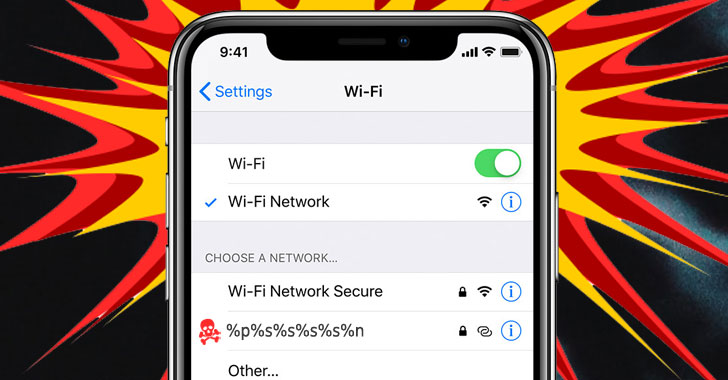
The Wi-Fi network name bug that was found to completely disable
an iPhone’s networking functionality had remote code execution
capabilities and was silently fixed by Apple earlier this year,
according to new research.
The denial-of-service vulnerability, which came to light last month[1], stemmed from the way
iOS handled string formats associated with the SSID input,
triggering a crash on any up-to-date iPhone that connected to any
wireless access points with percent symbols in their names such as
“%p%s%s%s%s%n.”
While the issue is remediable by resetting the network settings
(Settings > General > Reset > Reset Network Settings),
Apple is expected to push a patch[2] for the bug in its iOS
14.7 update, which is currently available to developers and public
beta testers.
But in what could have had far-reaching consequences,
researchers from mobile security automation firm ZecOps found that
the same bug could be exploited to achieve remote code execution
(RCE) on targeted devices by attaching the string pattern “%@” to
the Wi-Fi hotspot’s name.
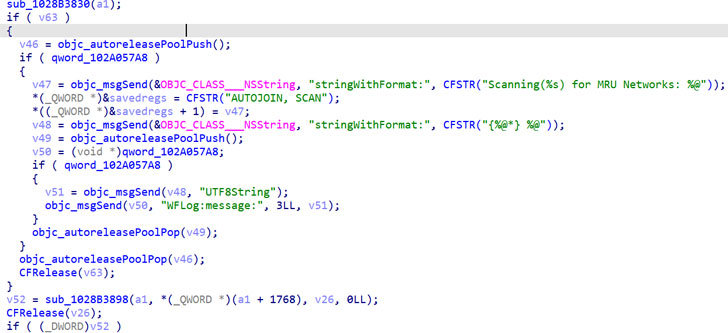
ZecOps nicknamed the issue “WiFiDemon[3].” It’s also a zero-click
vulnerability in that it allows the threat actor to infect a device
without requiring any user interaction, although it requires that
the setting to automatically join Wi-Fi networks[4] is enabled (which it is,
by default).
“As long as the WiFi is turned on this vulnerability can be
triggered,” the researchers noted. “If the user is connected to an
existing WiFi network, an attacker can launch another attack to
disconnect/de-associate the device and then launch this 0-click
attack.”
“This 0-click vulnerability is powerful: if the malicious access
point has password protection and the user never joins the wifi,
nothing will be saved to the disk,” the company added. “After
turning off the malicious access point, the user’s WIFI function
will be normal. A user could hardly notice if they have been
attacked.”
All iOS versions starting with iOS 14.0 and prior to iOS 14.3
were found to be vulnerable to the RCE variant, with Apple
“silently” patching the issue in January 2021 as part of its
iOS 14.4 update[5]. No CVE identifier was
assigned to the flaw.
Given the exploitable nature of the bug, it’s highly recommended
that iPhone and iPad users update their devices to the latest iOS
version to mitigate the risk associated with the vulnerability.
References
- ^
which
came to light last month
(thehackernews.com) - ^
expected
to push a patch (9to5mac.com) - ^
WiFiDemon
(blog.zecops.com) - ^
automatically join Wi-Fi networks
(support.apple.com) - ^
iOS 14.4
update (support.apple.com)
Read more http://feedproxy.google.com/~r/TheHackersNews/~3/TBSEy5OiD9k/turns-out-that-low-risk-ios-wi-fi.html