A sweeping probe into a data leak of more than 50,000 phone
numbers has revealed an extensive misuse of Israeli company NSO
Group’s Pegasus “military-grade spyware” to facilitate human rights
violations by surveilling heads of state, activists, journalists,
and lawyers around the world.
Dubbed the “Pegasus Project[1],” the investigation[2]
is a collaboration by more than 80 journalists from a consortium of
17 media organizations in 10 countries coordinated by Forbidden
Stories, a Paris-based media non-profit, along with the technical
support of Amnesty International.
“The Pegasus Project lays bare how NSO’s spyware is a weapon of
choice for repressive governments seeking to silence journalists,
attack activists and crush dissent, placing countless lives in
peril,” Amnesty International’s Secretary-General, Agnès Callamard,
said[3].
“These revelations blow apart any claims by NSO that such
attacks are rare and down to rogue use of their technology. While
the company claims its spyware is only used for legitimate criminal
and terror investigations, it’s clear its technology facilitates
systemic abuse. They paint a picture of legitimacy, while profiting
from widespread human rights violations,” Callamard added.
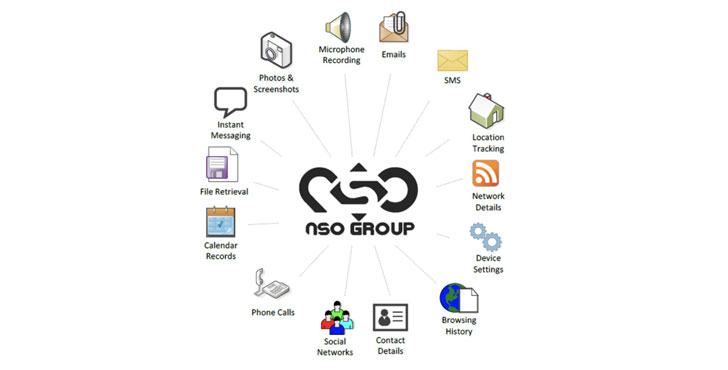
NSO Group is the maker of a cyber-surveillance weapon called
“Pegasus,” which, when surreptitiously installed on victims’ iPhone
and Android devices, enables an attacker to harvest emails, SMS
messages, media, calendars, calls, and contact information, as well
as chat content from messaging apps like WhatsApp, Telegram and
Signal, and stealthily activate the phone’s microphone and
camera.
The tool, which is sold by the surveillance vendor to
governments worldwide, is typically installed by either exploiting
previously unknown security vulnerabilities in common apps or by
tricking a potential target into clicking a malicious link. NSO
Group calls[4]
itself “the world leader in precision cyber intelligence solutions
for the sole use of vetted-and-approved, state-administered
intelligence and law enforcement agencies.”
The list of phone numbers, while not including the names, is
said to contain hundreds of business executives, religious figures,
academics, NGO employees, union officials, and government
officials, with the probe uncovering NSO Group clients in at least
11 countries, including Azerbaijan, Bahrain, Hungary, India,
Kazakhstan, Mexico, Morocco, Rwanda, Saudi Arabia, Togo, and the
U.A.E.
The investigation has so far identified 180 journalists and more
than 600 politicians and government officials, spanning across more
than 50 countries, even as the timeline of the attacks spread over
a seven-year period from 2014 up to as recently as July 2021.
However, Rwanda, Morocco, India, and Hungary denied[5]
having used Pegasus to hack the phones of the individuals named in
the list.
Troublingly, a forensic analysis[6]
of 67 mobile devices showed the intrusions involved the ongoing use
of so-called “zero-click” exploits — which do not require any
interaction from the target — since May 2018. In one instance
highlighted by Amnesty International, the compromise is believed to
have leveraged multiple zero-days in iMessage to attack a fully
patched iPhone 12 running iOS 14.6 in July 2021.
“All this indicates that NSO Group can break into the latest
iPhones,” Citizen Lab’s Bill Marczak said[7]
in a series of tweets. “It also indicates that Apple has a MAJOR
blinking red five-alarm-fire problem with iMessage security that
their BlastDoor Framework[8]
(introduced in iOS 14 to make zero-click exploitation more
difficult) ain’t solving.”
Of the tested smartphones, 23 devices had been successfully
infected with Pegasus, and 15 exhibited signs of attempted
penetration, the Washington Post said[9]
in an in-depth report.
“The coming week’s stories about the global hacking of phones
identical to the one in your pocket, by for-profit companies, make
it clear that export controls have failed as a means to regulate
this industry,” U.S. whistleblower Edward Snowden tweeted[10]. “Only a comprehensive
moratorium on sales can remove the profit motive.”
This is far from the first time NSO Group’s phone-penetrating
spy software has been used to target human rights activists and
journalists. In October 2019, Facebook-owned WhatsApp revealed[11] that at least two dozen
academics, lawyers, Dalit activists, and journalists in India were
the target of unlawful surveillance by taking advantage of a
then-unpatched vulnerability[12] in the messaging
service.
WhatsApp has since taken the company to court[13] in the U.S., citing
evidence that “the attackers used servers and Internet-hosting
services that were previously associated with NSO.”
For its part, the Israeli company flatly disputed the
allegations, stating it’s “full of wrong assumptions and
uncorroborated theories that raise serious doubts about the
reliability and interests of the sources,” while stressing that
it’s on a “life-saving mission” to “break up pedophilia rings, sex
and drug-trafficking rings, locate missing and kidnapped children,
locate survivors trapped under collapsed buildings, and protect
airspace against disruptive penetration by dangerous drones.”
“After checking their claims, we firmly deny the false
allegations made in their report,” the company added[14]. “Their sources have
supplied them with information which has no factual basis, as
evident by the lack of supporting documentation for many of their
claims. In fact, these allegations are so outrageous and far from
reality, that NSO is considering a defamation lawsuit.”
The latest development also comes days after another Israeli
company called Candiru[15] was outed as the
commercial spyware vendor behind the exploitation of a number of
zero-day flaws in Google Chrome and Microsoft Windows in a series
of “precision attacks” to hack more than 100 journalists,
academics, activists, and political dissidents globally.
References
- ^
Pegasus
Project (www.theguardian.com) - ^
investigation
(twitter.com) - ^
said
(www.amnesty.org) - ^
calls
(www.nsogroup.com) - ^
denied
(www.theguardian.com) - ^
forensic
analysis (www.amnesty.org) - ^
said
(twitter.com) - ^
BlastDoor Framework
(thehackernews.com) - ^
said
(www.washingtonpost.com) - ^
tweeted
(twitter.com) - ^
revealed
(thenextweb.com) - ^
then-unpatched vulnerability
(citizenlab.ca) - ^
taken
the company to court
(www.washingtonpost.com) - ^
added
(www.nsogroup.com) - ^
Candiru
(thehackernews.com)
Read more http://feedproxy.google.com/~r/TheHackersNews/~3/WCLNQvg-w9Y/new-leak-reveals-abuse-of-pegasus.html