For years, security professionals have recognized the need to
enhance SaaS security. However, the exponential adoption of
Software-as-a-Service (SaaS) applications over 2020 turned
slow-burning embers into a raging fire.
Organizations manage anywhere from thirty-five to more than a
hundred applications. From collaboration tools like Slack and
Microsoft Teams to mission-critical applications like SAP and
Salesforce, SaaS applications act as the foundation of the modern
enterprise. 2020 created an urgent need for security solutions that
mitigate SaaS misconfiguration risks.
Recognizing the importance of SaaS security, Gartner named a new
category, SaaS Security Posture Management (SSPM), to distinguish
solutions that have the capabilities to offer a continuous
assessment of security risks arising from a SaaS application’s
deployment.
To understand how security teams are currently dealing with
their SaaS security posture and what their main concerns are,
Adaptive Shield, a leading SSPM solution, commissioned an
independent survey of 300 InfoSecurity professionals from North
America and Western Europe, in companies ranging from 500 to more
than 10,000 employees.
The results of the 2021 SaaS Security Survey Report present a
picture of widespread SaaS application security concerns as well as
uncovers less-than-best practices organizations are turning to de
facto, while trying to manage the overwhelming amount of SaaS
security configurations.
Learn more about how to gain control of
your SaaS Security[1]
Understanding the SaaS Security Management Landscape
SaaS applications provide easy-to-use, scalable solutions that
offer a wide variety of native security controls. However,
ultimately the configuration of all the settings, user permissions,
and compliance falls on the security professionals to manage.
SaaS Misconfiguration Worries
85% of respondents in the 2021 SaaS Security Survey Report cited
SaaS misconfigurations as one of the top three risks facing their
organization. Interestingly, the other security risks that topped
the list – account hijacking and data leakage – as well as many of
the others on the list, can also stem directly from SaaS
misconfigurations. For example, a misconfiguration[2]
in Jira led to data leakage for many Fortune 500 companies,
including potential exposure for email addresses and IDs, employee
roles, current projects and milestones, and more.
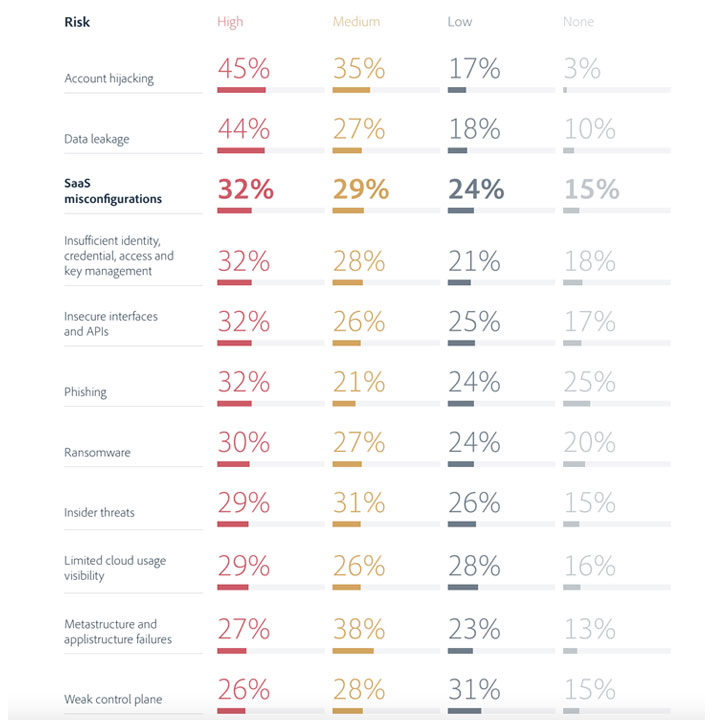 |
| Figure 1 taken from the 2021 SaaS Security Survey Report |
More Apps Mean Less Monitoring
Although this seems counterintuitive at first, upon further
thought, ‘more apps means less monitoring’ makes sense for the
organization handling the monitoring process manually. The
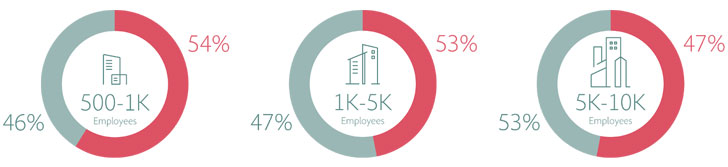
respondents to the survey report that as organizations continue to
onboard more applications, the organization is less successful in
monitoring their apps. In fact, according to the respondents, only
12% of companies using 50-99 applications engage in weekly
misconfiguration checks.
With each app having its own design, settings, user roles, and
distinct permissions, and in a dynamic environment with a steady
turnover of employees, automatic software updates, and complex
cross-department needs, it makes sense that organizations can lose
control the more apps they onboard.
 |
| Figure 2 taken from the 2021 SaaS Security Survey Report |
Delegating Security Impacts Risk
With the scope of the ever-growing portfolio of SaaS app estate,
52% of respondents report regularly putting responsibility for
checking and maintaining SaaS security into the hands of the SaaS
owner. The responsible parties are often in areas like Sales,
Marketing, or Product. Unfortunately, these stakeholders often have
little to no security background or skills.
SSPM Is a 2021 Top Priority
An SSPM’s key capabilities enable secure cloud
configuration:
- Compliance assessment
- Operational monitoring
- Risk identification
- Policy enforcement
- Threat assessment
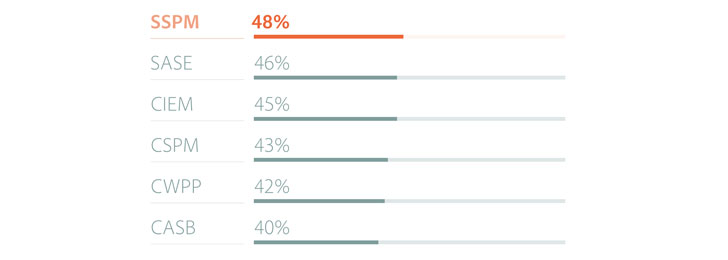
As CSPM and CASB tools aren’t built to address the challenges of
a SaaS environment, SSPM has risen to the top of the enterprise
agenda and is the top pick in terms of priorities in 2021. 48% of
respondents named SSPM tools as the #1 item on their priority
list.
Security teams want full and continuous visibility into their
SaaS application security posture, and SSPM solutions provide these
functionalities.
Learn how Adaptive Shield’s SSPM
Solution Reduces Misconfigurations[3]
Automating SaaS Security with Adaptive Shield
Automating maintenance of security settings and controls can
enable security teams to take control of their SaaS
applications.
SaaS Security Posture Management (SSPM), like Adaptive Shield,
offers a powerful platform designed uniquely to enable security
teams to proactively maintain continuous security across their
interconnected, divergent SaaS application estate.
Managing SaaS app security adaptively means complete
visibility and threats across the whole SaaS app estate, from video
conferencing platforms and customer support tools to HR management
systems, dashboards and workspaces, and much more. Adaptive
Shield:
- Leverages built-in security settings/controls to discover all
gaps and fix them automatically proactively. - Continuously monitors global settings and user privileges to
verify there are no breaches or drifts. - Offers a comprehensive bank of SaaS app integrations with more
SaaS apps added by the week. - Enables swift remediation for SaaS security issues from
beginning to end. - Displays the health of the organization’s SaaS security posture
in one place for data-driven decision making. - Takes minutes to deploy for zero business disruption
By automating monitoring and enforcement with Adaptive Shield,
security teams no longer need to delegate responsibility to app
owners, or have no visibility to the management of the security
settings of the SaaS.
Get the full 2021 SaaS Security Survey Report
here, or reach out to one of Adaptive Shield’s
security experts about your own unique SaaS
environment.[4]
References
- ^
Learn
more about how to gain control of your SaaS Security
(www.adaptive-shield.com) - ^
a
misconfiguration (logicbomb.medium.com) - ^
Learn
how Adaptive Shield’s SSPM Solution Reduces Misconfigurations
(www.adaptive-shield.com) - ^
2021
SaaS Security Survey Report here
(www.adaptive-shield.com)