Google intervened to remove nine Android apps downloaded more
than 5.8 million times from the company’s Play Store after the apps
were caught furtively stealing users’ Facebook login
credentials.
“The applications were fully functional, which was supposed to
weaken the vigilance of potential victims. With that, to access all
of the apps’ functions and, allegedly, to disable in-app ads, users
were prompted to log into their Facebook accounts,” researchers
from Dr. Web said[1]. “The advertisements
inside some of the apps were indeed present, and this maneuver was
intended to further encourage Android device owners to perform the
required actions.”
The offending apps masked their malicious intent by disguising
as photo-editing, rubbish cleaner, fitness, and astrology programs,
only to trick victims into logging into their Facebook account and
hijack the entered credentials via a piece of JavaScript code
received from an adversary-controlled server.
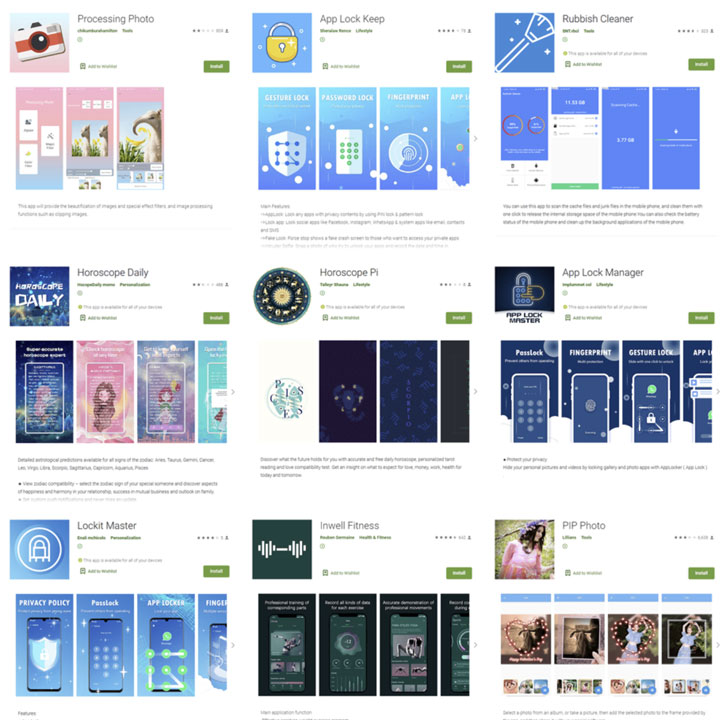
The list of apps are as follows –
- PIP Photo (>5,000,000 installs)
- Processing Photo (>500,000 installs)
- Rubbish Cleaner (>100,000 installs)
- Horoscope Daily (>100,000 installs)
- Inwell Fitness (>100,000 installs)
- App Lock Keep (50,000 installs)
- Lockit Master (5,000 installs)
- Horoscope Pi (>1,000 installs)
- App Lock Manager (10 installs)
In the last link of the attack, the stolen information was
exfiltrated to the server using the trojanized applications.
While this specific campaign appears to have set its sights on
Facebook accounts, Dr. Web researchers cautioned that this attack
could have been easily expanded to load the login page of any
legitimate web service with the goal of stealing logins and
passwords from any platform.
The latest disclosure comes days after Google announced[2]
new measures for the Play Store, including requiring developer
accounts to turn on 2-Step Verification (2SV), provide an address,
and verify their contact details as part of its ongoing efforts to
combat scams and fraudulent developer accounts.
If anything, the development is yet another reminder that users
are better off served by installing apps from known and trusted
developers, watch out for permissions requested by the apps, as
well as to pay attention to other user reviews prior to
installation.