
A threat actor with suspected ties to Pakistan has been striking
government and energy organizations in the South and Central Asia
regions to deploy a remote access trojan on compromised Windows
systems, according to new research.
“Most of the organizations that exhibited signs of compromise
were in India, and a small number were in Afghanistan,” Lumen’s
Black Lotus Labs said[1]
in a Tuesday analysis. “The potentially compromised victims aligned
with the government and power utility verticals.”
Some of the victims include a foreign government organization, a
power transmission organization, and a power generation and
transmission organization. The covert operation is said to have
begun at least in January 2021.
The intrusions are notable for a number of reasons, not least
because in addition to its highly-targeted nature, the tactics,
techniques, and procedures (TTPs) adopted by the adversary rely on
repurposed open-source code and the use of compromised domains in
the same country as the targeted entity to host their malicious
files.
At the same time, the group has been careful to hide their
activity by modifying the registry keys, granting them the ability
to maintain persistence on the target device without attracting
attention surreptitiously.
Explaining the multi-step infection chain, Lumen noted the
campaign “resulted in the victim downloading two agents; one
resided in-memory, while the second was side-loaded, granting
threat actor persistence on the infected workstations.”
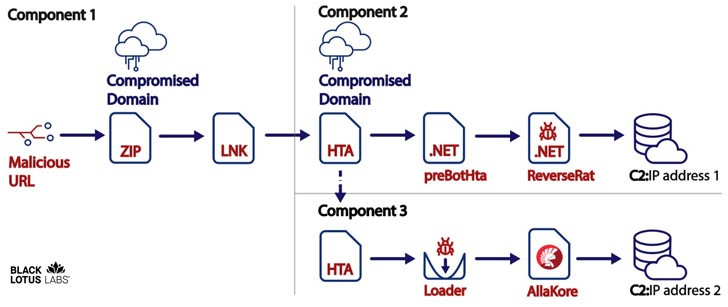
The attack commences with a malicious link sent via phishing
emails or messages that, when clicked, downloads a ZIP archive file
containing a Microsoft shortcut file (.lnk) and a decoy PDF file
from a compromised domain.
The shortcut file, besides displaying the benign document to the
unsuspecting recipient, also takes care of stealthily fetching and
running an HTA (HTML application) file from the same compromised
website.
The lure documents largely describe events catering to India,
disguising as a user manual for registering and booking an
appointment for COVID-19 vaccine through the CoWIN[2] online portal, while a
few others masquerade as the Bombay Sappers[3], a regiment of the Corps
of Engineers of the Indian Army.
Irrespective of the PDF document displayed to the victim, the
HTA file — itself a JavaScript code based on a GitHub project
called CactusTorch[4]
— is leveraged to inject a 32-bit shellcode into a running process
to ultimately install a .NET backdoor called ReverseRat that runs
the typical spyware gamut, with capabilities to capture
screenshots, terminate processes, execute arbitrary executables,
perform file operations, and upload data to a remote server.
The custom-developed framework also comes with a third component
in which a second HTA file is downloaded from the same domain to
deploy the open-source AllaKore[5]
remote agent, potentially in an alternative attempt to maintain
access to the compromised network.
“While this threat actor’s targets have thus far remained within
the South and Central Asian regions, they have proven effective at
gaining access to networks of interest,” the researchers said.
“Despite previously relying upon open-source frameworks such as
AllaKore, the actor was able to remain effective and expand its
capabilities with the development of the Svchostt agent and other
components of the ReverseRat project.”
References
- ^
said
(blog.lumen.com) - ^
CoWIN
(www.cowin.gov.in) - ^
Bombay
Sappers (en.wikipedia.org) - ^
CactusTorch
(github.com) - ^
AllaKore
(github.com)