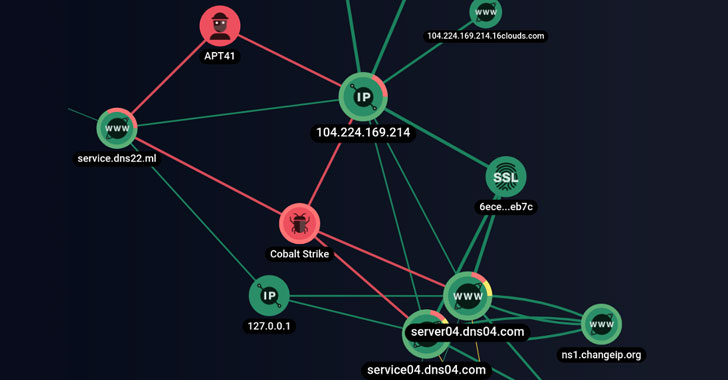
The cyber assault on Air India that came to light last month
lasted for a period of at least two months and 26 days, new
research has revealed, which attributed the incident with moderate
confidence to a Chinese nation-state threat actor called APT41.
Group-IB dubbed the campaign “ColunmTK” based on the names of
the command-and-control (C2) server domains that were used for
communications. “The potential ramifications of this incident for
the entire airline industry and carriers that might yet discover
traces of ColunmTK in their networks are significant,” the
Singapore-headquartered threat hunting company said[1].
Also known by other monikers such as Winnti Umbrella, Axiom, and
Barium, APT41[2]
is a prolific Chinese-speaking nation-state advanced persistent
threat known for its campaigns centered around information theft and espionage[3] against healthcare,
high-tech, and telecommunications sectors to establish and maintain
strategic access for stealing intellectual property and committing
financially motivated cybercrimes.
“Their cyber crime intrusions are most apparent among video game
industry targeting, including the manipulation of virtual
currencies, and attempted deployment of ransomware,” according[4]
to FireEye. “APT41 operations against higher education, travel
services, and news/media firms provide some indication that the
group also tracks individuals and conducts surveillance.”
On May 21, India’s flag carrier airline, Air India, disclosed[5]
a data breach affecting 4.5 million of its customers over a period
stretching nearly 10 years in the wake of a supply chain attack
directed at its Passenger Service System (PSS) provider SITA
earlier this February[6].
The breach involved personal data registered between Aug. 26,
2011, and Feb. 3, 2021, including details such as names, dates of
birth, contact information, passport information, ticket
information, Star Alliance, and Air India frequent flyer data, as
well as credit card data.
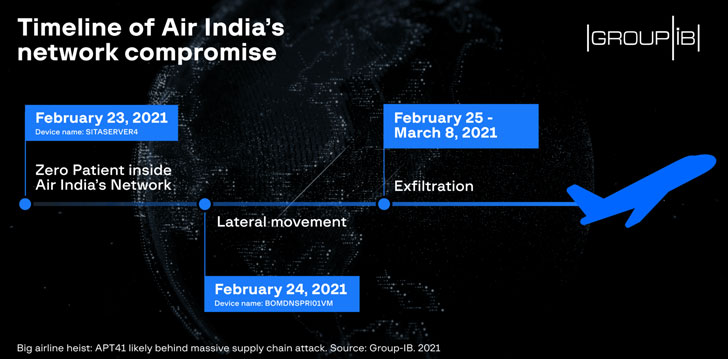
Group-IB’s analysis into the incident has revealed that at least
since Feb. 23, an infected device inside Air India’s network (named
“SITASERVER4”) communicated with a server hosting Cobalt Strike
payloads dating all the way back to Dec. 11, 2020. Following this
initial compromise, the attackers are said to have established
persistence and obtained passwords in order to pivot laterally to
the broader network with the goal of gathering information inside
the local network.
No fewer than 20 devices were infected during the course of
lateral movement, the company said. “The attackers exfiltrated NTLM
hashes and plain-text passwords from local workstations using
hashdump and mimikatz,” Group-IB Threat Intelligence Analyst Nikita
Rostovcev said. “The attackers tried to escalate local privileges
with the help of BadPotato malware.”
In all, the adversary extracted 23.33 MB of data from five
devices named SITASERVER4, AILCCUALHSV001, AILDELCCPOSCE01,
AILDELCCPDB01, and WEBSERVER3, with the attackers taking 24 hours
and 5 minutes to spread Cobalt Strike beacons to other devices in
the airline’s network.
While the initial entry point remains unknown, the fact that
“the first device that started communicating with the
adversary-controlled C&C server was a SITA server and the fact
that SITA notified Air India about its security incident give
reasonable ground to believe that the compromise of Air India’s
network was the result of a sophisticated supply chain attack,
which might have started with SITA.”
Connections to Barium are grounded on the basis of overlaps
between the C2 servers found in the attack infrastructure with
those used in earlier[7]
attacks[8]
and tactics employed by the threat actor to park their domains[9]
once their operations are over. Group-IB also said it discovered a
file named “Install.bat[10]” that bore similarities
to payloads deployed in a 2020 global intrusion campaign[11].
Indicators of compromise (IoC) associated with the incident can
be accessed here[12].
References
- ^
said
(blog.group-ib.com) - ^
APT41
(malpedia.caad.fkie.fraunhofer.de) - ^
information theft and espionage
(thehackernews.com) - ^
according
(www.fireeye.com) - ^
disclosed
(thehackernews.com) - ^
earlier
this February (www.sita.aero) - ^
earlier
(techcommunity.microsoft.com) - ^
attacks
(ptsecurity.com) - ^
park
their domains (en.wikipedia.org) - ^
Install.bat
(www.virustotal.com) - ^
global
intrusion campaign (www.fireeye.com) - ^
here
(blog.group-ib.com)