
Google’s upcoming plans to replace third-party cookies with a
less invasive ad targeted mechanism have a number of issues that
could defeat its privacy objectives and allow for significant
linkability of user behavior, possibly even identifying individual
users.
“FLoC is premised on a compelling idea: enable ad targeting
without exposing users to risk,” said[1]
Eric Rescorla, author of TLS standard and chief technology officer
of Mozilla. “But the current design has a number of privacy
properties that could create significant risks if it were to be
widely deployed in its current form.”
Short for Federated Learning of Cohorts, FLoC[2]
is part of Google’s fledgling Privacy Sandbox[3]
initiative that aims to develop alternate solutions to satisfy
cross-site use cases without resorting to third-party cookies or
other opaque tracking mechanisms.
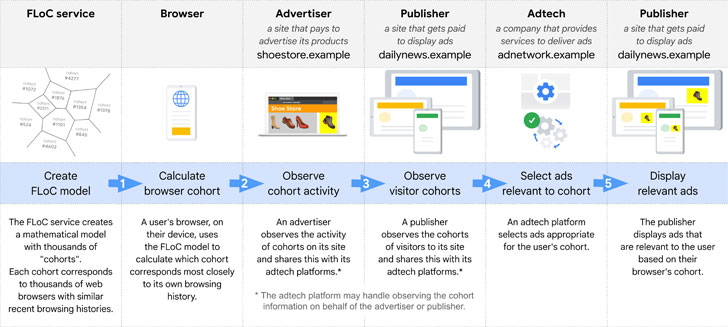
Essentially, FLoC allows marketers to guess users’ interests
without having to uniquely identify them, thereby eliminating the
privacy implications associated with tailored advertising, which
currently relies on techniques such as tracking cookies and device
fingerprinting that expose users’ browsing history across sites to
advertisers or ad platforms.
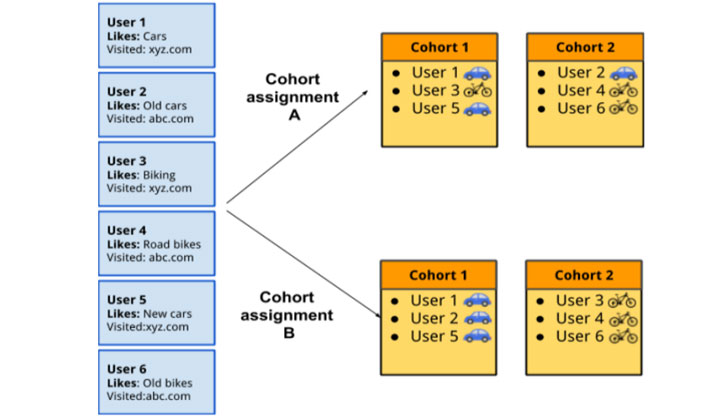
FLoC sidesteps the cookie with a new “cohort” identifier wherein
users are bucketed into clusters based on similar browsing
behaviors. Advertisers can aggregate this information to build a
list of websites that all the users in a cohort visit as opposed to
using the history of visits made by a specific user, and then
target ads based on the cohort interest.
“With FLoC, individual profiles are a potential source of
additional information about the properties of the FLoC as a
whole,” Mozilla said. “For instance, information from individual
profiles can be generalized to inform decisions about the FLoC
cohort as a whole.”
Additionally, the cohort ID assigned to users is recalculated
weekly on the device, which is meant to reflect their evolving
interests over time as well as prevent its use as a persistent
identifier to track users. Google is currently running an origin
trial for FLoC in its Chrome browser, with plans to roll it out in
place of third-party cookies at some point next year.
Despite its promise to offer a greater degree of anonymity,
Google’s proposals have been met with stiff resistance from
regulators, privacy advocates, publishers, and every major browser
that uses the open-source Chromium project, including Brave,
Vivaldi[4], Opera, and Microsoft
Edge. “The worst aspect of FLoC is that it materially harms user
privacy, under the guise of being privacy-friendly,” Brave said[5]
in April.
The “privacy-safe ad targeting” method has also come under the
scanner from the Electronic Frontier Foundation, which called FLoC
a “terrible idea[6]” that can lower the
barrier to companies gathering information about individuals just
based on the cohort IDs assigned to them. “If a tracker starts with
your FLoC cohort, it only has to distinguish your browser from a
few thousand others (rather than a few hundred million),” the EFF
said.
Indeed, according to a recent report[7]
from Digiday, “companies are starting to combine FLoC IDs with
existing identifiable profile information, linking unique insights
about people’s digital travels to what they already know about
them, even before third-party cookie tracking could have revealed
it,” effectively neutralizing the privacy benefits of the
system.
Mozilla’s analysis of FLoC backs up this argument. Given that
only a few thousand users share a specific cohort ID, trackers that
are in possession of additional information can narrow down the set
of users very quickly by linking the identifiers with
fingerprinting data and even leverage the periodically recomputed
cohort IDs as a leakage point to distinguish individual users from
one week to the other.
“Before the pandemic and some time back, I attended a Mew
concert, a Ghost concert, Disney on Ice, and a Def Leppard concert.
At each of those events I was part of a large crowd. But I bet you
I was the only one to attend all four,” said[8] John Wilander, WebKit
privacy and security engineer, earlier this April, pointing out how
cohort IDs can be collected over time to create cross-site tracking
IDs.
What’s more, because FLoC IDs are the same across all websites
for all users in a cohort, the identifiers undermine restrictive
cookie policies and leak more information than necessary by turning
into a shared key to which trackers can map data from other
external sources, the researchers detailed.
Google has put in place mechanisms to address these undesirable
privacy shortcomings, including making FLoC opt-in for websites and
suppressing cohorts that it believes are closely correlated with
“sensitive” topics. But Mozilla said “these countermeasures rely on
the ability of the browser manufacturer to determine which FLoC
inputs and outputs are sensitive, which itself depends on their
ability to analyze user browsing history as revealed by FLoC,” in
turn circumventing the privacy protections.
As potential avenues for improvement, the researchers suggest
creating FLoC IDs per domain, partitioning the FLoC ID by the
first-party site, and falsely suppressing the cohort ID belonging
to users without sensitive browsing histories so as to protect
users who cannot report a cohort ID. It’s worth noting that the
FLoC API returns an empty string when a cohort is marked as
sensitive.
“When considered as coexisting with existing state-based
tracking mechanisms, FLoC has the potential to significantly
increase the power of cross-site tracking,” the researchers
concluded. “In particular, in cases where cross-site tracking is
prevented by partitioned storage, the longitudinal pattern of FLoC
IDs might allow an observer to re-synchronize visits by the same
user across multiple sites, thus partially obviating the value of
these defenses.”
Ultimately, the biggest threat to FLoC may be Google itself[9], which is not only the
biggest search engine, but also the developer behind the world’s
most used web browser and the owner of the world’s largest
advertising platform, landing it between a rock and a hard place
where any attempt to rewrite the rules of the web could be
perceived as an attempt to bolster its own dominance in the
sector.
Such is its scope and outsized impact, Privacy Sandbox is
attracting plenty of regulatory scrutiny. The U.K.’s Competition
and Markets Authority (CMA) earlier today announced[10] that it’s taking up a
“role in the design and development of Google’s Privacy Sandbox
proposals to ensure they do not distort competition.”
References
- ^
said
(blog.mozilla.org) - ^
FLoC
(thehackernews.com) - ^
Privacy
Sandbox (developer.chrome.com) - ^
Vivaldi
(vivaldi.com) - ^
said
(brave.com) - ^
terrible
idea (www.eff.org) - ^
recent
report (digiday.com) - ^
said
(github.com) - ^
Google
itself (digiday.com) - ^
announced
(www.gov.uk)
Read more http://feedproxy.google.com/~r/TheHackersNews/~3/KChC0ET19HA/mozilla-says-googles-new-ad.html