Cybersecurity researchers on Thursday took the wraps off a new
cyberespionage group that has been behind a series of targeted
attacks against diplomatic entities and telecommunication companies
in Africa and the Middle East since at least 2017.
Dubbed “BackdoorDiplomacy[1],” the campaign involves
targeting weak points in internet-exposed devices such as web
servers to perform a panoply of cyber hacking activities, including
laterally moving across the network to deploy a custom implant
called Turian that’s capable of exfiltrating sensitive data stored
in removable media.
“BackdoorDiplomacy shares tactics, techniques, and procedures
with other Asia-based groups. Turian likely represents a next stage
evolution of Quarian[2], the backdoor last
observed in use in 2013 against diplomatic targets in Syria and the
U.S,” said Jean-Ian Boutin, head of threat research at Slovak
cybersecurity firm ESET.
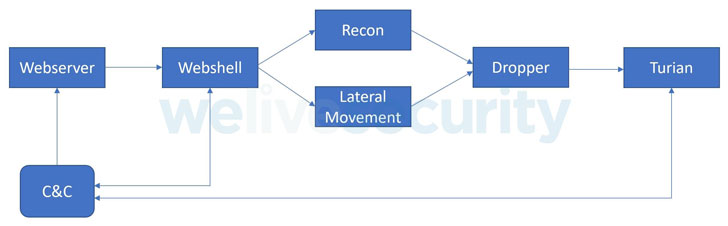
Engineered to target both Windows and Linux operating systems,
the cross-platform group singles out management interfaces for
networking equipment and servers with internet-exposed ports,
likely exploiting unpatched vulnerabilities to deploy the China
Chopper web shell for initial access, using it to conduct
reconnaissance and install the backdoor.
Targeted systems include F5 BIG-IP devices (CVE-2020-5902),
Microsoft Exchange servers, and Plesk web hosting control panels.
Victims have been identified in the Ministries of Foreign Affairs
of multiple African countries, as well as in Europe, the Middle
East, and Asia. Additionally, telecom providers in Africa and at
least one Middle Eastern charity have also been hit.
“In each case, operators employed similar tactics, techniques,
and procedures (TTPs), but modified the tools used, even within
close geographic regions, likely to make tracking the group more
difficult,” the researchers said. BackdoorDiplomacy is also
believed to overlap with previously reported campaigns operated by
a Chinese-speaking group Kaspersky tracks as “CloudComputating[3].”
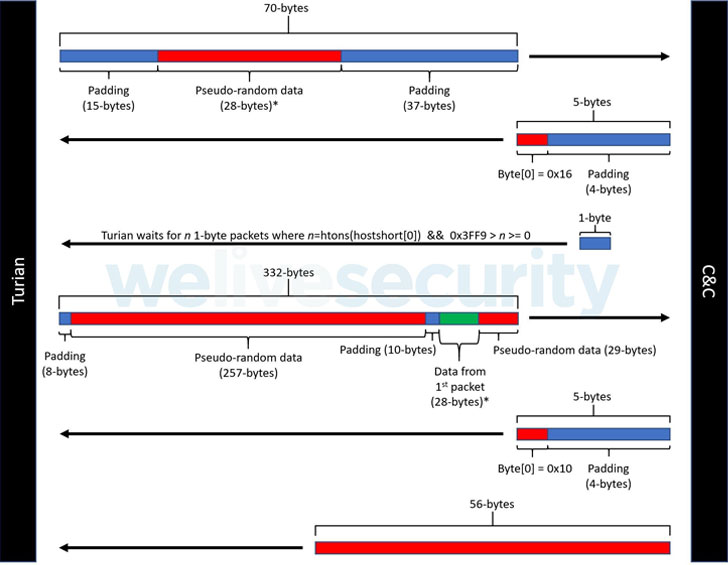
Besides its features to gather system information, take
screenshots, and carry out file operations, ESET researchers said
Turian’s network encryption protocol is nearly identical to that
employed by WhiteBird[4], a C++ backdoor operated
by an Asia-based threat actor named Calypso, that was installed
within diplomatic organizations in Kazakhstan and Kyrgyzstan, and
during the same timeframe as BackdoorDiplomacy.
References
- ^
BackdoorDiplomacy
(www.welivesecurity.com) - ^
Quarian
(malpedia.caad.fkie.fraunhofer.de) - ^
CloudComputating
(securelist.com) - ^
WhiteBird
(malpedia.caad.fkie.fraunhofer.de)