Researchers have disclosed a new type of attack that exploits
misconfigurations in transport layer security (TLS) servers to
redirect HTTPS traffic from a victim’s web browser to a different
TLS service endpoint located on another IP address to steal
sensitive information.
The attacks have been dubbed ALPACA[1], short for “Application
Layer Protocol Confusion – Analyzing and mitigating Cracks in tls
Authentication,” by a group of academics from Ruhr University
Bochum, Münster University of Applied Sciences, and Paderborn
University.
“Attackers can redirect traffic from one subdomain to another,
resulting in a valid TLS session,” the study said. “This breaks the
authentication of TLS and cross-protocol attacks may be possible
where the behavior of one protocol service may compromise the other
at the application layer.”
TLS[2]
is a cryptographic protocol underpinning several application layer
protocols like HTTPS, SMTP, IMAP, POP3, and FTP to secure
communications over a network with the goal of adding a layer of
authentication and preserving integrity of exchanged data while in
transit.
ALPACA attacks are possible because TLS does not bind a TCP
connection to the intended application layer protocol, the
researchers elaborated. The failure of TLS to protect the integrity
of the TCP connection could therefore be abused to “redirect TLS
traffic for the intended TLS service endpoint and protocol to
another, substitute TLS service endpoint and protocol.”
Given a client (i.e., web browser) and two application servers
(i.e., the intended and substitute), the goal is to trick the
substitute server into accepting application data from the client,
or vice versa. Since the client uses a specific protocol to open a
secure channel with the intended server (say, HTTPS) while the
substitute server employs a different application layer protocol
(say, FTP) and runs on a separate TCP endpoint, the mix-up
culminates in what’s called a cross-protocol attack.
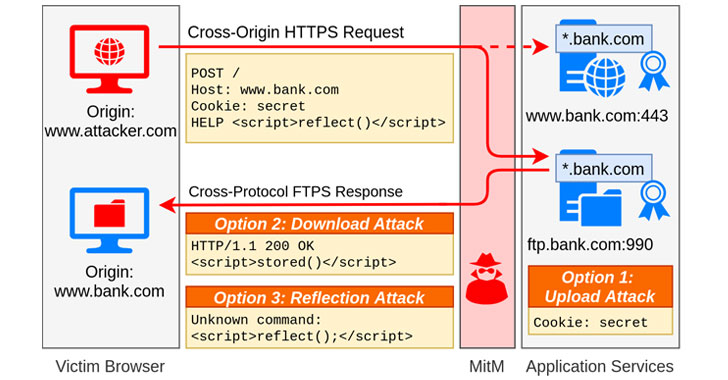
At least three hypothetical cross-protocol attack scenarios have
been uncovered, which can be leveraged by an adversary to
circumvent TLS protections and target FTP and email servers. The
attacks, however, hinge on the prerequisite that the perpetrator
can intercept and divert the victim’s traffic at the TCP/IP
layer.
Put simply, the attacks take the form of a man-in-the-middle
(MitM) scheme wherein the malicious actor entices a victim into
opening a website under their control to trigger a cross-origin
HTTPS request with a specially crafted FTP payload. This request is
then redirected to an FTP server that uses a certificate that’s
compatible with that of the website, culminating in a valid TLS
session.
Consequently, the misconfiguration in TLS services can be
exploited to exfiltrate authentication cookies or other private
data to the FTP server (Upload Attack), retrieve a malicious
JavaScript payload from the FTP server in a stored XSS attack
(Download Attack), or even execute a reflected XSS[3]
in the context of the victim website (Reflection Attack).
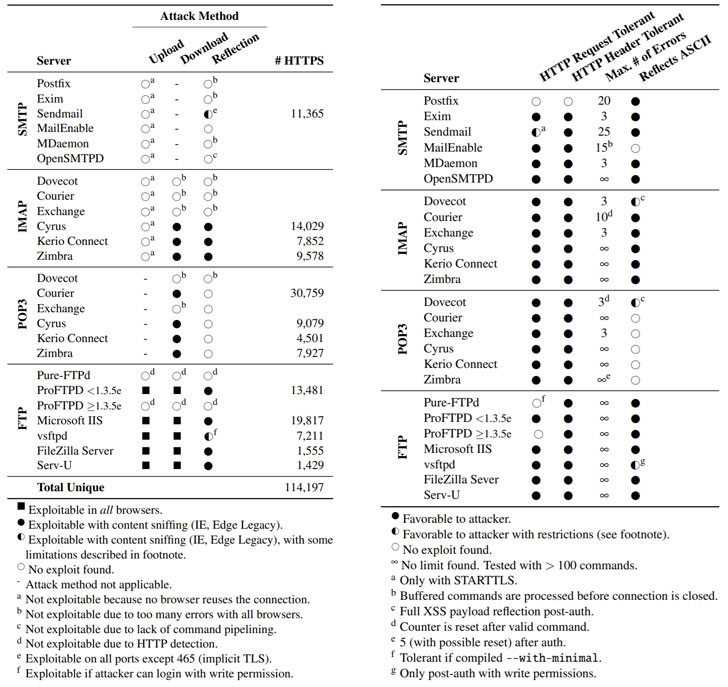
All TLS servers that have compatible certificates with other TLS
services are expected to be affected. In an experimental setup, the
researchers found that at least 1.4 million web servers were
vulnerable to cross-protocol attacks, with 114,197 of the servers
considered prone to attacks using an exploitable SMTP, IMAP, POP3,
or FTP server with a trusted and compatible certificate.
To counter cross-protocol attacks, the researchers propose
utilizing Application Layer Protocol Negotiation (ALPN[4]) and Server Name
Indication (SNI[5]) extensions to TLS that
can be used by a client to let the server know about the intended
protocol to be used over a secure connection and the hostname it’s
attempting to connect to at the start of the handshake[6]
process.
The findings are expected to be presented at Black Hat USA 2021
and at USENIX Security Symposium 2021. Additional artifacts
relevant to the ALPACA attack can be accessed via GitHub here[7].