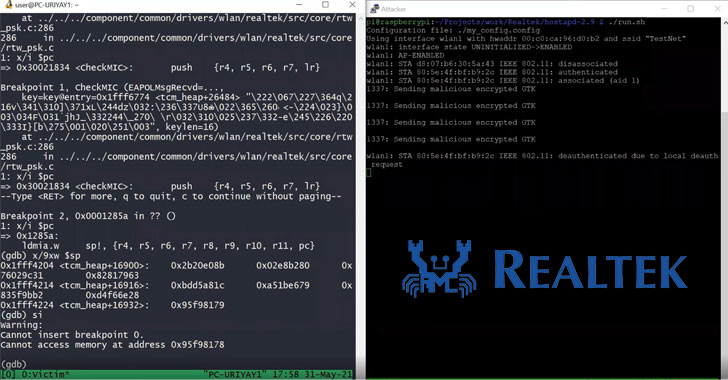
A new set of critical vulnerabilities has been disclosed in the
Realtek RTL8170C Wi-Fi module that an adversary could abuse to gain
elevated privileges on a device and hijack wireless
communications.
“Successful exploitation would lead to complete control of the
Wi-Fi module and potential root access on the OS (such as Linux or
Android) of the embedded device that uses this module,” researchers
from Israeli IoT security firm Vdoo said[1]
in a write-up published yesterday.
The Realtek RTL8710C[2]
Wi-Fi SoC underpins Ameba, an Arduino-compatible programmable
platform equipped with peripheral interfaces for building a variety
of IoT applications by devices spanning across agriculture,
automotive, energy, healthcare, industrial, security, and smart
home sectors.
The flaws affect all embedded and IoT devices that use the
component to connect to Wi-Fi networks and would require an
attacker to be on the same Wi-Fi network as the devices that use
the RTL8710C module or know the network’s pre-shared key (PSK),
which, as the name implies, is a cryptographic secret used to
authenticate wireless clients on local area networks.
The findings follow an earlier analysis[3]
in February that found similar weaknesses in the Realtek RTL8195A
Wi-Fi module, chief among them being a buffer overflow
vulnerability (CVE-2020-9395) that permits an attacker in the
proximity of an RTL8195 module to completely take over the module
without having to know the Wi-Fi network password.
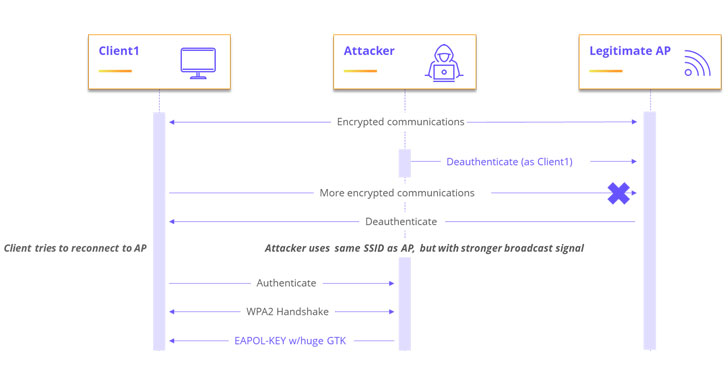
In the same vein, the RTL8170C Wi-Fi module’s WPA2 four-way handshake[4]
mechanism is vulnerable to two stack-based buffer overflow
vulnerabilities (CVE-2020-27301 and CVE-2020-27302, CVSS scores:
8.0) that abuse the attacker’s knowledge of the PSK to obtain
remote code execution on WPA2 clients that use this Wi-Fi
module.
As a potential real-world attack scenario, the researchers
demonstrated a proof-of-concept (PoC) exploit wherein the attacker
masquerades as a legitimate access point and sends a malicious
encrypted group temporal key (GTK) to any client (aka supplicant)
that connects to it via WPA2 protocol. A group temporal key is used
to secure all multicast and broadcast traffic.
Vdoo said there are no known attacks underway exploiting the
vulnerabilities, adding firmware versions released after Jan. 11,
2021 include mitigations that resolve the issue. The company also
recommends using a “strong, private WPA2 passphrase” to prevent
exploitation of the above issues in scenarios where the device’s
firmware can’t be updated.
References
- ^
said
(www.vdoo.com) - ^
RTL8710C
(www.amebaiot.com) - ^
earlier
analysis (thehackernews.com) - ^
four-way
handshake (en.wikipedia.org)
Read more http://feedproxy.google.com/~r/TheHackersNews/~3/4HEXvl33VRQ/researchers-warn-of-critical-bugs.html