
Cybercrime groups are distributing malicious PHP web shells
disguised as a favicon to maintain remote access to the compromised
servers and inject JavaScript skimmers into online shopping
platforms with an aim to steal financial information from their
users.
“These web shells known as Smilodon or Megalodon are used to
dynamically load JavaScript skimming code via server-side requests
into online stores,” Malwarebytes Jérôme Segura said[1]
in a Thursday write-up. “This technique is interesting as most
client-side security tools will not be able to detect or block the
skimmer.”
Injecting web skimmers on e-commerce websites to steal credit
card details is a tried-and-tested modus operandi of Magecart, a
consortium of different hacker groups who target online shopping
cart systems. Also known as formjacking attacks, the skimmers are
typically JavaScript code that the operators stealthily insert into
an e-commerce website, often on payment pages, with an intent to
capture customers’ card details in real-time and transmit it to a
remote attacker-controlled server.
While injecting skimmers typically work by making a client-side
request to an external JavaScript resource hosted on an
attacker-controlled domain when a customer visits the online store
in question, the latest attack is a little different in that the
skimmer code is introduced into the merchant site dynamically at
the server-side.
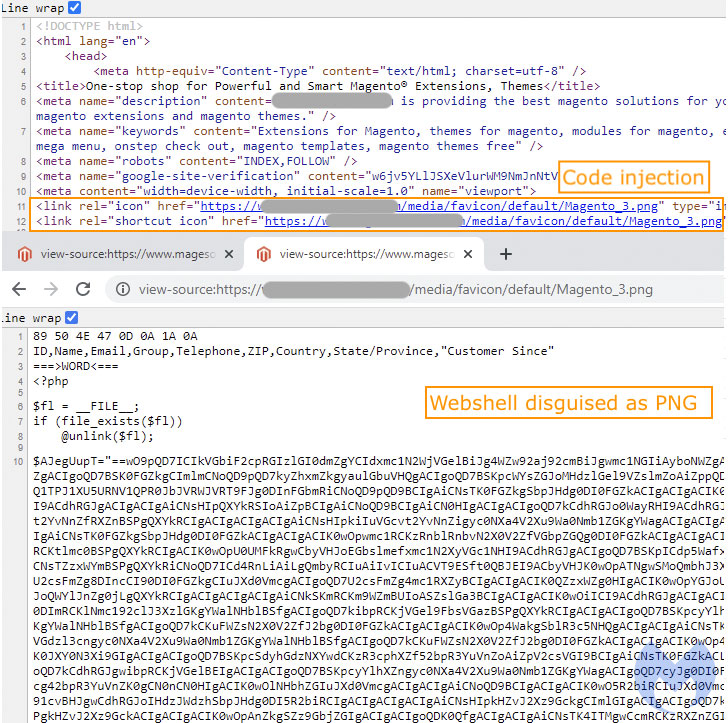
The PHP-based web shell malware passes off as a favicon
(“Magento.png”), with the malware inserted into compromised sites
by tampering with the shortcut
icon[2] tags in HTML code to
point to the fake PNG image file. This web shell, in turn, is
configured to retrieve the next-stage payload from an external
host, a credit card skimmer that shares similarities with another
variant used in Cardbleed[3]
attacks last September, suggesting the threat actors modified their
toolset following public disclosure.
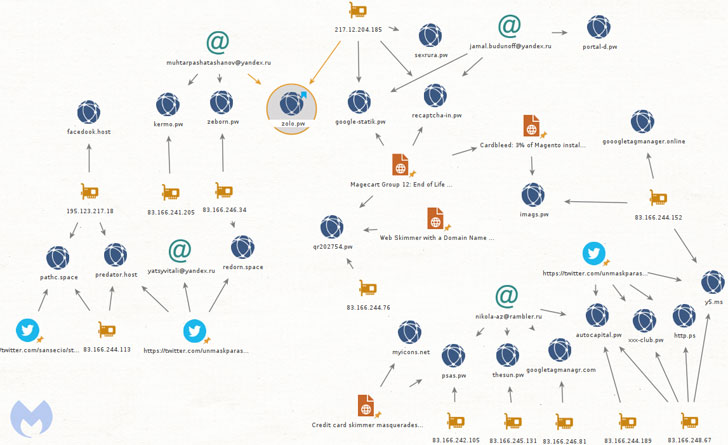
Malwarebytes attributed the latest campaign to Magecart Group
12[4] based on overlaps[5]
in tactics, techniques, and procedures employed, adding “the newest
domain name we found (zolo[.]pw) happens to be hosted on the same
IP address (217.12.204[.]185) as recaptcha-in[.]pw and
google-statik[.]pw, domains previously associated with Magecart
Group 12.”
Operating with the primary intention of capturing and
exfiltrating payment data, Magecart actors have embraced a wide range of attack vectors[6] over the past several
months to stay under the radar, avoid detection, and plunder data.
From hiding card stealer code inside image metadata[7]
and carrying out IDN homograph attacks[8]
to plant web skimmers concealed within a website’s favicon file to
using Google Analytics[9]
and Telegram[10] as an exfiltration
channel, the cybercrime syndicate has intensified in its efforts to
compromise online stores.
Skimming has become so prevalent and lucrative a practice that
the Lazarus Group, a collective of state-sponsored hackers
affiliated with North Korea, attacked websites that accept
cryptocurrency payments with malicious JavaScript sniffers to steal
bitcoins and ether in a new campaign called “BTC
Changer[11]” that started early
last year.
References
- ^
said
(blog.malwarebytes.com) - ^
shortcut
icon (en.wikipedia.org) - ^
Cardbleed
(thehackernews.com) - ^
Magecart
Group 12 (sansec.io) - ^
overlaps
(community.riskiq.com) - ^
wide
range of attack vectors (thehackernews.com) - ^
image
metadata (thehackernews.com) - ^
IDN
homograph attacks (thehackernews.com) - ^
Google
Analytics (thehackernews.com) - ^
Telegram
(thehackernews.com) - ^
BTC
Changer (blog.group-ib.com)