
The maintainers of Exim have released patches[1]
to remediate as many as 21 security vulnerabilities in its software
that could enable unauthenticated attackers to achieve complete
remote code execution and gain root privileges.
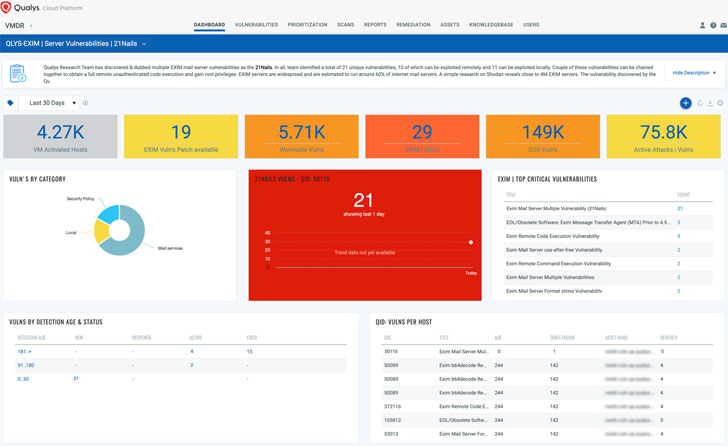
Collectively named ’21Nails[2],’ the flaws include 11
vulnerabilities that require local access to the server and 10
other weaknesses that could be exploited remotely. The issues were
discovered by Qualys and reported to Exim on Oct. 20, 2020.
“Some of the vulnerabilities can be chained together to obtain a
full remote unauthenticated code execution and gain root privileges
on the Exim Server,” Bharat Jogi, senior manager at Qualys, said in
public disclosure. “Most of the vulnerabilities discovered by the
Qualys Research Team for e.g. CVE-2020-28017 affects all versions
of Exim going back all the way to 2004.”
Exim is a popular mail transfer agent (MTA) used on Unix-like
operating systems, with over 60% of the publicly reachable mail
servers[3] on the Internet running
the software.
“According to a recent survey, an estimated 60% of internet
servers run on Exim. A Shodan search reveals nearly 4 million Exim
servers are exposed to the internet.”
A quick summary of the 21 bugs[4]
is listed below. If successfully exploited, they could be used to
tweak email settings and even add new accounts on the compromised
mail servers. Technical specifics about the flaws can be accessed
here[5].
Local vulnerabilities:
- CVE-2020-28007: Link attack in Exim’s log directory
- CVE-2020-28008: Assorted attacks in Exim’s spool directory
- CVE-2020-28014: Arbitrary file creation and clobbering
- CVE-2021-27216: Arbitrary file deletion
- CVE-2020-28011: Heap buffer overflow in queue_run()
- CVE-2020-28010: Heap out-of-bounds write in main()
- CVE-2020-28013: Heap buffer overflow in parse_fix_phrase()
- CVE-2020-28016: Heap out-of-bounds write in
parse_fix_phrase() - CVE-2020-28015: New-line injection into spool header file
(local) - CVE-2020-28012: Missing close-on-exec flag for privileged
pipe - CVE-2020-28009: Integer overflow in get_stdinput()
Remote vulnerabilities:
- CVE-2020-28017: Integer overflow in
receive_add_recipient() - CVE-2020-28020: Integer overflow in receive_msg()
- CVE-2020-28023: Out-of-bounds read in smtp_setup_msg()
- CVE-2020-28021: New-line injection into spool header file
(remote) - CVE-2020-28022: Heap out-of-bounds read and write in
extract_option() - CVE-2020-28026: Line truncation and injection in
spool_read_header() - CVE-2020-28019: Failure to reset function pointer after BDAT
error - CVE-2020-28024: Heap buffer underflow in smtp_ungetc()
- CVE-2020-28018: Use-after-free in tls-openssl.c
- CVE-2020-28025: Heap out-of-bounds read in
pdkim_finish_bodyhash()
In light of the recent Microsoft Exchange server hacks[6], it’s imperative the
patches are applied immediately, as email servers have emerged as a
lucrative target for espionage campaigns. In the past, flaws in
Exim software have been actively exploited by bad actors to mount a
variety of attacks, including deploying a Linux worm[7]
to install cryptocurrency miners on affected servers.
Last May, the U.S. National Security Agency (NSA) warned that
Russian military operatives, publicly known as Sandworm Team, were
taking advantage of a remote code execution vulnerability tracked
as CVE-2019-10149[8]
(aka The Return of the WIZard[9]) to “add privileged
users, disable network security settings, execute additional
scripts for further network exploitation” at least since August
2019.
The NSA called[10] it an “attacker’s dream
access.”
“Mail Transfer Agents are interesting targets for attackers
because they are usually accessible over the internet,” Jogi said.
“Once exploited, they could modify sensitive email settings on the
mail servers, allow adversaries to create new accounts on the
target mail servers.”
References
- ^
released
patches (www.openwall.com) - ^
’21Nails
(blog.qualys.com) - ^
over 60%
of the publicly reachable mail servers
(www.securityspace.com) - ^
21
bugs (www.exim.org) - ^
here
(www.qualys.com) - ^
Microsoft Exchange server hacks
(thehackernews.com) - ^
Linux
worm (www.cybereason.com) - ^
CVE-2019-10149
(thehackernews.com) - ^
The
Return of the WIZard (www.qualys.com) - ^
called
(www.nsa.gov)
Read more http://feedproxy.google.com/~r/TheHackersNews/~3/71ykmtStIUg/alert-new-21nails-exim-bugs-expose.html