Researchers on Tuesday disclosed a novel malware that uses a
variety of tricks to stay under the radar and evade detection,
while stealthily capable of executing arbitrary commands on
infected systems.
Called ‘Pingback,’ the Windows malware leverages Internet
Control Message Protocol (ICMP[1]) tunneling for covert
bot communications, allowing the adversary to utilize ICMP packets
to piggyback attack code, according to an analysis[2]
published today by Trustwave.
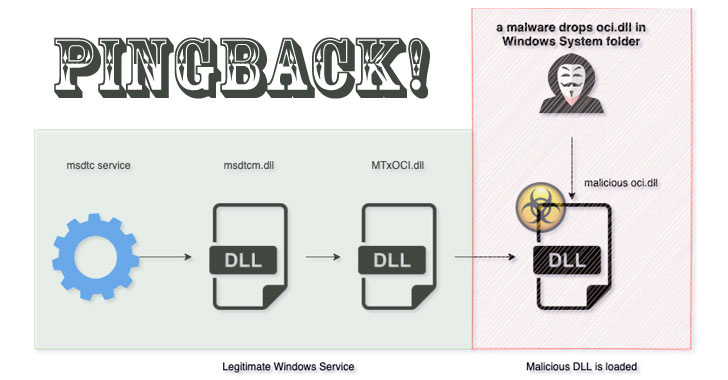
Pingback (“oci.dll[3]“) achieves this by
getting loaded through a legitimate service called MSDTC[4]
(Microsoft Distributed Transaction Coordinator) — a component
responsible for handling database operations that are distributed
over multiple machines — by taking advantage of a method called
DLL search order hijacking[5], which involves using a
genuine application to preload a malicious DLL file.
Naming the malware as one of the plugins required for supporting
Oracle ODBC[6]
interface in MSDTC is key to the attack, the researchers noted.
While MSDTC isn’t configured to run automatically on startup, a
VirusTotal sample[7]
submitted in July 2020 was found to install the DLL file into the
Windows System directory and start the MSDTC service to achieve
persistence, raising the possibility that a separate executable is
crucial to installing the malware.
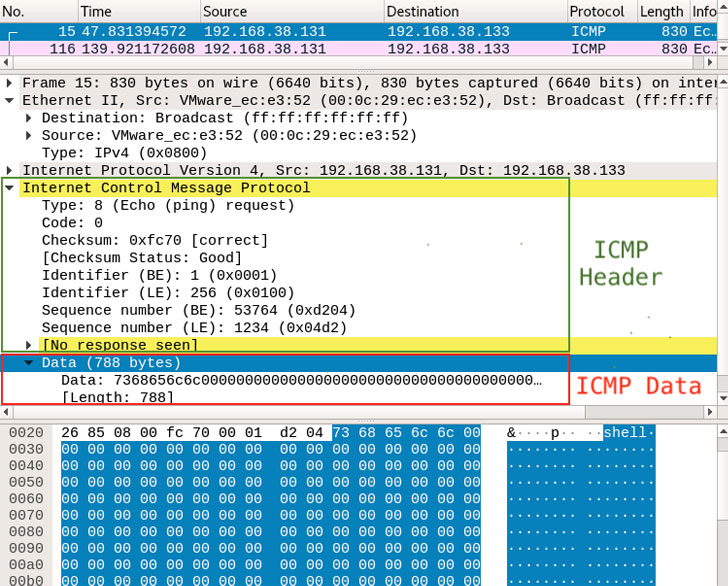
Upon successful execution, Pingback resorts to using the ICMP
protocol for its main communication. ICMP is a network layer
protocol mainly used for sending error messages and operational
information, say, a failure alert when another host becomes
unreachable.
Specifically, Pingback takes advantage of an Echo request (ICMP
message type 8), with the message sequence numbers 1234, 1235, and
1236 denoting the type of information contained in the packet —
1234 being a command or data, and 1235 and 1236 being the
acknowledgment for receipt of data on the other end. Some of the
commands supported by the malware include the capability to run
arbitrary shell commands, download and upload files from and to the
attacker’s host, and execute malicious commands on the infected
machine.
An investigation into the malware’s initial intrusion route is
ongoing.
“ICMP tunneling is not new, but this particular sample piqued
our interest as a real-world example of malware using this
technique to evade detection,” the researchers said. “ICMP is
useful for diagnostics and performance of IP connections, [but] it
can also be misused by malicious actors to scan and map a target’s
network environment. While we are not suggesting that ICMP should
be disabled, we do suggest putting in place monitoring to help
detect such covert communications over ICMP.”
References
- ^
ICMP
(en.wikipedia.org) - ^
analysis
(www.trustwave.com) - ^
oci.dll
(www.virustotal.com) - ^
MSDTC
(en.wikipedia.org) - ^
DLL
search order hijacking (attack.mitre.org) - ^
Oracle
ODBC (www.oracle.com) - ^
VirusTotal sample
(www.virustotal.com)
Read more http://feedproxy.google.com/~r/TheHackersNews/~3/W9afjY854iY/new-pingback-malware-using-icmp.html