
Security is only as strong as the weakest link. As further proof
of this, Apple released an update to macOS operating systems to
address an actively exploited zero-day vulnerability that could
circumvent all security protections, thus permitting unapproved
software to run on Macs.
The macOS flaw, identified as CVE-2021-30657[1], was discovered and
reported to Apple by security engineer Cedric Owens on March 25,
2021.
“An unsigned, unnotarized, script-based proof of concept
application […] could trivially and reliably sidestep all of
macOS’s relevant security mechanisms (File Quarantine, Gatekeeper,
and Notarization Requirements), even on a fully patched M1 macOS
system,” security researcher Patrick Wardle explained[2]
in a write-up. “Armed with such a capability macOS malware authors
could (and are) returning to their proven methods of targeting and
infecting macOS users.”
Apple’s macOS comes with a feature called Gatekeeper[3], which allows only
trusted apps[4]
to be run by ensuring that the software has been signed by the App
Store or by a registered developer and has cleared an automated
process called “app notarization[5]” that scans the software
for malicious content.
But the new flaw uncovered by Owens could enable an adversary to
craft a rogue application in a manner that would deceive the
Gatekeeper service and get executed without triggering any security
warning. The trickery involves packaging a malicious shell script
as a “double-clickable app” so that the malware could be
double-clicked and run like an app.
“It’s an app in the sense that you can double click it and macOS
views it as an app when you right click -> Get Info on the
payload,” Owens said[6]. “Yet it’s also shell
script in that shell scripts are not checked by Gatekeeper even if
the quarantine[7]
attribute is present.”

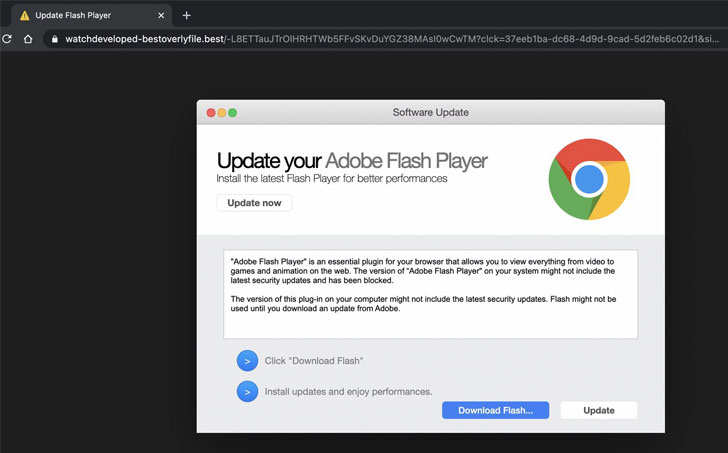
According to macOS security firm Jamf[8], the threat actor behind
Shlayer[9]
malware has been abusing this Gatekeeper bypass vulnerability as
early as January 9, 2021. Distributed via a technique called search
engine poisoning or spamdexing, Shlayer accounts for almost 30% of
all detections on the macOS platform, with one in ten systems
encountering the adware at least once, according to Kaspersky[10] statistics for
2019.
The attack works by manipulating search engine results to
surface malicious links that, when clicked, redirects users to a
web page that prompts users to download a seemingly benign app
update for out-of-date software, which in this campaign, is a bash
script designed to retrieve next-stage payloads, including Bundlore
adware stealthily. Troublingly, this infection scheme could be
leveraged to deliver more advanced threats such as surveillanceware
and ransomware.
In addition to the aforementioned vulnerability, Monday’s
updates also address a critical flaw in WebKit Storage (tracked as
CVE-2021-30661) that concerns an arbitrary code execution flaw in
iOS[11], macOS[12], tvOS[13], and watchOS[14] when processing
maliciously crafted web content.
“Apple is aware of a report that this issue may have been
actively exploited,” the company said in a security document,
adding it addressed the use-after-free weakness with improved
memory management.
Aside from these updates, Apple has also released iCloud for
Windows 12.3[15] with patches for four
security issues in WebKit and WebRTC, among others, that could
allow an attacker to cross-site scripting (XSS) attacks
(CVE-2021-1825) and corrupt kernel memory (CVE-2020-7463).
Users of Apple devices are recommended to update to the latest
versions to mitigate the risk associated with the flaws.
References
- ^
CVE-2021-30657
(support.apple.com) - ^
explained
(objective-see.com) - ^
Gatekeeper
(support.apple.com) - ^
trusted
apps (support.apple.com) - ^
app
notarization (developer.apple.com) - ^
said
(cedowens.medium.com) - ^
quarantine
(www.trendmicro.com) - ^
Jamf
(www.jamf.com) - ^
Shlayer
(www.intego.com) - ^
Kaspersky
(securelist.com) - ^
iOS
(support.apple.com) - ^
macOS
(support.apple.com) - ^
tvOS
(support.apple.com) - ^
watchOS
(support.apple.com) - ^
iCloud
for Windows 12.3 (support.apple.com)