
Facebook on Wednesday said it took steps to dismantle malicious
activities perpetrated by two state-sponsored hacking groups
operating out of Palestine that abused its platform to distribute
malware.
The social media giant attributed the attacks to a network
connected to the Preventive Security Service (PSS[1]), the security apparatus
of the State of Palestine, and another threat actor known as Arid
Viper (aka Desert Falcon and APT-C-23), the latter of which is
alleged to be connected to the cyber arm of Hamas.
The two digital espionage campaigns, active in 2019 and 2020,
exploited a range of devices and platforms, such as Android, iOS,
and Windows, with the PSS cluster primarily targeting domestic
audiences in Palestine. The other set of attacks went after users
in the Palestinian territories and Syria and, to a lesser extent
Turkey, Iraq, Lebanon, and Libya.
Both the groups appear to have leveraged the platform as a
springboard to launch a variety of social engineering attacks in an
attempt to lure people into clicking on malicious links and
installing malware on their devices. To disrupt the adversary
operations, Facebook said it took down their accounts, blocked
domains associated with their activity, and alerted users it
suspects were singled out by these groups to help them secure their
accounts.
Android Spyware in Benign-Looking Chat Apps
PSS is said to have used custom-built Android malware that was
disguised as secure chat applications to stealthily capture device
metadata, capture keystrokes, and upload the data to Firebase. In
addition, the group deployed another Android malware called SpyNote
that came with the ability to monitor calls and remotely access the
compromised phones.
This group used fake and compromised accounts to create
fictitious personas, often posing as young women, and also as
supporters of Hamas, Fatah, various military groups, journalists,
and activists with an aim to build relationships with the targets
and guide them toward phishing pages and other malicious
websites.
“This persistent threat actor focused on a wide range of
targets, including journalists, people opposing the Fatah-led
government, human rights activists and military groups including
the Syrian opposition and Iraqi military,” Facebook researchers
leading the cyber espionage investigations said[2].
A Sophisticated Espionage Campaign
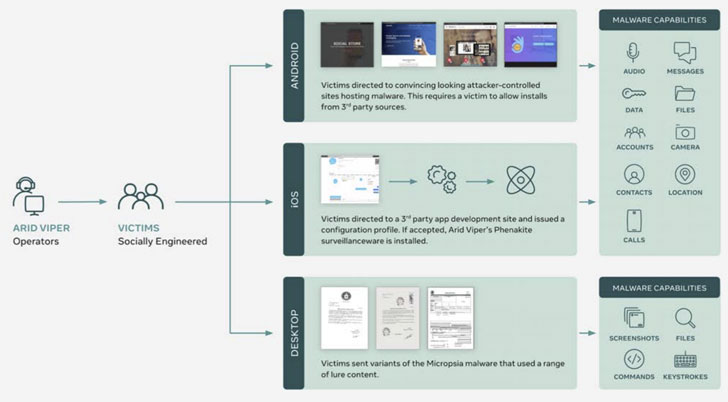
Arid Viper[3], on the other hand, was
observed incorporating a new custom iOS surveillanceware dubbed
“Phenakite” in their targeted campaigns, which Facebook noted was
capable of stealing sensitive user data from iPhones without
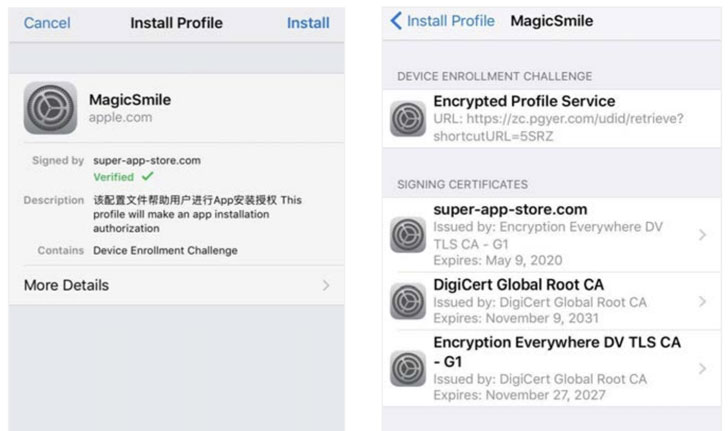
jailbreaking the devices prior to the compromise. Phenakite was
delivered to users in the form of a fully functional but trojanized
chat application named MagicSmile hosted on a third-party Chinese
app development site that would surreptitiously run in the
background and grab data stored on the phone without the user’s
knowledge.
The group also maintained a huge infrastructure comprising 179
domains that were used to host malware or acted as
command-and-control (C2) servers.
“Lure content and known victims suggest the target demographic
is individuals associated with pro-Fatah groups, Palestinian
government organizations, military and security personnel, and
student groups within Palestine,” the researchers added.
Facebook suspects Arid Viper used the iOS malware only in a
handful of cases, suggesting a highly-targeted operation, with the
Hamas-linked hackers simultaneously focusing on an evolving set of
Android-based spyware apps that claimed to facilitate dating,
networking, and regional banking in the Middle East, with the
adversary masking the malware as fake app updates for legitimate
apps like WhatsApp.
Once installed, the malware urged victims to disable Google Play
Protect and give the app device admin permissions, using the
entrenched access to record calls, capture photos, audio, video, or
screenshots, intercept messages, track device location, retrieve
contacts, call logs, and calendar details, and even notification
information from messaging apps such as WhatsApp, Instagram, Imo,
Viber, and Skype.
In an attempt to add an extra layer of obfuscation, the malware
was then found to contact a number of attacker-controlled sites,
which in turn provided the implant with the C2 server for data
exfiltration.
“Arid Viper recently expanded their offensive toolkit to include
iOS malware that we believe is being deployed in targeted attacks
against pro-Fatah groups and individuals,” Facebook researchers
said. “As the technological sophistication of Arid Viper can be
considered to be low to medium, this expansion in capability should
signal to defenders that other low-tier adversaries may already
possess, or can quickly develop, similar tooling.”
References
Read more http://feedproxy.google.com/~r/TheHackersNews/~3/OFz5y_4fN-g/facebook-busts-palestinian-hackers.html