
When dealing with user data, it’s essential that we design our
password policies around compliance. These policies are defined
both internally and externally.
While companies uphold their own password standards, outside
forces like HIPAA and NIST have a heavy influence. Impacts are
defined by industry and one’s unique infrastructure. How do IT
departments maintain compliance with NIST and HIPAA?
We’ll discuss each compliance measure and its importance in this
article.
What is NIST compliance?
Defined by the National Institute of Standards and Technology,
NIST compliance aims to harden federal systems against
cyber-attacks. While the agency is non-regulatory, it is
part of the U.S. Department of Commerce, which has plenty of
influence over government agencies and their contractors.
For example, NIST guidelines help agencies satisfy the requirements of the Federal
Information Security Management Act[1]
(FISMA). NIST is instrumental in creating Federal Information
Processing Standards (FIPS[2]) that comply with FISMA.
None of this would be possible without the NIST Cybersecurity
Framework.
The Framework outlines steps and best practices that data
processors should follow.
Controls relate to
the following[3]:
- Authentication-based access for local workstations, databases,
websites, and web services - Audit events for password changes, failed logins, and failed
access related to Personal Identity Verification (PIV) credentials,
third-party credentials, or admin actions - Group (shared privilege) accounts and individual accounts
- Passwords, access tokens, biometrics, and multi-factor
authentication (MFA) - Encryption and password hashing
- Minimum password length, complexity, and validation time
Notably, an admin complying with NIST standards might define
necessary password policies to enforce minimum length and leaked
password filtering requirements. Password policy could also include
the blocking of common character substitution and other predictable
password construction patterns such as changing a password by only
adding numbers or symbols at the end.
NIST encourages removing password expiry and complexity — but
this needs to be weighed with the organization’s regulatory
obligations; for example, PCI-DSS and HITRUS-CFS require these.
Regular assessment or identification of compromised passwords is
crucial. Organizations can use automated tools to identify and
enforce change when detected continually.
NIST Cybersecurity Framework compliance is an excellent stepping
stone to strong security. However, the agency warns that NIST
guidelines do NOT create impenetrable systems. No framework is
perfect.
What is HIPAA compliance?
Personal health information falls under the high-sensitivity
umbrella. These records are confidential and contain private
information, hence why databases and data warehouses must employ
strong protections. There’s also an argument that password policies
exist to protect patient dignity.
Patient-doctor confidentiality, and provider-patient
relationships, are critical to maintaining privacy across the
healthcare landscape. However, many patients don’t even have a
stellar perception of healthcare providers. In 2016, Black Book revealed[4]
that 87% of patients withheld some degree of health information
from “trusted” providers.
You might see where this is going. Personal medical data is
so personal that trust is hard-earned outside of one’s
inner circle. That phenomenon is amplified in our digital age,
where remote access and electronic record sharing are
commonplace.
Some other areas of concern:
- Patient financial information
- Patient portal access
- Personal information submitted as part of an online
profile
Protection via password compliance
So much information is collected these days that patients
themselves find it difficult to sift through. Technology-savvy
providers are entrusted with safeguarding this data and making it
accessible to the right individual(s). This is where the
Health Insurance Portability and Accountability Act (HIPAA) steps
in.
First, HIPAA outlines three types of standards[5] that organizations must
meet:
- Technical standards – which describe the
safeguards necessary to protect and maintain an infrastructure that
stores personal electronic health information - Physical standards – which describe how
brick-and-mortar premises must be protected both inside and
out - Administrative standards – which describe the
necessary controls and maintenance efforts on the part of staff
members in upholding the security of personal health
information
Our natural focus is on technical and administrative
standards—the first covers online systems or databases that store
highly sensitive data. Administrative standards entail staff roles
in dictating password management and access authorization. What
does that look like in a password policy?
Note that HIPAA and NIST guidelines aren’t mutually exclusive.
Following these rules will keep you both HIPAA and NIST
compliant:
- Mandate that passwords be 8+ characters in length (even up to
64 for some data) - Don’t give password hints to users
- Encourage the creation of memorable passwords, not obscure ones
requiring record keeping - Vet passwords according to banned password lists[6], or dictionaries of
compromised passwords
These guidelines are critical. Additionally, HIPAA does provide
some wiggle room in accordance with the entity monitoring key data.
Because providers can be microscopic and massive (health systems,
insurance providers), unique password policies are needed.
Better NIST and HIPAA Compliance with Specops
External tools can provide plenty of help when crafting
compliant password policies. We recommend two tools:
Specops Password Auditor and Specops
Password Policy. These automate multiple processes
critical to ongoing password security.
Password Auditor[7]
is a free tool that offers three main benefits: password reporting,
Active Directory account auditing, and standards compliance.
Auditor scans your environment to ensure that general and
fine-grained password policies promote secure passwords.
Informative reports highlight weak points and problematic
accounts—simplifying remediation. These reports even compare your
policies against those pushed by the NIST.
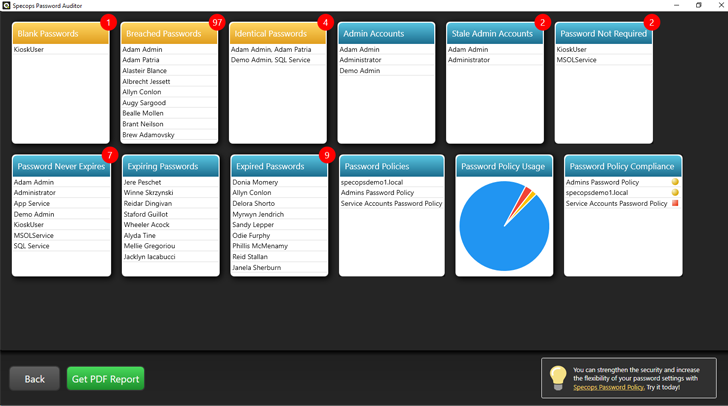
Password Auditor will also show you how resilient your systems
are against attacks. You can also view domains and their respective
accounts. Vulnerable passwords are identified if they match those
found within our breached-passwords lists.
Meanwhile, Password Policy[8]
provides similar benefits with greater granularity. Mainly, you can
accomplish the following: block weak passwords, create compliant
password policies, and target password entropy. The tool lets you
bring your own password dictionary and incorporate the Specops list
of 2 billion breached passwords.
Specops does the heavy lifting—automatically accepting passwords
(and even phrases) while rejecting non-compliant passwords. Enforce
your own password length, complexity, and character requirements.
Finally, compliance tools will show you how your existing policies
compare to industry-compliant policies. Password Policy provides
templating and analysis to protect company-held data against
popular cyber-attack methods.
NIST and HIPAA compliance rests with strong password
policies. Thankfully, the compliance process doesn’t have to be
complicated.
References
- ^
satisfy
the requirements of the Federal Information Security Management
Act (csrc.nist.gov) - ^
FIPS
(www.nist.gov) - ^
Controls relate to the following
(nvd.nist.gov) - ^
Black
Book revealed (www.hipaajournal.com) - ^
three
types of standards (compliancy-group.com) - ^
banned
password lists (specopssoft.com) - ^
Password
Auditor (specopssoft.com) - ^
Password
Policy (specopssoft.com)
Read more http://feedproxy.google.com/~r/TheHackersNews/~3/wIpPed6ruFE/nist-and-hipaa-is-there-password.html