
The maintainers of the PHP programming language have issued an
update regarding the security incident that came to light late last
month, stating that the actors may have gotten hold of a user
database containing their passwords to make unauthorized changes to
the repository.
“We no longer believe the git.php.net server has been
compromised. However, it is possible that the master.php.net user
database leaked,” Nikita Popov said[1]
in a message posted on its mailing list on April 6.
On March 28, unidentified actors used the names of Rasmus
Lerdorf and Popov to push malicious commits[2]
to the “php-src” repository hosted on the git.php.net server that
involved adding a backdoor to the PHP source code in an instance of
a software supply chain attack.
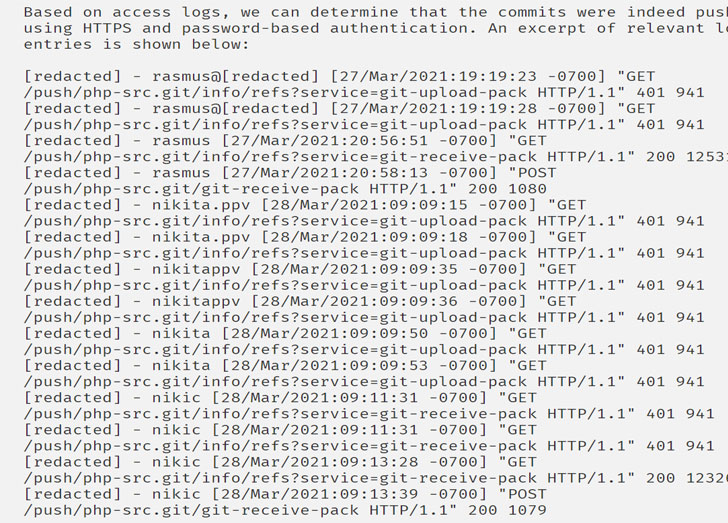
While this was initially treated as a compromise of the
git.php.net server, further investigation into the incident has
revealed that the commits were a result of pushing them using HTTPS
and password-based authentication, leading them to suspect a
possible leak of the master.php.net user database.
The “git.php.net (intentionally) support[s] pushing changes not
only via SSH (using the Gitolite infrastructure and public key
cryptography), but also via HTTPS,” Popov said. “The latter did not
use Gitolite, and instead used git-http-backend behind Apache 2 Digest[3]
authentication against the master.php.net user database.”
“It is notable that the attacker only makes a few guesses at
usernames, and successfully authenticates once the correct username
has been found. While we don’t have any specific evidence for this,
a possible explanation is that the user database of master.php.net
has been leaked, although it is unclear why the attacker would need
to guess usernames in that case.”
Additionally, the master.php.net authentication system is said
to be on a very old operating system and a version of PHP, raising
the possibility that the attackers may have also exploited a
vulnerability in the software to stage the attack.
As a consequence, the maintainers have migrated master.php.net
to a new main.php.net system with support for TLS 1.2, in addition
to resetting all existing passwords and storing passwords using
bcrypt[4]
instead of a plain MD5 hash.
References
- ^
said
(news-web.php.net) - ^
push
malicious commits (thehackernews.com) - ^
Apache 2
Digest (httpd.apache.org) - ^
bcrypt
(en.wikipedia.org)