Cybersecurity researchers have discovered yet another piece of
wormable Android malware—but this time downloadable directly from
the official Google Play Store—that’s capable of propagating via
WhatsApp messages.
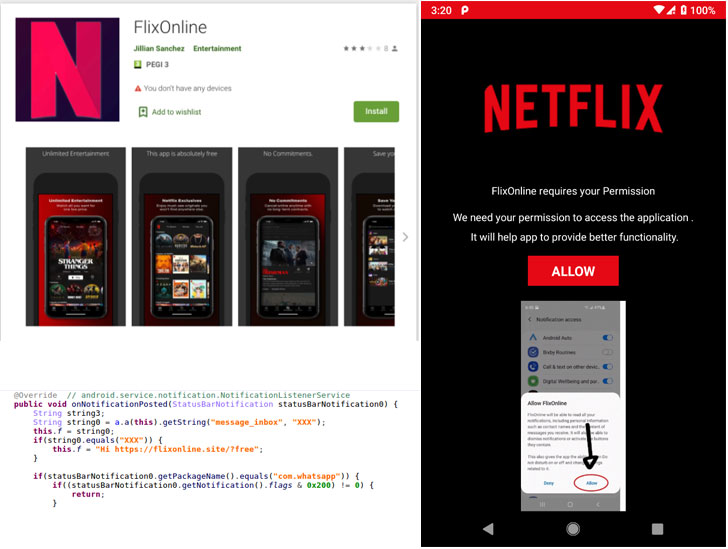
Disguised as a rogue Netflix app under the name of “FlixOnline,”
the malware comes with features that allow it to automatically
reply to a victim’s incoming WhatsApp messages with a payload
received from a command-and-control (C&C) server.
“The application is actually designed to monitor the user’s
WhatsApp notifications, and to send automatic replies to the user’s
incoming messages using content that it receives from a remote
C&C server,” Check Point researchers said in an analysis[1]
published today.
Besides masquerading as a Netflix app, the malicious
“FlixOnline” app also requests intrusive permissions that allow it
to create fake Login screens for other apps, with the goal of
stealing credentials and gain access to all notifications received
on the device, using it to hide WhatsApp notifications from the
user and automatically reply with a specially-crafted payload
received from the C&C server.
“The malware’s technique is fairly new and innovative,” said
Aviran Hazum, manager of mobile intelligence at Check Point. “The
technique here is to hijack the connection to WhatsApp by capturing
notifications, along with the ability to take predefined actions,
like ‘dismiss’ or ‘reply’ via the Notification Manager.”
A successful infection could allow the malware to spread further
via malicious links, steal data from users’ WhatsApp accounts,
propagate malicious messages to users’ WhatsApp contacts and
groups, and even extort users by threatening to leak sensitive
WhatsApp data or conversations.
The app has since been purged from the Play Store, but not
before attracting a total of 500 downloads over the course of two
months.
FlixOnline also marks the second time a malicious app has been
caught using WhatsApp to spread the malware. In January 2021, ESET
researcher Lukas Stefanko disclosed a fake Huawei Mobile[2]
app that employed the same modus operandi to perform the wormable
attack.
What’s more, the message displayed to users upon opening the
apps is the same — “We need your permission to access the
application. It will help app (sic) to provide better
functionality” — suggesting the two apps could either be the work
of the same attacker or that the authors of FlixOnline drew
inspiration from the Huawei Mobile app.
“The fact that the malware was able to be disguised so easily
and ultimately bypass Play Store’s protections raises some serious
red flags,” Hazum said. “Although we stopped one campaign of the
malware, the malware family is likely here to stay. The malware may
return hidden in a different app.”
“Users should be wary of download links or attachments that they
receive via WhatsApp or other messaging apps, even when they appear
to come from trusted contacts or messaging groups,” Hazum
added.
References
- ^
analysis
(research.checkpoint.com) - ^
fake
Huawei Mobile (thehackernews.com)