
Many enterprises rely on more than one security tool to protect
their technology assets, devices, and networks. This is
particularly true for organizations that use hybrid systems or a
combination of cloud and local applications. Likewise, companies
whose networks include a multitude of smartphones and IoT devices
are likely to deploy multiple security solutions suitable for
different scenarios.
Employing several security solutions tends to be inevitable for
many, especially those that have outgrown their previous network
setups. Companies that expand to new branches and even overseas
operations have to make use of additional security measures and
tools. This use of multiple tools or software often leads to
critical issues, though.
The management of the many cybersecurity solutions can become
too complicated and difficult to handle, especially for
organizations with little experience in addressing cyber threats,
let alone actual attacks. This can result in confusion and the
inability to detect vulnerabilities and respond to emerging
problems properly.
The solutions
One solution to the dilemma of using different security defenses
is to look for one company that provides everything to replace
existing security defenses. There are security providers that offer
a comprehensive range of protection, from client-based malware
detection and prevention tools to SaaS security.
However, this is unlikely to be a convenient choice for most
organizations. Switching to a new cybersecurity solution provider
entails a major change and is possibly going to be more costly with
everything taken into account. It also does not always guarantee
better protection.
The second solution does not require a switch to a different
platform or security provider. It is all about centralizing and
unifying even fragmented sets of security solutions. Organizations
can use a solution that serves as a cybersecurity central command
platform to monitor and manage all security tools through a unified
dashboard.
Centralized cybersecurity
To exemplify the idea of centralized cybersecurity Cyrebro[1] has designed a security
solution that unifies all of the security tools of an organization
to make it easier to track security events, proactively deal with
cyber threat intelligence, and ensure a rapid incident
response.
Cyrebro touts three highlight features: centralized vision, a
single cyber brain, and transparent accountability.
Centralized vision refers to Cyrebro’s ability to get
information on all security events and have a clear sense of what
they mean to the organization. It is not only about gathering
details from various sources. It is also about making sense out of
all the data through correlation and other approaches that take
advantage of having unified access to data from various sources. It
also enables smart prioritization when it comes to addressing
threats.
Meanwhile, Cyrebro’s “single cyber brain” utilizes proprietary
detection algorithms to track, analyze, and interpret the possible
outcomes of security events as detected by the different security
solutions employed by an organization. It works on the idea of
turning chaos into clarity made possible through automatic
integration, instant contextual analysis, and easy-to-understand
real-time recommendations.
Additionally, Cyrebro helps ensure transparent accountability,
which means that the centralization does not only result in the
streamlining of security controls. Another vital goal of Cyrebro is
to inform organizations which solutions work and which require
tweaking, reconfiguration, or in some cases, complete replacement.
It provides a clearer perspective of how secure or not an
organization is with its current set of measures.
One important feature worth mentioning about Cyrebro is that it
is technology-agnostic. It does not matter what kind of security
solutions are used in an organization or which specific platforms
or operating systems they are built to work with. To ensure
effective cybersecurity unification and centralization, Cyrebro
cannot discriminate which antivirus, firewall, or other security
software tool it can work with. It has to be compatible with
virtually all solutions to achieve comprehensive visibility and
effective security management.
Simplified process
So how exactly does cybersecurity unification and centralization
work? It’s simpler than what many would probably expect. Going back
to Cyrebro as the example, the process takes only a few steps.
Cyrebro is a SaaS solution, so it does not require any software
installation or maintenance. The first step is simply to obtain a
username and password to be able to log in to the system and access
its resources.
After logging in, the integration of security solutions follows.
Basically, this means connecting all of an organization’s security
tools to Cyrebro, so they can be monitored and managed. Cyrebro
works with various antiviruses, endpoint detection and response
software, security information and event management applications,
network firewalls, web application firewalls, secure web gateways,
VPNs, email security tools, cloud access security brokers (CASB),
IDS/IPS security tools, cloud platforms, data loss prevention
systems (DLS), network access controls (NACs), privileged access
management (PAMs), and user and entity behavior analytics (UEBA)
solutions.
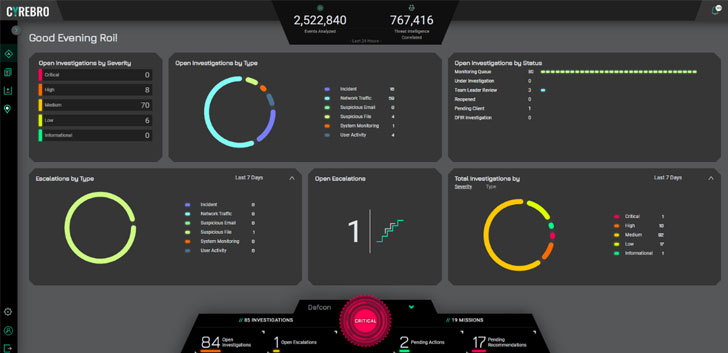 |
| Screenshot of the Cyrebro dashboard |
After integration is completed, organizations can start
monitoring all security activities as information from various
points converge in a single Cyrebro dashboard. Everything the
security officers need to know is shown in a unified and
centralized interface with contextual details to facilitate a
better understanding of the security events detected.
Benefits of centralization
By having comprehensive visibility of the entire enterprise
cybersecurity system, CTOs, CISOs, as well as CIOs have a better
understanding of their security stance. They are not left in the
dark because of unnecessary red tape or the incompetence of those
tasked to manage specific security solutions in specific branches
or offices.
This infers proactive security defense wherein organizations
know what matters for their network protection and what to do when
they encounter threats and attacks. Centralization enables
strategic monitoring as a unified cybersecurity platform like
Cyrebro is designed to provide contextual visibility across
systems, making it faster and easier to detect the early signs of
suspicious network activity.
Strategic monitoring, in turn, results in enhanced threat
intelligence and snappier incident response. Cyrebro has a
continuous Indication of Compromise (IOC) feature based on granular
contextual details and machine learning to make sure that all the
right alerts are raised in a timely manner. It is easy to generate
security alerts, but too many of them can stifle response as it
would be difficult to go through thousands of security incidents.
Proper threat intelligence requires efficiency, which means the
need to minimize false positives without reducing the thoroughness
of threat detection and contextual analysis.
According to a CNBC report[2], 93 percent of attacks
manage to compromise assets within a few minutes. Similarly
alarming, the global average for cyber attack dwell time is 146
days according to a report cited by Infocyte[3]. This means that it
takes organizations nearly five months to detect attacks from the
time the compromise happened.
Organizations need to be quick in responding to attacks,
something that can only be done by promptly knowing all of the
vital security incident details. Quick response and mitigation
lessen the impact of security incidents on business continuity.
Cyrebro improves this quick response benefit further by including
real-time security analyst support to help organizations with
minimal cybersecurity experiences assess their information
better.
Additionally, cybersecurity centralization enables system
optimization based on all the threat intelligence and updates
accumulated. It also promotes proactive threat hunting, to make
sure that nothing penetrates the security defenses and sleeper
attacks are detected before they get activated.
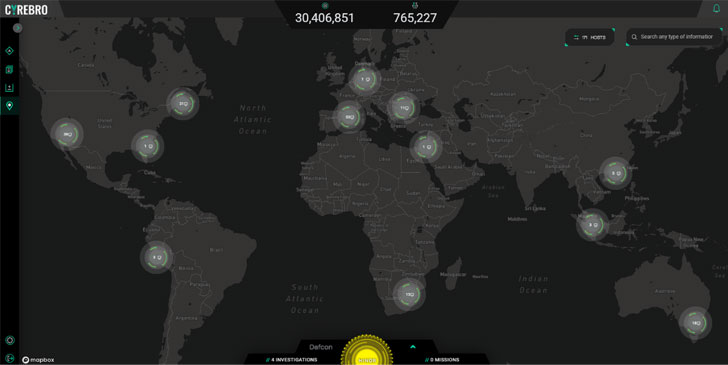 |
| Screenshot of the Cyrebro threat information search interface |
Moreover, the unification of enterprise security solutions
provides a significant boost to forensic investigations. With all
security data compiled in one place for easy access, organizations
can accelerate ongoing investigations over suspected incursions.
Also, in cases when highly sophisticated attacks manage to
penetrate, especially insider-driven ones, centralization makes it
easy to scrutinize everything to determine what went wrong and plug
the vulnerabilities or change ineffective measures.
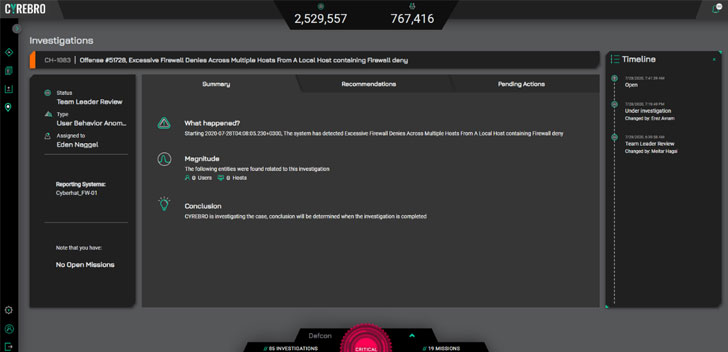 |
| Screenshot of the Cyrebro Investigations interface |
Who needs cybersecurity centralization?
Cyrebro is designed for a wide variety of users, from micro and
SMBs to enterprises and managed security service providers.
Logically, if an organization uses many security solutions, it
would be better to unify them for easier monitoring and response.
Regardless of the size, a business can be prone to frequent attacks
and vulnerabilities because of the use of various devices and
multiple networks and web services.
Cyrebro recently received a report from a client about a
phishing scheme. The website of a humanitarian aid agency was used
by a malicious actor who sent emails that resembled a legitimate
service notification from Microsoft.
The phishing URL reportedly redirects multiple times, ultimately
landing on a simulated Microsoft login page. Clueless victims who
enter their login details end up submitting their credentials
through POST to the same phishing domain. The humanitarian aid
agency apparently suffers from a reflected XSS or cross-site
scripting vulnerability, and they had no prior knowledge of this
until Cyrebro informed them.
This case is a demonstration of how everyone needs to pay extra
attention to their security posture. Small businesses or large
enterprises need to have a proactive and high-visibility
cybersecurity policy to make sure that all hints of a possible
social engineering scheme are detected and addressed promptly. At
the same time, larger organizations or institutions should also
ensure extensive security visibility not only to deter attacks
against them but also to avoid becoming an unwitting accomplice in
phishing or other sophisticated cyber attacks.
Without cybersecurity centralization, Cyrebro’s client would not
have promptly detected the phishing attack. Meanwhile, if the
humanitarian aid agency had a centralized cybersecurity posture,
they would have detected the vulnerability in their website and
implemented the necessary remedies.
The takeaway
Centralization may be frowned upon in the capitalist world, but
it tends to be the more preferable approach when it comes to
security. There’s a reason why in decentralized federal forms of
government, the defense role is assigned to the federal government,
and states are not left to handle defense and security concerns
individually.
At the height of the hacktivism attacks against the United
States government, a Boston University paper[4]
called for cybersecurity centralization to improve response to the
ongoing threats. Centralization allows security professionals to
coordinate better and evaluate vulnerabilities, threats, and actual
attacks with greater accuracy and efficiency.
Effective defense posture necessitates coordination,
collaboration, and comprehensive visibility. Competition among
departments, branches, or units rarely results in anything
productive. It only creates siloing, which prevents the sharing of
useful information and technologies that could bolster defenses and
enable prompt response to threats and attacks.
References
- ^
Cyrebro
(www.cyrebro.io) - ^
CNBC
report (www.cnbc.com) - ^
Infocyte
(www.infocyte.com) - ^
Boston
University paper (www.researchgate.net)
Read more http://feedproxy.google.com/~r/TheHackersNews/~3/TcNJi30SmF8/how-cyrebro-can-unify-multiple.html