
Cybersecurity researchers on Monday disclosed a new wave of
ongoing attacks exploiting multiple vulnerabilities to deploy Mirai
variants on compromised systems.
“Upon successful exploitation, the attackers try to download a
malicious shell script, which contains further infection behaviors
such as downloading and executing Mirai variants and
brute-forcers,” Palo Alto Networks’ Unit 42 Threat Intelligence
Team said[1]
in a write-up.
The rash of vulnerabilities being exploited include:
- VisualDoor[2]
— a SonicWall SSL-VPN remote command injection vulnerability that
came to light earlier this January - CVE-2020-25506[3]
– a D-Link DNS-320 firewall remote code execution (RCE)
vulnerability - CVE-2021-27561 and CVE-2021-27562[4] – Two vulnerabilities in
Yealink Device Management that allow an unauthenticated attacker to
run arbitrary commands on the server with root privileges - CVE-2021-22502[5]
– an RCE flaw in Micro Focus Operation Bridge Reporter (OBR),
affecting version 10.40 - CVE-2019-19356[6]
– a Netis WF2419 wireless router RCE exploit, and - CVE-2020-26919[7]
– a Netgear ProSAFE Plus RCE vulnerability
Also included in the mix are three previously undisclosed
command injection vulnerabilities that were deployed against
unknown targets, one of which, according to the researchers, has
been observed in conjunction with MooBot[8].
The attacks are said to have been detected over a month-long
period starting from February 16 to as recent as March 13.
Regardless of the flaws used to achieve successful exploitation,
the attack chain involves the use of wget utility to download a
shell script from the malware infrastructure that’s then used to
fetch Mirai[9]
binaries, a notorious malware that turns networked IoT devices
running Linux into remotely controlled bots that can be used as
part of a botnet in large-scale network attacks.
Besides downloading Mirai, additional shell scripts have been
spotted retrieving executables to facilitate brute-force attacks to
break into vulnerable devices with weak passwords.
“The IoT realm remains an easily accessible target for
attackers. Many vulnerabilities are very easy to exploit and could,
in some cases, have catastrophic consequences,” the researcher
said.
New ZHtrap Botnet Traps Victims Using a Honeypot
In a related development, researchers from Chinese security firm
Netlab 360 discovered a new Mirai-based botnet called ZHtrap that
makes use of a honeypot to harvest additional victims, while
borrowing some features from a DDoS botnet known as Matryosh[10].
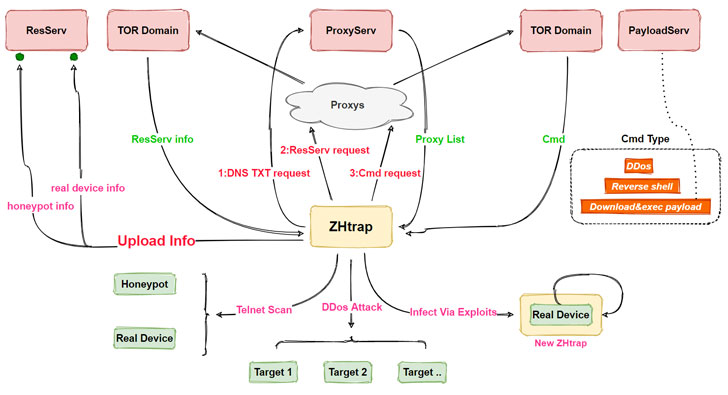
While honeypots typically mimic a target for cyber criminals so
as to take advantage of their intrusion attempts to glean more
information about their modus operandi, the ZHtrap botnet uses a
similar technique by integrating a scanning IP collection module
for gathering IP addresses that are used as targets for further
worm-like propagation.
It achieves this by listening on 23 designated ports and
identifying IP addresses that connect to these ports, then using
the amassed IP addresses to inspect them for four vulnerabilities
to inject the payload –
“ZHtrap’s propagation uses four N-day vulnerabilities, the main
function is DDoS and scanning, while integrating some backdoor
features,” the researchers said[11]. “Zhtrap sets up a
honeypot on the infected device, [and] takes snapshots for the
victim devices, and disables the running of new commands based on
the snapshot, thus achieving exclusivity over the device.”
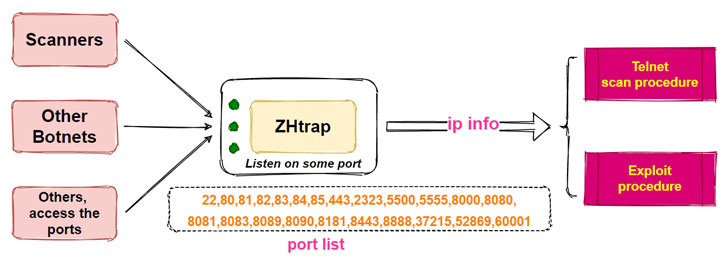
Once it has taken over the devices, ZHtrap takes a cue from the
Matryosh botnet by using Tor for communications with a
command-and-control server to download and execute additional
payloads.
Noting that the attacks began from February 28, 2021, the
researchers said ZHtrap’s ability to turn infected devices into
honeypots marks an “interesting” evolution of botnets to facilitate
finding more targets.
“Many botnets implement worm-like scan propagation, and when
ZHtrap’s honeypot port is accessed, its source is most likely a
device that has been infected by another botnet,” the researchers
speculated about the malware’s authors. “This device can be
infected, there must be flaws, I can use my scanning mechanism to
scan again.This could be a good chance that I can implant my bot
samples, and then with the process control function, I can have
total control, isn’t that awesome?”
References
- ^
said
(unit42.paloaltonetworks.com) - ^
VisualDoor
(darrenmartyn.ie) - ^
CVE-2020-25506
(nvd.nist.gov) - ^
CVE-2021-27561 and CVE-2021-27562
(ssd-disclosure.com) - ^
CVE-2021-22502
(github.com) - ^
CVE-2019-19356
(nvd.nist.gov) - ^
CVE-2020-26919
(nvd.nist.gov) - ^
MooBot
(malpedia.caad.fkie.fraunhofer.de) - ^
Mirai
(malpedia.caad.fkie.fraunhofer.de) - ^
Matryosh
(thehackernews.com) - ^
said
(blog.netlab.360.com)