The U.S. Cybersecurity and Infrastructure Security Agency (CISA)
and the Federal Bureau of Investigation (FBI) on Wednesday issued a
joint advisory warning of active exploitation of vulnerabilities in
Microsoft Exchange on-premises products by nation-state actors and
cybercriminals.
“CISA and FBI assess that adversaries could exploit these
vulnerabilities to compromise networks, steal information, encrypt
data for ransom, or even execute a destructive attack,” the
agencies said[1]. “Adversaries may also
sell access to compromised networks on the dark web.”
The attacks have primarily targeted local governments, academic
institutions, non-governmental organizations, and business entities
in various industry sectors, including agriculture, biotechnology,
aerospace, defense, legal services, power utilities, and
pharmaceutical, which the agencies say are in line with previous
activity conducted by Chinese cyber actors.
Tens of thousands of entities, including the European Banking Authority[2] and the Norwegian Parliament[3], are believed to have
been breached to install a web-based backdoor called the China Chopper web shell[4]
that grants the attackers the ability to plunder email inboxes and
remotely access the target systems.
The development comes in light of the rapid expansion[5]
of attacks aimed at vulnerable Exchange Servers, with multiple
threat actors exploiting the vulnerabilities as early as February
27 before they were eventually patched by Microsoft last week,
swiftly turning what was labeled as “limited and targeted” into an
indiscriminate mass exploitation campaign.
While there is no concrete explanation for the widespread
exploitation by so many different groups, speculations are that the
adversaries shared or sold exploit code, resulting in other groups
being able to abuse these vulnerabilities, or that the groups
obtained the exploit from a common seller.
From RCE to Web Shells to Implants
On March 2, 2021, Volexity[6]
publicly disclosed the detection of multiple zero-day exploits[7] used to target flaws in
on-premises versions of Microsoft Exchange Servers, while pegging
the earliest in-the-wild exploitation activity on January 3,
2021.

Successful weaponization of these flaws, called ProxyLogon,
allows an attacker to access victims’ Exchange Servers, enabling
them to gain persistent system access and control of an enterprise
network.
Although Microsoft initially pinned the intrusions on Hafnium, a
threat group that’s assessed to be state-sponsored and operating
out of China, Slovakian cybersecurity firm ESET on Wednesday
said[8]
it identified no fewer than 10 different threat actors that likely
took advantage of the remote code execution flaws to install
malicious implants on victims’ email servers.
Apart from Hafnium, the five groups detected as exploiting the
vulnerabilities prior to the patch release are Tick, LuckyMouse,
Calypso, Websiic, and Winnti (aka APT41 or Barium), with five
others (Tonto Team, ShadowPad, “Opera” Cobalt Strike, Mikroceen,
and DLTMiner) scanning and compromising Exchange servers in the
days immediately following the release of the fixes.
Despite no conclusive evidence connecting the campaign to China,
Domain Tools’ Senior Security Researcher Joe Slowik noted[9]
that several of the aforementioned groups have been formerly linked
to China-sponsored activity, including Tick, LuckyMouse, Calypso,
Tonto Team, Mikroceen APT Group, and the Winnti Group.
“It seems clear that there are numerous clusters of groups
leveraging these vulnerabilities, the groups are using mass
scanning or services that allow them to independently target the
same systems, and finally there are multiple variations of the code
being dropped, which may be indicative of iterations to the
attack,” Palo Alto Networks’ Unit 42 threat intelligence team
said[10].
In one cluster tracked as “Sapphire Pigeon[11]” by researchers from
U.S.-based Red Canary, attackers dropped multiple web shells on
some victims at different times, some of which were deployed days
before they conducted follow-on activity.
According to ESET’s telemetry analysis, more than 5,000 email
servers belonging to businesses and governments from over 115
countries are said to have been affected by malicious activity
related to the incident. For its part, the Dutch Institute for
Vulnerability Disclosure (DIVD) reported[12] Tuesday that it found
46,000 servers out of 260,000 globally that were unpatched against
the heavily exploited ProxyLogon vulnerabilities.
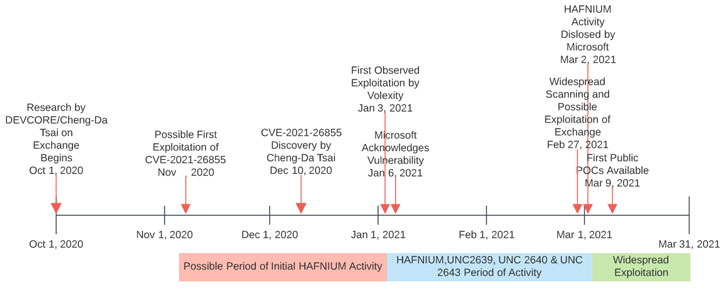
Troublingly, evidence points to the fact that the deployment of
the web shells ramped up following the availability of the patch on
March 2, raising the possibility that additional entities have
opportunistically jumped in to create exploits by reverse
engineering Microsoft updates as part of multiple, independent
campaigns.
“The day after the release of the patches, we started to observe
many more threat actors scanning and compromising Exchange servers
en masse,” said ESET researcher Matthieu Faou. “Interestingly, all
of them are APT groups focused on espionage, except one outlier
that seems related to a known coin-mining campaign (DLTminer). It
is still unclear how the distribution of the exploit happened, but
it is inevitable that more and more threat actors, including
ransomware operators, will have access to it sooner or later.”
Aside from installing the web shell, other behaviors related to
or inspired by Hafnium activity include conducting reconnaissance[13] in victim environments
by deploying batch scripts that automate several functions such as
account enumeration, credential-harvesting, and network
discovery.
Public Proof-of-Concept Available
Complicating the situation further is the availability of what
appears to be the first functional public proof-of-concept (PoC)
exploit for the ProxyLogon flaws despite Microsoft’s attempts to
take down exploits published on GitHub over the past few days.
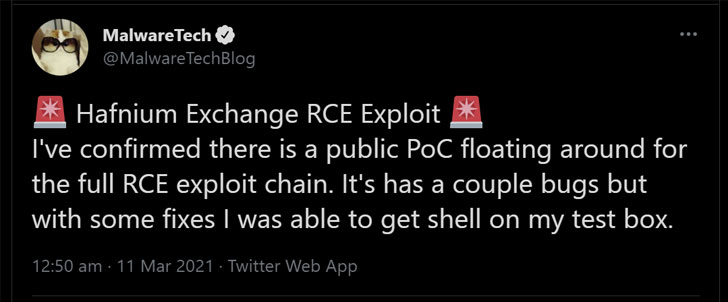
“I’ve confirmed there is a public PoC floating around for the
full RCE exploit chain,” security researcher Marcus Hutchins
said[14]. “It has a couple bugs
but with some fixes I was able to get shell on my test box.”
Also accompanying the PoC’s release is a detailed technical write-up[15] by Praetorian
researchers, who reverse-engineered CVE-2021-26855 to build a fully
functioning end-to-end exploit by identifying differences between
the vulnerable and patched versions.
While the researchers deliberately decided to omit critical PoC
components, the development has also raised concerns that the
technical information could further accelerate the development of a
working exploit, in turn triggering even more threat actors to
launch their own attacks.
As the sprawling hack’s timeline slowly crystallizes, what’s
clear is that the surge of breaches against Exchange Server appears
to have happened in two phases, with Hafnium using the chain of
vulnerabilities to stealthily attack targets in a limited fashion,
before other hackers began driving the frenzied scanning activity
starting February 27.
Cybersecurity journalist Brian Krebs attributed[16] this to the prospect
that “different cybercriminal groups somehow learned of Microsoft’s
plans to ship fixes for the Exchange flaws a week earlier than
they’d hoped.”
“The best advice to mitigate the vulnerabilities disclosed by
Microsoft is to apply the relevant patches,” Slowik said[17]. “However, given the
speed in which adversaries weaponized these vulnerabilities and the
extensive period of time pre-disclosure when these were actively
exploited, many organizations will likely need to shift into
response and remediation activities to counter existing
intrusions.”
References
- ^
said
(us-cert.cisa.gov) - ^
European
Banking Authority (thehackernews.com) - ^
Norwegian Parliament
(www.reuters.com) - ^
China
Chopper web shell (www.fireeye.com) - ^
rapid
expansion (thehackernews.com) - ^
Volexity
(www.volexity.com) - ^
multiple
zero-day exploits (thehackernews.com) - ^
said
(www.welivesecurity.com) - ^
noted
(www.domaintools.com) - ^
said
(unit42.paloaltonetworks.com) - ^
Sapphire Pigeon
(redcanary.com) - ^
reported
(csirt.divd.nl) - ^
conducting reconnaissance
(discuss.elastic.co) - ^
said
(twitter.com) - ^
technical write-up
(www.praetorian.com) - ^
attributed
(krebsonsecurity.com) - ^
said
(www.domaintools.com)
Read more http://feedproxy.google.com/~r/TheHackersNews/~3/RLLH3Q2VKfw/proxylogon-exchange-poc-exploit.html