A malicious web shell deployed on Windows systems by leveraging
a previously undisclosed zero-day in SolarWinds’ Orion network
monitoring software may have been the work of a possible Chinese
threat group.
In a report[1]
published by Secureworks on Monday, the cybersecurity firm
attributed the intrusions to a threat actor it calls Spiral.
Back on December 22, 2020, Microsoft disclosed[2]
that a second espionage group may have been abusing the IT
infrastructure provider’s Orion software to drop a persistent
backdoor called Supernova on target systems.
The findings were also corroborated by cybersecurity firms Palo
Alto Networks’ Unit 42[3]
threat intelligence team and GuidePoint Security[4], both of whom described
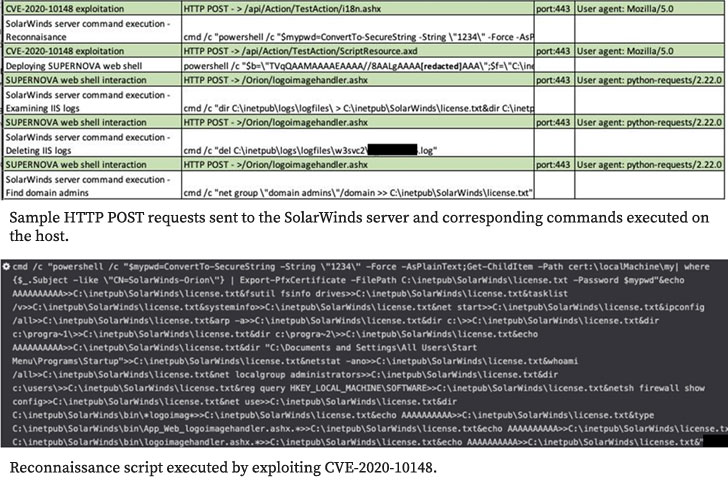
Supernova as a .NET web shell implemented by modifying an
“app_web_logoimagehandler.ashx.b6031896.dll” module of the
SolarWinds Orion application.
The alterations were made possible not by breaching the
SolarWinds app update infrastructure but instead by leveraging an
authentication bypass vulnerability in the Orion API tracked as
CVE-2020-10148[5], in turn allowing a
remote attacker to execute unauthenticated API commands.
“Unlike Solorigate [aka Sunburst], this malicious DLL does not
have a digital signature, which suggests that this may be unrelated
to the supply chain compromise,” Microsoft had noted.
While the Sunburst campaign has since been formally linked to Russia[6], the origins of
Supernova remained a mystery until now.
According to Secureworks Counter Threat Unit (CTU) researchers —
who discovered the malware in November 2020 while responding to a
hack in one of its customers’ networks — “the immediate and
targeted nature of the lateral movement suggests that Spiral had
prior knowledge of the network.”
During the course of further investigation, the firm said it
found similarities between the incident and that of a prior
intrusion activity on the same network uncovered in August 2020,
which had been accomplished by exploiting a vulnerability in a
product known as ManageEngine ServiceDesk as early as 2018.
“CTU researchers were initially unable to attribute the August
activity to any known threat groups,” the researchers said.
“However, the following similarities to the Spiral intrusion in
late 2020 suggest that the Spiral threat group was responsible for
both intrusions.”
The connection to China stems from the fact that attacks
targeting ManageEngine servers have long been associated with
threat groups located in the country, not to mention the modus
operandi of exploiting long-term persistence to collect
credentials, exfiltrate sensitive data, and plunder intellectual
property.
But more solid evidence arrived in the form of an IP address
that geolocated to China, which the researchers said came from a
host that was used by the attackers to run Secureworks’s endpoint
detection and response (EDR) software for reasons best known to the
threat actor, suggesting the software may have been stolen from the
compromised customer.
“The threat group likely downloaded the endpoint agent installer
from the network and executed it on the attacker-managed
infrastructure,” the researchers detailed. “The exposure of the IP
address was likely unintentional, so its geolocation supports the
hypothesis that the Spiral threat group operates out of China.”
It’s worth pointing out that SolarWinds addressed Supernova[7]
in an update to Orion Platform released on December 23, 2020.
References
- ^
report
(www.secureworks.com) - ^
disclosed
(thehackernews.com) - ^
Unit
42 (unit42.paloaltonetworks.com) - ^
GuidePoint Security
(www.guidepointsecurity.com) - ^
CVE-2020-10148
(thehackernews.com) - ^
linked
to Russia (thehackernews.com) - ^
addressed Supernova
(thehackernews.com)