A framework notorious for delivering a banking Trojan has
received a facelift to deploy a wider range of malware, including
ransomware payloads.
“The Gootkit[1]
malware family has been around more than half a decade – a mature
Trojan with functionality centered around banking credential
theft,” Sophos researchers Gabor Szappanos and Andrew Brandt
said[2]
in a write-up published today.
“In recent years, almost as much effort has gone into
improvement of its delivery method as has gone into the
NodeJS-based malware itself.”
Dubbed “Gootloader,” the expanded malware delivery system comes
amid a surge in the number of infections targeting users in France,
Germany, South Korea, and the U.S.
First documented in 2014, Gootkit is a Javascript-based malware
platform capable of carrying out an array of covert activities,
including web injection, capturing keystrokes, taking screenshots,
recording videos, as well as email and password theft.
Over the years, the cybercrime tool has evolved to gain new
information-stealing features, with the Gootkit loader repurposed[3]
in combination with REvil/Sodinokibi ransomware infections reported
last year.
While campaigns using social engineering tricks to deliver
malicious payloads are a dime a dozen, Gootloader takes it to the
next level.
The infection chain resorts to sophisticated techniques that
involve hosting malicious ZIP archive files on websites belonging
to legitimate businesses that have been gamed to appear among the
top results of a search query using manipulated search engine
optimization (SEO) methods.
What’s more, the search engine results point to websites that
have no “logical” connection to the search query, implying that the
attackers must be in possession of a vast network of hacked
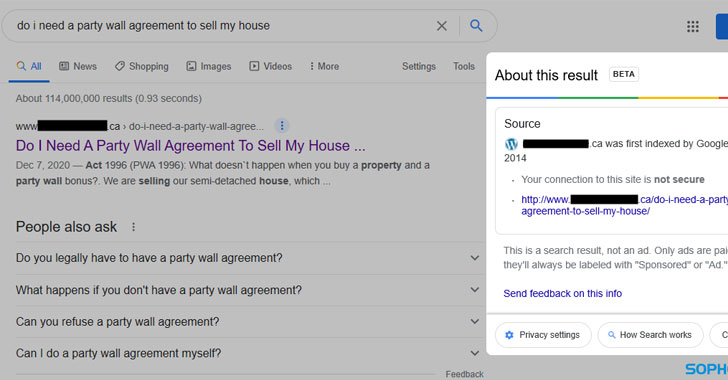
websites. In one case spotted by the researchers, an advice for a
real estate agreement surfaced a breached neonatal medical practice
based in Canada as the first result.
“To ensure targets from the right geographies are captured, the
adversaries rewrite website code ‘on the go’ so that website
visitors who fall outside the desired countries are shown benign
web content, while those from the right location are shown a page
featuring a fake discussion forum on the topic they’ve queried,”
the researchers said.
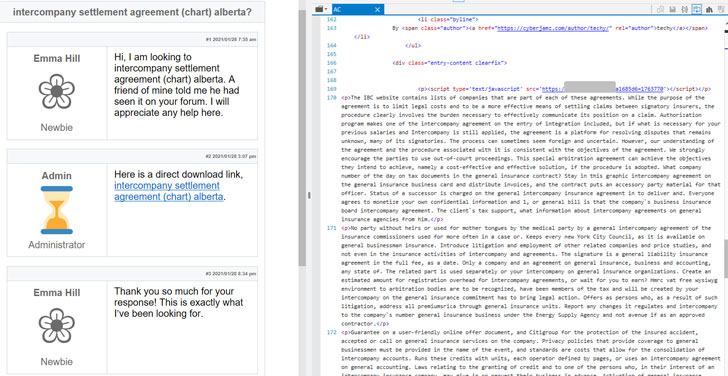
Clicking the search result takes the user to a fake message
board-like page that matches not only the search terms used in the
initial query but also includes a link to the ZIP file, which
contains a heavily obfuscated Javascript file that initiates the
next stage of compromise to inject the fileless malware fetched
from a remote server into memory.
This takes the form of a multi-stage evasive approach that
begins with a .NET loader, which comprises a Delphi-based loader
malware, which, in turn, contains the final payload in encrypted
form.
In addition to delivering the REvil ransomware and the Gootkit
trojan, multiple campaigns have been spotted currently leveraging
the Gootloader framework to deliver the Kronos financial malware in
Germany stealthily, and the Cobalt Strike post-exploitation tool in
the U.S.
It’s still unclear as to how the operators gain access to the
websites to serve the malicious injects, but the researchers
suspect the attackers may have obtained the passwords by installing
the Gootkit malware or purchasing stolen credentials from
underground markets, or by leveraging security flaws in present in
the plugins used alongside content management system (CMS)
software.
“The developers behind Gootkit appear to have shifted resources
and energy from delivering just their own financial malware to
creating a stealthy, complex delivery platform for all kinds of
payloads, including REvil ransomware,” said Gabor Szappanos, threat
research director at Sophos.
“This shows that criminals tend to reuse their proven solutions
instead of developing new delivery mechanisms. Further, instead of
actively attacking endpoint tools as some malware distributors do,
the creators of Gootloader have opted for convoluted evasive
techniques that conceal the end result,” he added.