Let’s first take a look back at 2020!
Adding to the list of difficulties that surfaced last year, 2020
was also grim for personal data protection, as it has marked a new
record number of leaked credentials and PI data.
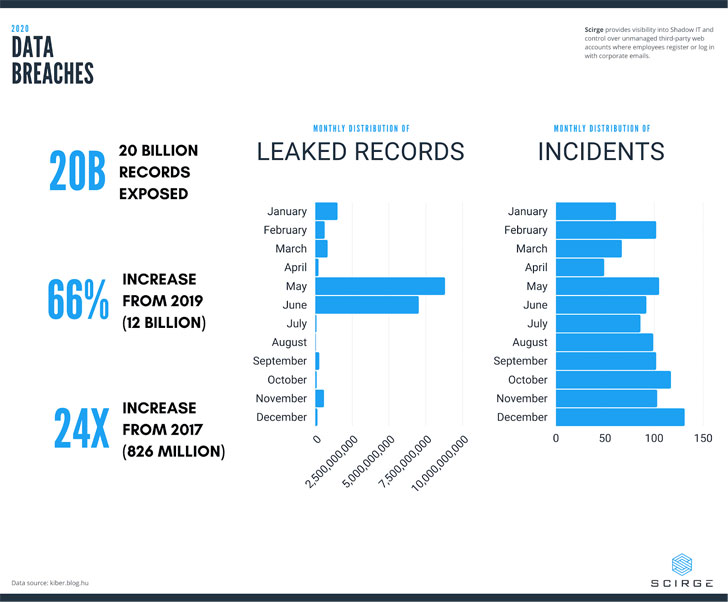
A whopping 20 billion records were stolen in a single year,
increasing 66% from 12 billion in 2019. Incredibly, this is a 9x
increase from the comparatively “small” amount of 2.3 billion
records stolen in 2018.
This trend seems to fit an exponential curve; even worse, we are
yet to see the fallouts from the end of the year “Solorigate”
campaign, which has the potential to marginalize even these numbers
by the end of 2021.
Found among the leaked data are usernames, passwords, credit
card numbers, bank account details, healthcare information, and
other personal data. Malicious actors utilize these treasure troves
of information for fraud and further attacks.
In just the first quarter of 2020, the Dutch government managed
to lose a hard drive containing confidential citizen data.
Meanwhile, the UK government exposed 28 million children’s data to
betting companies, and Microsoft exposed 250 million records of
customer support—including customers’ geographic data, IP
addresses, and other private information.
By April, Zoom had lost 500,000 passwords at the start of the
global remote working period. In June of Q2, Oracle had also leaked
billions of web tracking data by storing data on an unsecured
server.
Q3 kicked off with Joe Biden’s campaign app exposing millions of
users’ sensitive voter data. This was followed by 300,000 Spotify
users falling victim to account takeover attempts after their
credentials were made public.
The year ended with Solorigate: an incident with a lasting
impact that has yet to be fully seen. Ultimately, 2020 closed with
a total of 1,114 incidents, with several governments and well-known
brands—such as Estee Lauder, Marriott, Nintendo, and
GoDaddy—involved in large-scale breaches.
Why are companies and organizations still
failing?
This trend of data breaches[1] is quite disappointing
when compared to the staggering $120 Billion in global IT security
spending; according to Gartner, this number has grown each year
rapidly.
The only possible solution to this inconsistency rests in user
awareness and the possibility that existing technologies are
missing something substantial to turn the tide on these trends.
The most common cause behind data breaches is the leak of some
authentication measure—this may be a username, password, token,
API-key, or a negligent password-less server or application.
Users are registering to third-party websites and services with
corporate email addresses and credentials every day. In tandem,
they create massive blind spots in visibility and a field of Shadow
IT that no audit or security tool has been able to mitigate thus
far. Each employee has around 200 accounts—for every 1,000
employees, that is 200,000 potentially unknown or weak passwords,
many of which may be corporate related.
Once these third parties get compromised, the credentials
obtained might be reused to gain unauthorized access to other
corporate services, such as email accounts or VPN servers, using
attack techniques like credential stuffing or password
spraying.
This was exactly the case with British Airways, which received a
record GDPR fine of £20 million after 400,000 passengers’ data was
breached, initiated through a VPN gateway accessed by a compromised
account.
Most large organizations use data leak prevention technologies
yet fail to protect against password leaks and account takeovers.
This demonstrates an apparent need for a new approach—a hybrid of
technological controls and immediate user awareness improvement
that implements a fresh perspective on account protection.
Shedding Light on Shadow IT
Scirge was developed[2]
with a simple and clear focus on solving an overlooked aspect of
existing IT security mechanisms: discovering and protecting
accounts created by employees in the cloud. This includes the
capability to monitor all new registrations, as well as viewing
logins with existing credentials to websites and web
applications.
Furthermore, it involves centrally managed strength and
complexity checks for all passwords while also warning users for
proper credential management.
Policy-based controls may be created to block the usage of
certain email addresses or websites. Scirge will immediately
provide users with awareness messages when they are misusing
corporate credentials or disregarding password complexity
requirements.
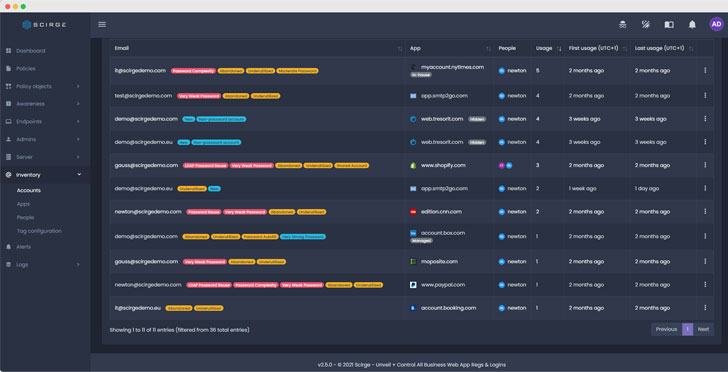
Central intelligence helps unveil reused passwords and
compromised accounts via comparing every company-related account to
leak databases and locally-used (Active Directory) accounts. Scirge
can illuminate organizations’ otherwise hidden cloud footprint
while simultaneously empowering users with knowledge about password
hygiene, corporate policies, and unwanted behavior when using
corporate accounts.
Scirge accomplishes each of these goals with a clean,
browser-based approach. It eliminates the need to control or view
network traffic, decrypt SSL, or burden clients with full-blown
agents—a common source of performance degradation and compatibility
issues with other security tools.
Utilizing its unique features, Scirge creates visibility for all
employee-created accounts and reveals password hygiene issues.
Inventory for all users—including departing workers—is readily
available, unveiling unwanted account sharing between users and
potential insider threats of misusing identities when accessing
online resources.
The dashboard also shows IT management what cloud apps are most
used without consent, helping the company comply with regulations
via collecting privacy policies and T&Cs of all services.
Learn more about account protection and Shadow IT awareness
here[3]
or register to one of our webinars[4].
References
- ^
This
trend of data breaches (scirge.com) - ^
Scirge
was developed (scirge.com) - ^
here
(scirge.com) - ^
webinars
(webinars.scirge.com)