
Researchers have uncovered gaps in Amazon’s skill vetting
process for the Alexa voice assistant ecosystem that could allow a
malicious actor to publish a deceptive skill under any arbitrary
developer name and even make backend code changes after approval to
trick users into giving up sensitive information.
The findings were presented on Wednesday at the Network and
Distributed System Security Symposium (NDSS) conference by a group
of academics from Ruhr-Universität Bochum and the North Carolina
State University, who analyzed 90,194 skills available in seven
countries, including the US, the UK, Australia, Canada, Germany,
Japan, and France.
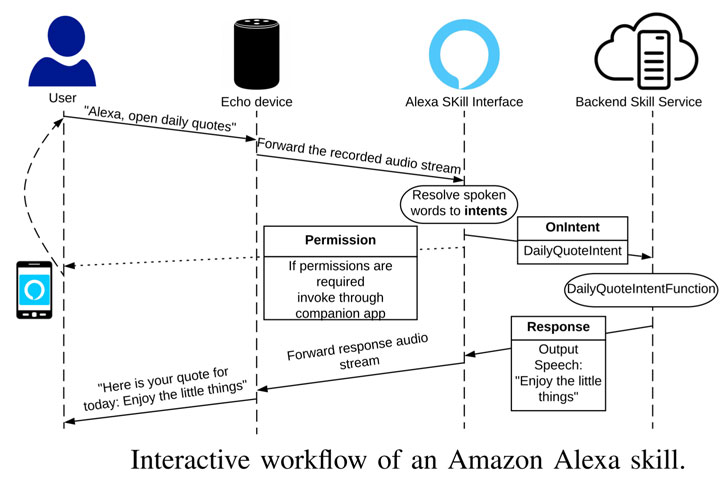
Amazon Alexa allows third-party developers to create additional
functionality for devices such as Echo smart speakers by
configuring “skills” that run on top of the voice assistant,
thereby making it easy for users to initiate a conversation with
the skill and complete a specific task.
Chief among the findings is the concern that a user can activate
a wrong skill, which can have severe consequences if the skill
that’s triggered is designed with insidious intent.
The pitfall stems from the fact that multiple skills can have
the same invocation phrase.
Indeed, the practice is so prevalent that investigation spotted
9,948 skills that share the same invocation name with at least one
other skill in the US store alone. Across all the seven skill
stores, only 36,055 skills had a unique invocation name.
Given that the actual criteria Amazon uses to auto-enable a
specific skill among several skills with the same invocation names
remain unknown, the researchers cautioned it’s possible to activate
the wrong skill and that an adversary can get away with publishing
skills using well-known company names.
“This primarily happens because Amazon currently does not employ
any automated approach to detect infringements for the use of
third-party trademarks, and depends on manual vetting to catch such
malevolent attempts which are prone to human error,” the
researchers explained[1]. “As a result users
might become exposed to phishing attacks launched by an
attacker.”
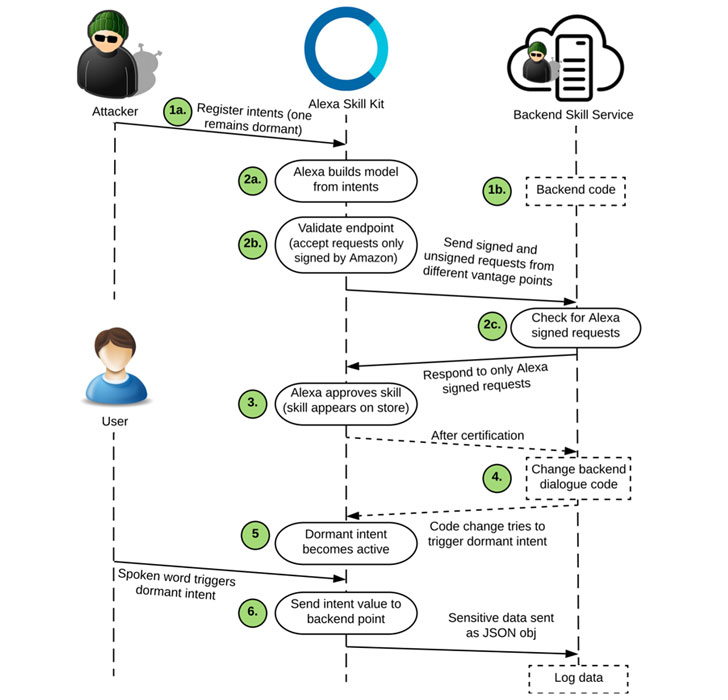
Even worse, an attacker can make code changes following a
skill’s approval to coax a user into revealing sensitive
information like phone numbers and addresses by triggering a
dormant intent.
In a way, this is analogous to a technique called versioning
that’s used to bypass verification defences. Versioning refers to
submitting a benign version of an app to the Android or iOS app
store to build trust among users, only to replace the codebase over
time with additional malicious functionality through updates at a
later date.
To test this out, the researchers built a trip planner skill
that allows a user to create a trip itinerary that was subsequently
tweaked after initial vetting to “inquire the user for his/her
phone number so that the skill could directly text (SMS) the trip
itinerary,” thus deceiving the individual into revealing his (or
her) personal information.
Furthermore, the study found that the permission model[2]
Amazon uses to protect sensitive Alexa data can be circumvented.
This means that an attacker can directly request data (e.g., phone
numbers, Amazon Pay details, etc.) from the user that are
originally designed to be cordoned by permission APIs.
The idea is that while skills requesting for sensitive data[3] must invoke the
permission APIs, it doesn’t stop a rogue developer from asking for
that information straight from the user.
The researchers said they identified 358 such skills capable of
requesting information that should be ideally secured by the
API.

Lastly, in an analysis of privacy policies across different
categories, it was found that only 24.2% of all skills provide a
privacy policy link, and that around 23.3% of such skills do not
fully disclose the data types associated with the permissions
requested.
Noting that Amazon does not mandate a privacy policy for skills
targeting children under the age of 13, the study raised concerns
about the lack of widely available privacy policies in the “kids”
and “health and fitness” categories.
“As privacy advocates we feel both ‘kid’ and ‘health’ related
skills should be held to higher standards with respect to data
privacy,” the researchers said, while urging Amazon to validate
developers and perform recurring backend checks to mitigate such
risks.
“While such applications ease users’ interaction with smart
devices and bolster a number of additional services, they also
raise security and privacy concerns due to the personal setting
they operate in,” they added.
References
- ^
explained
(www.ndss-symposium.org) - ^
permission model
(developer.amazon.com) - ^
requesting for sensitive data
(developer.amazon.com)