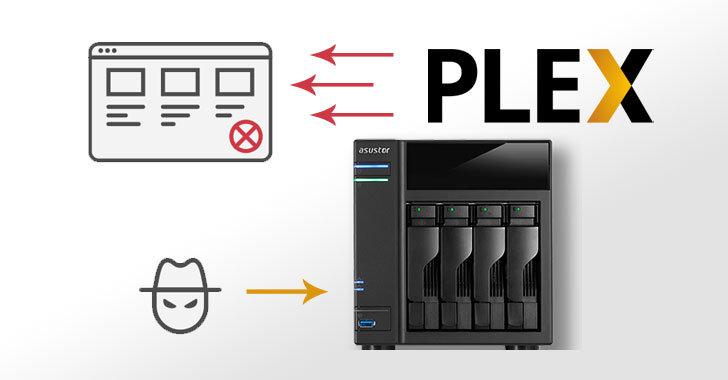
A new distributed denial-of-service attack (DDoS) vector has
ensnared Plex Media Server systems to amplify malicious traffic
against targets to take them offline.
“Plex’s startup processes unintentionally expose a Plex
UPnP-enabled service registration responder to the general
Internet, where it can be abused to generate
reflection/amplification DDoS attacks,” Netscout researchers
said[1]
in a Thursday alert.
Plex Media Server[2]
is a personal media library and streaming system that runs on
modern Windows, macOS, and Linux operating systems, as well as
variants customized for special-purpose platforms such as
network-attached storage (NAS) devices and digital media players.
The desktop application organizes video, audio, and photos from a
user’s library and from online services, allowing access to and
stream the contents to other compatible devices.
DDoS attacks typically involve flooding a legitimate target with
junk network traffic that comes from a large number of devices that
have been corralled into a botnet, effectively causing bandwidth
exhaustion and leading to significant service disruptions.
A DDoS amplification[3]
attack occurs when an attacker sends a number of specially-crafted
requests to a third-party server that causes the server to respond
with large responses to a victim. This is done by spoofing the
source IP address to appear as if they are the victim instead of
the attacker, resulting in traffic that overwhelms victim
resources.
Thus when the third parties respond to the attacker’s request,
the replies are routed to the server being targeted rather than the
attacker device that sent the request.
Now according to Netscout, DDoS-for-hire services are
weaponizing Plex Media Servers to beef up their attack
infrastructure, providing an average amplification factor of about
4.68.
Plex makes use of Simple Service Discovery Protocol (SSDP) to
scan other media devices and streaming clients, but this gives way
to a problem when the probe locates an SSDP-enabled broadband
internet access router, and in the process, exposes the Plex
service registration responder directly on the Internet on UDP port
32414.
Making matters worse, the cybersecurity firm said it identified
about 27,000 abusable servers on the Internet to date.
“The collateral impact of PMSSDP reflection/amplification
attacks is potentially significant for broadband Internet access
operators whose customers have inadvertently exposed PMSSDP
reflectors/amplifiers to the Internet,” Netscout researchers Roland
Dobbins and Steinthor Bjarnason said.
“This may include partial or full interruption of end-customer
broadband internet access, as well as additional service disruption
due to access/distribution/aggregation/core/peering/transit link
capacity consumption.”
Netscout recommends network operators to filter traffic directed
towards UDP/32414 and disable SSDP on operator-supplied broadband
internet access equipment to mitigate the attack.
The development comes after Netscout, earlier this month,
reported[4]
that Windows Remote Desktop Protocol (RDP) servers are being abused
by DDoS-for-hire services as a reflection/amplification DDoS
vector.
References
- ^
said
(www.netscout.com) - ^
Plex
Media Server (support.plex.tv) - ^
DDoS
amplification (www.noction.com) - ^
reported
(www.netscout.com)