Twin cyber operations conducted by state-sponsored Iranian
threat actors demonstrate their continued focus on compiling
detailed dossiers on Iranian citizens that could threaten the
stability of the Islamic Republic, including dissidents, opposition
forces, and ISIS supporters, and Kurdish natives.
Tracing the extensive espionage operations to two advanced
Iranian cyber-groups Domestic Kitten[1]
(or APT-C-50) and Infy[2], cybersecurity firm
Check Point revealed new and recent evidence of their ongoing
activities that involve the use of a revamped malware toolset as
well as tricking unwitting users into downloading malicious
software under the guise of popular apps.
“Both groups have conducted long-running cyberattacks and
intrusive surveillance campaigns which target both individuals’
mobile devices and personal computers,” Check Point[3]
researchers said in a new analysis. “The operators of these
campaigns are clearly active, responsive and constantly seeking new
attack vectors and techniques to ensure the longevity of their
operations.”
Despite overlaps in the victims and the kind of information
amassed, the two threat actors are considered to be independently
operating from one another. But the “synergistic effect” created by
using two different sets of attack vectors to strike the same
targets cannot be overlooked, the researchers said.
Domestic Kitten Mimics a Tehran Restaurant App
Domestic Kitten, which has been active since 2016[4], has been known to
target specific groups of individuals with malicious Android apps
that collect sensitive information such as SMS messages, call logs,
photos, videos, and location data on the device along with their
voice recordings.
Spotting four active campaigns, the most recent of which began
in November 2020 according to Check Point, the APT-C-50 actor has
been found to leverage a wide variety of cover apps, counting VIPRE
Mobile Security (a fake mobile security application), Exotic
Flowers (a repackaged variant of a game available on Google Play),
and Iranian Woman Ninja (a wallpaper app), to distribute a piece of
malware called FurBall.
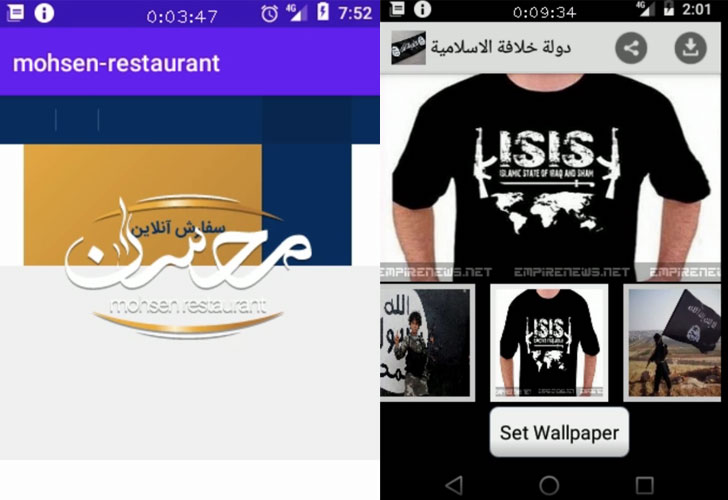
The latest November operation is no different, which takes
advantage of a fake app for Mohsen Restaurant located in Tehran to
achieve the same objective by luring victims into installing the
app by multiple vectors — SMS messages with a link to download the
malware, an Iranian blog that hosts the payload, and even shared
via Telegram channels.
Prominent targets of the attack included 1,200 individuals
located in Iran, the US, Great Britain, Pakistan, Afghanistan,
Turkey, and Uzbekistan, the researchers said, with over 600
successful infections reported.
Once installed, FurBall grants itself wide permissions to
execute the app every time automatically on device startup and
proceeds to collect browser history, hardware information, files on
the external SD card, and periodically exfiltrate videos, photos,
and call records every 20 seconds.
It also monitors clipboard content, gains access to all
notifications received by the device, and comes with capabilities
to remotely execute commands issued from a command-and-control (C2)
server to record audio, video, and phone calls.
Interestingly, FurBall appears to be based on a commercially
available Spyware called KidLogger, implying the actors “either
obtained the KidLogger source-code, or reverse-engineered a sample
and stripped all extraneous parts, then added more
capabilities.”
Infy Returns With New, Previously Unknown, Second-Stage
Malware
First discovered in May 2016[5]
by Palo Alto Networks, Infy’s (also called Prince of Persia)
renewed activity in April 2020 marks a continuation of the group’s
cyber operations that have targeted Iranian dissidents and
diplomatic agencies across Europe for over a decade.
While their surveillance efforts took a beating[6]
in June 2016 following a takedown operation by Palo Alto Networks
to sinkhole the group’s C2 infrastructure, Infy resurfaced in August 2017[7] with anti-takeover
techniques alongside a new Windows info-stealer called Foudre.
The group is also suggested to have ties to the
Telecommunication Company of Iran after researchers Claudio
Guarnieri and Collin Anderson disclosed evidence in July 2016[8] that a subset of the C2
domains redirecting to the sinkhole was blocked by DNS tampering
and HTTP filtering, thus preventing access to the sinkhole.
Then in 2018, Intezer Labs found a new version of the Foudre
malware, called version 8[9], that also contained an
“unknown binary” — now named Tonnerre by Check Point that’s used to
expand on the capabilities of the former.
“It seems that following a long downtime, the Iranian cyber
attackers were able to regroup, fix previous issues and
dramatically reinforce their OPSEC activities as well as the
technical proficiency and abilities of their tools,” the
researchers said.
As many as three versions of Foudre (20-22) have been uncovered
since April 2020, with the new variants downloading Tonnerre 11 as
the next-stage payload.
The attack chain commences by sending phishing emails containing
lure documents written in Persian, that when closed, runs a
malicious macro that drops and executes the Foudre backdoor, which
then connects to the C2 server to download the Tonnerre
implant.
Besides executing commands from the C2 server, recording sounds,
and capturing screenshots, what makes Tonnerre stand out is its use
of two sets of C2 servers — one to receive commands and download
updates using HTTP and a second server to which the stolen data is
exfiltrated via FTP.
At 56MB, Tonnerre’s unusual size is also likely to work in its
favor and evade detection as many vendors ignore large files during
malware scans, the researchers noted.
However, unlike Domestic Kitten, only a few dozen victims were
found to be targeted in this attack, including those from Iraq,
Azerbaijan, the U.K., Russia, Romania, Germany, Canada, Turkey, the
U.S., Netherlands, and Sweden.
“The operators of these Iranian cyber espionage campaigns seem
to be completely unaffected by any counter-activities done by
others, even though they were revealed and even stopped in the past
— they simply don’t stop,” said Yaniv Balmas, head of cyber
research at Check Point.
“These campaign operators simply learn from the past, modify
their tactics, and go on to wait for a while for the storm to pass
to only go at it again. Furthermore, it’s worthy to note the sheer
amount of resources the Iranian regime is willing to spend on
exerting their control.”
References
- ^
Domestic
Kitten (malpedia.caad.fkie.fraunhofer.de) - ^
Infy
(malpedia.caad.fkie.fraunhofer.de) - ^
Check
Point (research.checkpoint.com) - ^
active
since 2016 (research.checkpoint.com) - ^
May
2016 (unit42.paloaltonetworks.com) - ^
took a
beating (unit42.paloaltonetworks.com) - ^
resurfaced in August 2017
(unit42.paloaltonetworks.com) - ^
disclosed evidence in July 2016
(www.blackhat.com) - ^
version
8 (www.intezer.com)