
Cybersecurity researchers have unearthed a fourth new malware
strain—designed to spread the malware onto other computers in
victims’ networks—which was deployed as part of the SolarWinds supply chain attack[1] disclosed late last
year.
Dubbed “Raindrop” by Broadcom-owned Symantec, the malware joins
the likes of other malicious implants such as Sunspot[2], Sunburst (or
Solorigate), and Teardrop that were stealthily delivered to
enterprise networks.
The latest finding comes amid a continued probe into the breach,
suspected to be of Russian origin[3], that has claimed a
number of U.S. government agencies and private sector
companies.
“The discovery of Raindrop is a significant step in our
investigation of the SolarWinds attacks as it provides further
insights into post-compromise activity at organizations of interest
to the attackers,” Symantec researchers said[4].
The cybersecurity firm said it discovered only four samples of
Raindrop to date that were used to deliver the Cobalt Strike Beacon[5]
— an in-memory backdoor capable of command execution, keylogging,
file transfer, privilege escalation, port scanning, and lateral
movement.
Symantec, last month, had uncovered more than 2,000 systems
belonging to 100 customers that received the trojanized SolarWinds
Orion updates, with select targets infected with a second-stage
payload called Teardrop[6]
that’s also used to install the Cobalt Strike Beacon.
“The way Teardrop is built, it could have dropped anything; in
this case, it dropped Beacon, a payload included with Cobalt
Strike,” Check Point researchers said[7], noting that it was
possibly done to “make attribution harder.”
“While Teardrop was used on computers that had been infected by
the original Sunburst Trojan, Raindrop appeared elsewhere on the
network, being used by the attackers to move laterally and deploy
payloads on other computers.”
It’s worth noting that the attackers used the Sunspot malware
exclusively against SolarWinds in September 2019 to compromise its
build environment and inject the Sunburst Trojan into its Orion
network monitoring platform. The tainted software was then
delivered to 18,000 of the company’s customers.
Microsoft’s analysis[8]
of the Solorigate modus operandi last month found that the
operators carefully chose their targets, opting to escalate the
attacks only in a handful of cases by deploying Teardrop based on
intel amassed during an initial reconnaissance of the target
environment for high-value accounts and assets.
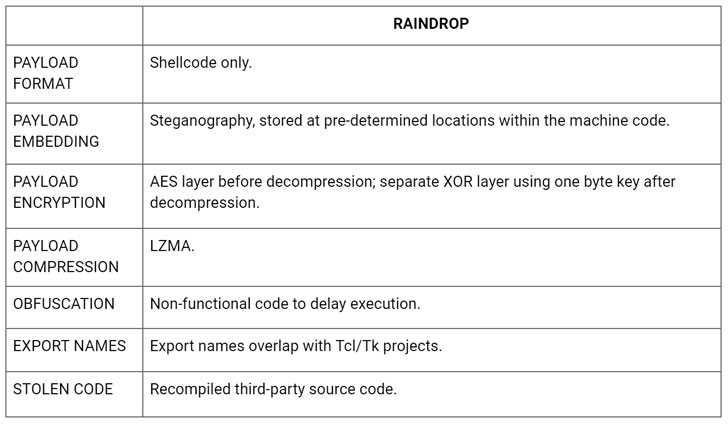
Now Raindrop (“bproxy.dll”) joins the mix. While both Teardrop
and Raindrop act as a dropper for the Cobalt Strike Beacon, they
also differ in a number of ways.
For a start, Teardrop is delivered directly by the initial
Sunburst backdoor, whereas Raindrop seems to have been deployed
with the goal of spreading across the victims’ network. What’s
more, the malware shows up on networks where at least one computer
has already been compromised by Sunburst, with no indication that
Sunburst triggered its installation.
The two malware strains also use different packers and Cobalt
Strike configurations.
Symantec did not identify the organizations impacted by Raindrop
but said the samples were found in a victim system that was running
computer access and management software and on a machine that was
found to execute PowerShell commands to infect additional computers
in the organization with the same malware.
References
- ^
SolarWinds supply chain attack
(thehackernews.com) - ^
Sunspot
(thehackernews.com) - ^
Russian
origin (thehackernews.com) - ^
said
(symantec-enterprise-blogs.security.com) - ^
Cobalt
Strike Beacon
(malpedia.caad.fkie.fraunhofer.de) - ^
Teardrop
(thehackernews.com) - ^
said
(research.checkpoint.com) - ^
analysis
(thehackernews.com)
Read more http://feedproxy.google.com/~r/TheHackersNews/~3/h6AQYcEfo6Q/researchers-discover-raindrop-4th.html