
As the investigation into the SolarWinds supply-chain attack
continues, cybersecurity researchers have disclosed a third malware
strain that was deployed into the build environment to inject the
backdoor into the company’s Orion network monitoring platform.
Called “Sunspot[1],” the backdoor adds to a
growing list of previously disclosed malicious software such as
Sunburst and Teardrop.
“This highly sophisticated and novel code was designed to inject
the Sunburst malicious code into the SolarWinds Orion Platform
without arousing the suspicion of our software development and
build teams,” SolarWinds’ new CEO Sudhakar Ramakrishna explained[2].
While preliminary evidence[3]
found that operators behind the espionage campaign managed to
compromise the software build and code signing infrastructure of
SolarWinds Orion platform as early as October 2019 to deliver the
Sunburst backdoor, the latest findings reveal a new timeline that
establishes the first breach of SolarWinds network on September 4,
2019 — all carried out with an intent to deploy Sunspot.
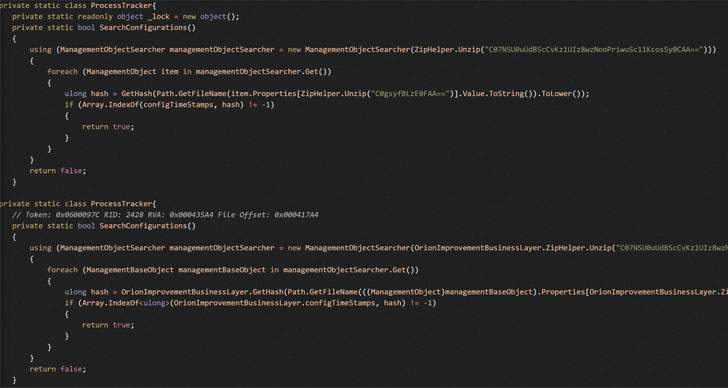
“Sunspot monitors running processes for those involved in
compilation of the Orion product and replaces one of the source
files to include the Sunburst backdoor code,” Crowdstrike
researchers said in a Monday analysis.
Crowdstrike is tracking the intrusion under the moniker
“StellarParticle.”
Once installed, the malware (“taskhostsvc.exe”) grants itself
debugging privileges and sets about its task of hijacking the Orion
build workflow by monitoring running software processes on the
server, and subsequently replace a source code file in the build
directory with a malicious variant to inject Sunburst while Orion
is being built.
The subsequent October 2019 version of the Orion Platform
release appears to have contained modifications designed to test
the perpetrators’ ability to insert code into our builds,”
Ramakrishna said, echoing previous reports from ReversingLabs.
The development comes as Kaspersky researchers found what
appears to be a first potential connection[4]
between Sunburst and Kazuar, a malware family linked to Russia’s
Turla state-sponsored cyber-espionage outfit.
The cybersecurity firm, however, refrained from drawing too many
inferences from the similarities, instead suggesting that the
overlaps may have been intentionally added to mislead
attribution.
While the similarities are far from a smoking gun tying the hack
to Russia, U.S. government officials last week formally pinned the
Solorigate operation on an adversary “likely Russian in
origin.”
References
- ^
Sunspot
(www.crowdstrike.com) - ^
explained
(orangematter.solarwinds.com) - ^
preliminary evidence
(thehackernews.com) - ^
potential connection
(thehackernews.com)