
Cybersecurity researchers, for the first time, may have found a
potential connection between the backdoor used in the SolarWinds hack[1]
to a previously known malware strain.
In new research[2]
published by Kaspersky researchers today, the cybersecurity firm
said it discovered several features that overlap with another
backdoor known as Kazuar[3], a .NET-based malware
first documented by Palo Alto Networks in 2017.
Disclosed early last month, the espionage campaign[4]
was notable for its scale and stealth, with the attackers
leveraging the trust associated with SolarWinds Orion software to
infiltrate government agencies and other companies so as to deploy
a custom malware codenamed “Sunburst.”
Shared Features Between Sunburst and Kazuar
Attribution for the SolarWinds supply-chain compromise has been
difficult in part due to little-to-no clues linking the attack
infrastructure to previous campaigns or other well-known threat
groups.
But Kaspersky’s latest analysis of the Sunburst backdoor has
revealed a number of shared features between the malware and
Kazuar, leading the researchers to suspect that —
- Both Sunburst and Kazuar were developed by the same threat
group - The adversary behind Sunburst used Kazuar as an
inspiration - The groups behind Kazuar (Turla) and Sunburst (UNC2452 or Dark
Halo) obtained the malware from a single source - The developers of Kazuar moved to another team, taking their
toolset with them, or - The Sunburst developers deliberately introduced these links as
“false flag” to shift blame to another group
The commonalities shared between the two malware families
include the use of a sleeping algorithm[5]
to stay dormant for a random period between connections to a C2
server, the extensive usage of the FNV-1a hash[6]
to obfuscate the malicious code, and the use of a hashing algorithm
to generate unique victim identifiers.
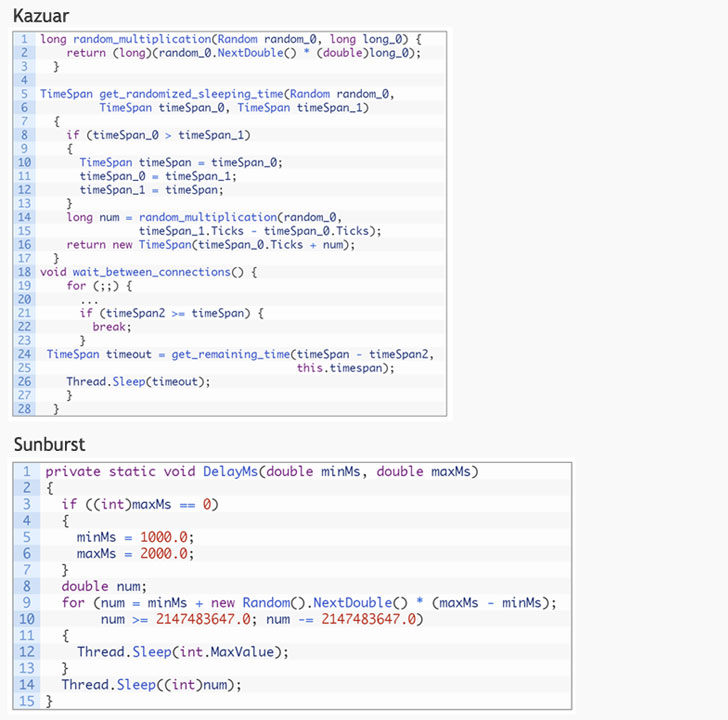
While Kazuar randomly selects a sleeping period between two and
four weeks between C2 connections, Sunburst randomly opts for a
sleeping period[7]
between 12 and 14 days before contacting the server for initial
reconnaissance. But researchers noted that the formula used to
calculate the sleeping time remains the same.
Kazuar’ Possible Links to Turla
Kazuar is a fully featured backdoor written using the .NET
Framework and relies on a command-and-control (C2) channel to allow
actors to interact with the compromised system and exfiltrate data.
Its features run the typical spyware gamut, with support for
running malicious commands, capture screenshots, and even deploy
additional functionalities via a plugin command.
Palo Alto Networks’ Unit 42 team tentatively linked[8]
the tool to the Russian threat group Turla[9]
(aka Uroburos and Snake) based on the fact that the “code lineage
in Kazuar can be traced back[10] to at least 2005.”
What’s more, on November 18, 2020, Kazuar appears to have
undergone a complete redesign with a new keylogger and
password-stealing functions added to the backdoor that’s
implemented in the form of C2 server command.
While it’s normal for threat actors to keep updating their
toolset and introduce features designed to bypass endpoint
detection and response (EDR) systems, Kaspersky researchers raised
the possibility that the changes may have been introduced in
response to the SolarWinds breach.
“Suspecting the SolarWinds attack might be discovered, the
Kazuar code was changed to resemble the Sunburst backdoor as little
as possible,” the researchers said.
CISA Updates SolarWinds Advisory
Last week, the U.S. Cybersecurity and Infrastructure Security
Agency (CISA), along with the Federal Bureau of Investigation
(FBI), the Office of the Director of National Intelligence (ODNI),
and the National Security Agency (NSA), issued a joint statement[11] formally accusing an
adversary “likely Russian in origin” for staging the SolarWinds
hack.
Furthermore, CISA, in an update[12] to its advisory on
January 6, said, “incident response investigations have identified
that initial access in some cases was obtained by password
guessing, password spraying, and inappropriately secured
administrative credentials accessible via external remote access
services.”
“These code overlaps between Kazuar and Sunburst are interesting
and represent the first potential identified link to a previously
known malware family,” Kaspersky researchers concluded.
“While Kazuar and Sunburst may be related, the nature of this
relation is still not clear. Through further analysis, it is
possible that evidence confirming one or several of these points
might arise. At the same time, it is also possible that the
Sunburst developers were really good at their opsec and didn’t make
any mistakes, with this link being an elaborate false flag.”
References
- ^
the
SolarWinds hack (thehackernews.com) - ^
research
(securelist.com) - ^
Kazuar
(malpedia.caad.fkie.fraunhofer.de) - ^
espionage campaign
(thehackernews.com) - ^
sleeping
algorithm (thehackernews.com) - ^
FNV-1a
hash (en.wikipedia.org) - ^
sleeping
period (thehackernews.com) - ^
linked
(unit42.paloaltonetworks.com) - ^
Turla
(malpedia.caad.fkie.fraunhofer.de) - ^
traced
back (www.symantec.com) - ^
issued
a joint statement (thehackernews.com) - ^
update
(us-cert.cisa.gov)