Cybercriminals are increasingly outsourcing the task of
deploying ransomware to affiliates using commodity malware and
attack tools, according to new research.
In a new analysis published by Sophos today and shared with The
Hacker News, recent deployments of Ryuk[1]
and Egregor[2]
ransomware have involved the use of SystemBC[3]
backdoor to laterally move across the network and fetch additional
payloads for further exploitation.
Affiliates are typically threat actors responsible for gaining
an initial foothold in a target network.
“SystemBC is a regular part of recent ransomware attackers’
toolkits,” said Sophos senior threat researcher and former Ars
Technica national security editor Sean Gallagher.
“The backdoor can be used in combination with other scripts and
malware to perform discovery, exfiltration and lateral movement in
an automated way across multiple targets. These SystemBC
capabilities were originally intended for mass exploitation, but
they have now been folded into the toolkit for targeted attacks —
including ransomware.”
First documented by Proofpoint[4]
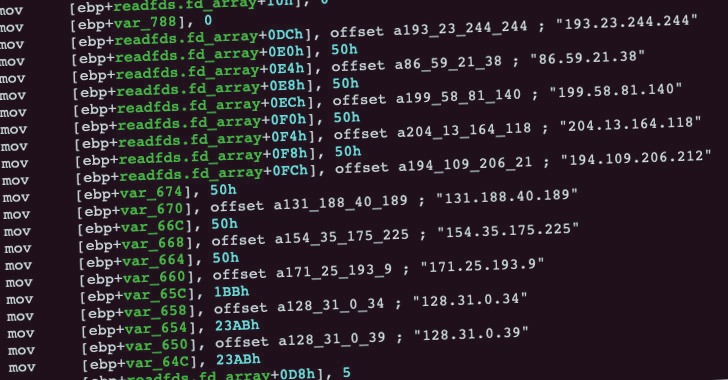
in August 2019, SystemBC is a proxy malware that leverages SOCKS5[5] internet protocol to
mask traffic to command-and-control (C2) servers and download the
DanaBot[6]
banking Trojan.
The SystemBC RAT has since expanded the breadth of its toolset
with new characteristics that allow it to use a Tor connection to
encrypt and conceal the destination of C2 communications, thus
providing attackers with a persistent backdoor to launch other
attacks.
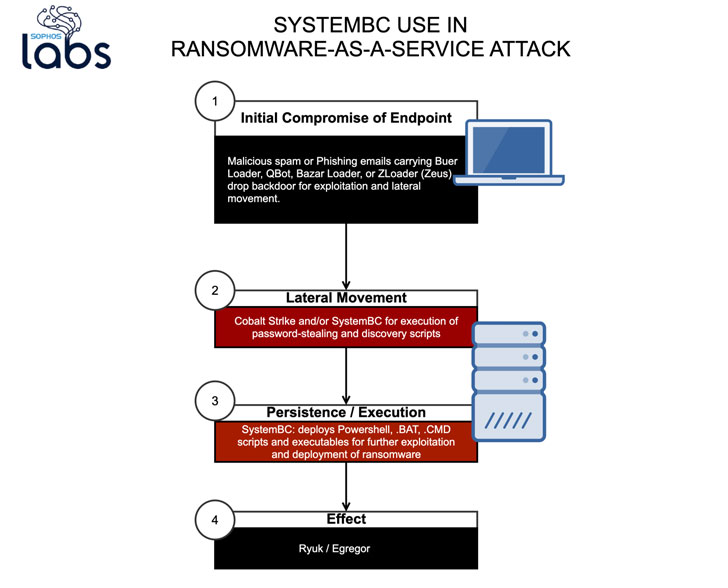
Researchers note that SystemBC has been used in a number of
ransomware attacks — often in conjunction with other
post-exploitation tools like CobaltStrike — to take advantage of
its Tor proxy and remote access features to parse and execute
malicious shell commands, VBS scripts, and other DLL blobs sent by
the server over the anonymous connection.
It also appears that SystemBC is just one of the many commodity
tools that are deployed as a consequence of initial compromise
stemming from phishing emails that deliver malware loaders[7]
like Buer Loader, Zloader, and Qbot — leading the researchers to
suspect that the attacks may have been launched by affiliates of
the ransomware operators, or by the ransomware gangs themselves
through multiple malware-as-a-service providers.
“These capabilities give attackers a point-and-shoot capability
to perform discovery, exfiltration and lateral movement with
packaged scripts and executables — without having to have hands on
a keyboard,” the researchers said.
The rise of commodity malware also points to a new trend where
ransomware is offered as a service to affiliates, like it’s in the
case of MountLocker[8], where the operators
provide double extortion capabilities to affiliates so as to
distribute the ransomware with minimal effort.
“The use of multiple tools in ransomware-as-a-service attacks
creates an ever more diverse attack profile that is harder for IT
security teams to predict and deal with,” Gallagher said.
“Defense-in-depth, employee education and human-based threat
hunting are essential to detecting and blocking such attacks.”