Cybersecurity firms Sophos and ReversingLabs on Monday jointly
released the first-ever production-scale malware research dataset
to be made available to the general public that aims to build
effective defenses and drive industry-wide improvements in security
detection and response.
“SoReL-20M[1]” (short for
Sophos-ReversingLabs
– 20 Million), as it’s called, is
a dataset containing metadata, labels, and features for 20 million
Windows Portable Executable (.PE) files, including 10 million
disarmed malware samples, with the goal of devising
machine-learning approaches for better malware detection
capabilities.
“Open knowledge and understanding about cyber threats also leads
to more predictive cybersecurity,” Sophos AI[2]
group said. “Defenders will be able to anticipate what attackers
are doing and be better prepared for their next move.”
Accompanying the release are a set of PyTorch[3] and LightGBM[4]-based machine learning
models pre-trained on this data[5] as baselines.
Unlike other fields such as natural language and image
processing, which have benefitted from vast publicly-available
datasets such as MNIST[6], ImageNet[7], CIFAR-10[8], IMDB Reviews[9], Sentiment140[10], and WordNet[11], getting hold of
standardized labeled datasets devoted to cybersecurity has proved
challenging because of the presence of personally identifiable
information, sensitive network infrastructure data, and private
intellectual property, not to mention the risk of providing
malicious software to unknown third-parties.
Although EMBER[12] (aka Endgame Malware
BEnchmark for Research) was released[13] in 2018 as an
open-source malware classifier, its smaller sample size (1.1
million samples) and its function as a single-label dataset
(benign/malware) meant it “limit[ed] the range of experimentation
that can be performed with it.”
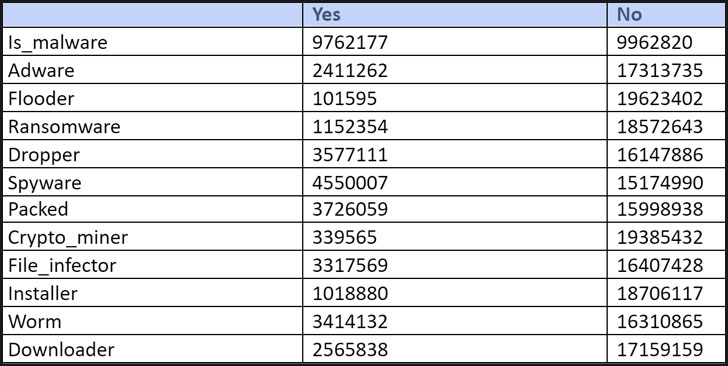
SoReL-20M aims to get around these problems with 20 million PE
samples, which also includes 10 million disarmed malware samples
(those can’t be executed), as well as extracted features and
metadata for an additional 10 million benign samples.
Furthermore, the approach leverages a deep learning-based
tagging model[14] trained to generate
human-interpretable semantic descriptions specifying important
attributes of the samples involved.
The release of SoReL-20M follows similar industry initiatives in
recent months, including that of a coalition led by Microsoft,
which released the Adversarial ML Threat Matrix[15] in October to help
security analysts detect, respond to, and remediate adversarial
attacks against machine learning systems.
“The idea of threat intelligence sharing in security isn’t new
but is more critical than ever given the innovation threat actors
have shown over the past several years,” ReversingLabs researchers
said. “Machine learning and AI have become central to these efforts
allowing threat hunters and SOC teams to move beyond signatures and
heuristics and become more proactive in detecting new or targeted
malware.”
References
- ^
SoReL-20M
(github.com) - ^
Sophos
AI (ai.sophos.com) - ^
PyTorch
(pytorch.org) - ^
LightGBM
(github.com) - ^
models
pre-trained on this data (github.com) - ^
MNIST
(en.wikipedia.org) - ^
ImageNet
(www.image-net.org) - ^
CIFAR-10
(www.cs.toronto.edu) - ^
IMDB
Reviews (ai.stanford.edu) - ^
Sentiment140
(help.sentiment140.com) - ^
WordNet
(wordnet.princeton.edu) - ^
EMBER
(arxiv.org) - ^
released
(www.elastic.co) - ^
deep learning-based tagging model
(arxiv.org) - ^
Adversarial ML Threat Matrix
(thehackernews.com)