
State-sponsored actors allegedly working for Russia have
targeted[1]
the US Treasury, the Commerce Department’s National
Telecommunications and Information Administration (NTIA), and other
government agencies to monitor internal email traffic[2] as part of a widespread
cyberespionage campaign.
The Washington Post, citing unnamed sources, said the latest
attacks were the work of APT29 or Cozy Bear, the same hacking group
that’s believed to have orchestrated a breach of US-based
cybersecurity firm FireEye[3]
a few days ago leading to the theft of its Red Team penetration
testing tools.
The motive and the full scope of what intelligence was
compromised remains unclear, but signs are that adversaries
tampered with a software update released by Texas-based IT
infrastructure provider SolarWinds earlier this year to infiltrate
the systems of government agencies as well as FireEye and mount a
highly-sophisticated supply chain attack[4].
SolarWinds’ networking and security products are used by more
than 300,000 customers worldwide[5], including Fortune 500
companies, government agencies, and education institutions.
It also serves the major US telecommunications companies, all
five branches of the US Military, and other prominent government
organizations such as the Pentagon, State Department, NASA,
National Security Agency (NSA), Postal Service, NOAA, Department of
Justice, and the Office of the President of the United States.
An Evasive Campaign to Distribute SUNBURST Backdoor
FireEye, which is tracking the ongoing intrusion campaign under
the moniker “UNC2452[6],” said the supply chain
attack takes advantage of trojanized SolarWinds Orion business
software updates in order to distribute a backdoor called
SUNBURST.
“This campaign may have begun as early as Spring 2020 and is
currently ongoing,” FireEye said in a Sunday analysis. “Post
compromise activity following this supply chain compromise has
included lateral movement and data theft. The campaign is the work
of a highly skilled actor and the operation was conducted with
significant operational security.”
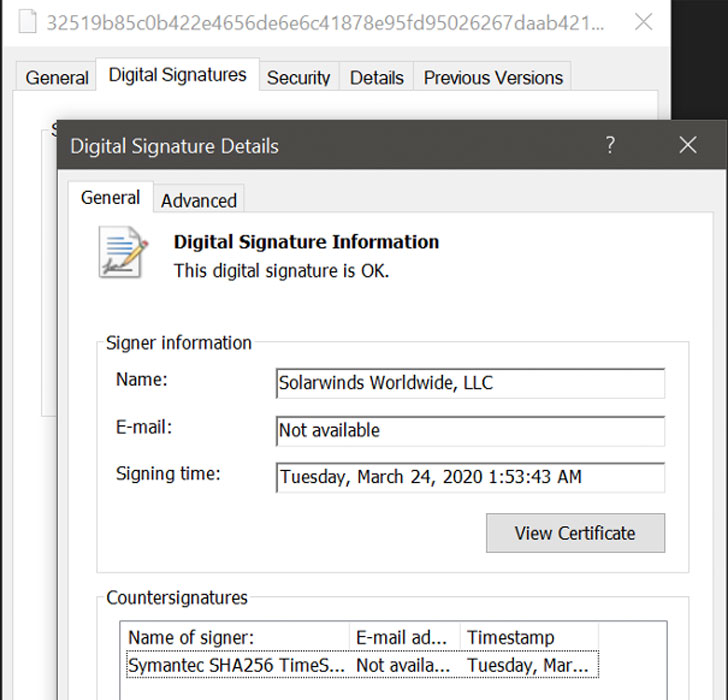
This rogue version of SolarWinds Orion plug-in, besides
masquerading its network traffic as the Orion Improvement Program
(OIP[7]) protocol, is said to
communicate via HTTP to remote servers so as to retrieve and
execute malicious commands (“Jobs”) that cover the spyware gamut,
including those for transferring files, executing files, profiling
and rebooting the target system, and disabling system services.
Orion Improvement Program or OIP is chiefly used to collect
performance and usage statistics data from SolarWinds users for
product improvement purposes.
What’s more, the IP addresses used for the campaign were
obfuscated by VPN servers located in the same country as the victim
to evade detection.
Microsoft also corroborated the findings in a separate analysis,
stating the attack (which it calls “Solorigate[8]“) leveraged the trust
associated with SolarWinds software to insert malicious code as
part of a larger campaign.
“A malicious software class was included among many other
legitimate classes and then signed with a legitimate certificate,”
the Windows maker said. The resulting binary included a backdoor
and was then discreetly distributed into targeted
organizations.”
SolarWinds Releases Security Advisory
In a security advisory[9]
published by SolarWinds, the company said the attack targets
versions 2019.4 through 2020.2.1 of the SolarWinds Orion Platform
software that was released between March and June 2020, while
recommending users to upgrade to Orion Platform release 2020.2.1 HF
1 immediately.
The firm, which is currently investigating the attack in
coordination with FireEye and the US Federal Bureau of
Investigation, is also expected to release an additional hotfix,
2020.2.1 HF 2, on December 15, which replaces the compromised
component and provides several extra security enhancements.
FireEye last week disclosed that it fell victim to a highly
sophisticated foreign-government attack that compromised its
software tools used to test the defenses of its customers.
Totaling as many as 60 in number[10], the stolen Red Team
tools are a mix of publicly available tools (43%), modified
versions of publicly available tools (17%), and those that were
developed in-house (40%).
Furthermore, the theft also includes exploit payloads that
leverage critical vulnerabilities in Pulse Secure SSL VPN
(CVE-2019-11510), Microsoft Active Directory (CVE-2020-1472), Zoho
ManageEngine Desktop Central (CVE-2020-10189), and Windows Remote
Desktop Services (CVE-2019-0708).
The campaign, ultimately, appears to be a supply chain attack on
a global scale, for FireEye said it detected this activity across
several entities worldwide, spanning government, consulting,
technology, telecom, and extractive firms in North America, Europe,
Asia, and the Middle East.
The indicators of compromise (IoCs) and other relevant attack
signatures designed to counter SUNBURST can be accessed here[11].
References
- ^
targeted
(www.washingtonpost.com) - ^
monitor
internal email traffic (www.reuters.com) - ^
FireEye
(thehackernews.com) - ^
supply
chain attack (en.wikipedia.org) - ^
300,000
customers worldwide (www.solarwinds.com) - ^
UNC2452
(www.fireeye.com) - ^
OIP
(support.solarwinds.com) - ^
Solorigate
(www.microsoft.com) - ^
security
advisory (www.solarwinds.com) - ^
60 in
number (www.picussecurity.com) - ^
here
(github.com)